Have you ever looked at a mathematical symbol and wondered about its origins, its geometric meaning, or how it connects to the physical world around us? One of the most iconic symbols in mathematics is the radical sign (√). While it might look like a stylized checkmark, it represents a powerful mathematical operation that reverses the process of squaring a number. In this comprehensive guide, we will explore what a radical expression is, how it connects to the geometry of squares, how to estimate values that do not fit perfectly into whole numbers, and how these concepts shaped the history of mathematics.
The Geometry of Roots: Squares and Side Lengths
To truly understand what a radical expression is, we must first look at geometry. Imagine you are planning to build a square wooden deck in your backyard. If you know that the side length of your square deck is 5 meters, finding the total area is straightforward. You simply multiply the side length by itself:
Area = side × side = 5 × 5 = 25 square meters
In algebraic terms, we say that the area (A) is the square of the side length (s), represented by the formula: A = s².
But what if the situation is reversed? What if you are buying a pre-built square garden plot that has an area of exactly 49 square meters, and you need to know how long one of its sides is so you can buy fencing? To solve this problem, you must work backward. You need to find a positive number that, when multiplied by itself, equals 49. That number is 7, because 7 × 7 = 49. This reverse process of squaring is called finding the square root, and it is the foundation of radical expressions.
Defining the Square Root in Your Own Words
If you had to explain a square root to a friend without using complex mathematical jargon, you might say: "The square root of a given number is the specific value that, when multiplied by itself, produces that original number."
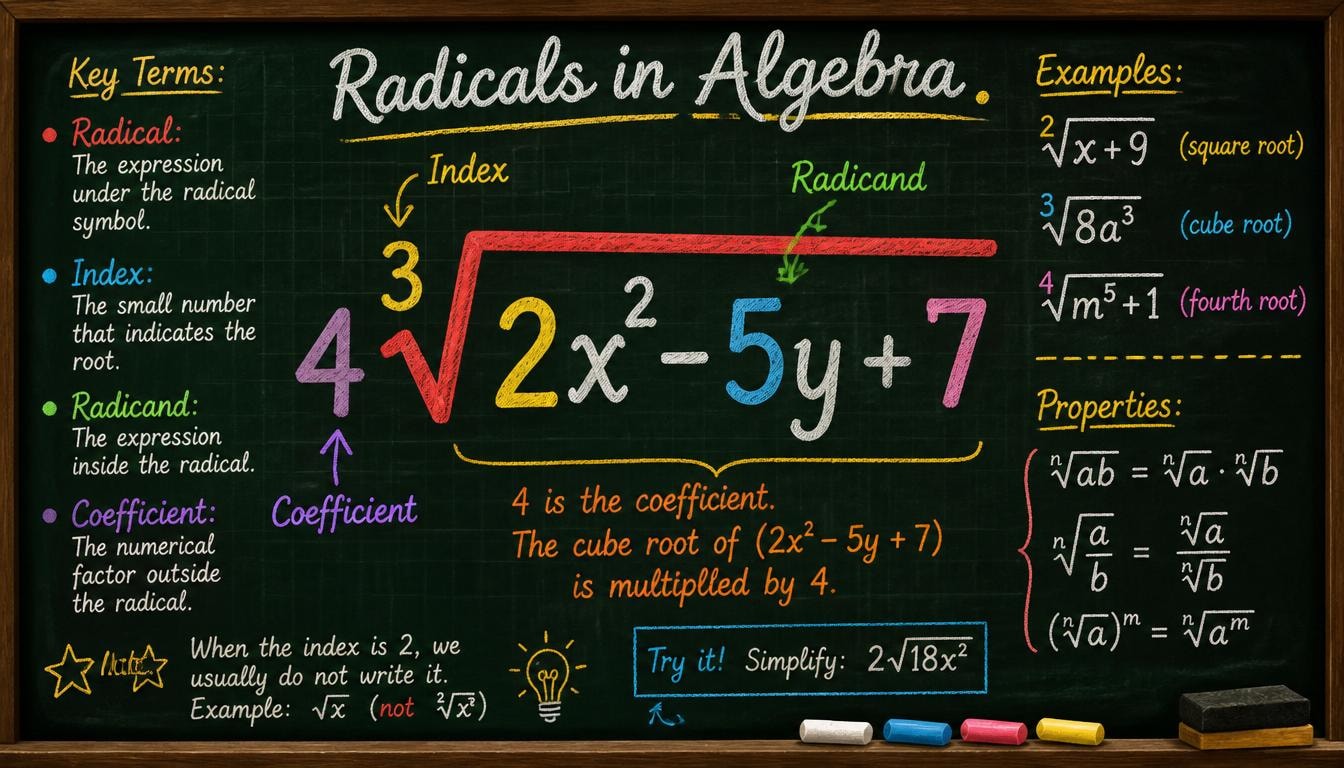
Mathematically, we write this using the radical symbol: √x = y, which means y² = x (where y is a non-negative number). There are two critical rules to keep in mind when dealing with basic real-number square roots:
The result is always non-negative: Although both (-5) × (-5) = 25 and 5 × 5 = 25, the standard radical symbol (√) specifically denotes the principal square root, which is always the positive value. Therefore, √25 is strictly 5, not -5.
We cannot take the square root of a negative number in the real number system: Since multiplying any real number (whether positive or negative) by itself always results in a positive number (or zero), there is no real number that can be multiplied by itself to yield a negative result like -9. Thus, √-9 is not a real number.
Perfect Squares and Their Roots
Some numbers are highly cooperative. When you take their square root, you get a clean, whole number. These are called perfect squares. A perfect square is the product of an integer multiplied by itself.
Let's look at a structured table to observe the relationship between side lengths, their squares (areas), and their corresponding radical expressions:
Side Length (s) Squaring Operation (s²) Area / Perfect Square (A) Radical Expression (√A) 1 1 × 1 1 √1 = 1 2 2 × 2 4 √4 = 2 3 3 × 3 9 √9 = 3 4 4 × 4 16 √16 = 4 5 5 × 5 25 √25 = 5 6 6 × 6 36 √36 = 6
By analyzing this table, we can easily see the direct link between the geometric area of a square and the arithmetic operation of taking a square root. The numbers 1, 4, 9, 16, 25, and 36 are all perfect squares because their roots are integers.
The Crisis of Non-Perfect Squares and Irrational Numbers
What happens if your square garden has an area of 10 square meters instead of 9 or 16? If you try to find its side length, you will quickly notice that there is no whole number that multiplies by itself to give exactly 10. Since 3 × 3 = 9 and 4 × 4 = 16, the side length of this garden must be somewhere between 3 and 4 meters.
This brings us to one of the most profound discoveries in mathematics: irrational numbers. Unlike rational numbers, which can be written as a simple fraction of two integers (like 1/2, 3/4, or 5/1), irrational numbers cannot be expressed as a fraction. Their decimal representations go on forever without repeating in any pattern.
The discovery of irrational numbers is historically tied to the square root of 2 (√2). In ancient Greece, the followers of Pythagoras believed that everything in the universe could be explained by whole numbers and their ratios (rational numbers). However, when they tried to calculate the length of the diagonal of a square with side lengths of 1, they used the Pythagorean theorem and found that the diagonal was equal to √2. When they proved that √2 could not be written as a fraction, it shocked their philosophical worldview, showing that some physical lengths could only be described by these endless, non-repeating numbers.
How to Estimate the Value of a Non-Perfect Square Root
When we encounter a non-perfect square root like √10, how can we understand its value without a calculator? We can use mathematical representations like a number line to estimate its approximate value.
Let's use a simple step-by-step strategy to locate the approximate value of √10:
Identify the surrounding perfect squares: Find the perfect square immediately below 10 and the perfect square immediately above 10. In this case, those numbers are 9 and 16.
Set up an inequality: Since 9 < 10 < 16, it must be true that √9 < √10 < √16.
Simplify the known roots: This tells us that 3 < √10 < 4. So, the value of √10 is a decimal between 3 and 4.
Determine which integer it is closer to: Look at the distance on a number line. The number 10 is much closer to 9 (a difference of 1) than it is to 16 (a difference of 6). Therefore, √10 must be very close to 3. A reasonable estimate would be around 3.1 or 3.2.
Approximation Strategies: Rounding vs. Truncating
With modern technology, we can easily find a highly precise decimal value for any radical expression using a calculator. If you type √10 into a calculator, you will see something like:
√10 ≈ 3.16227766017...
Because this decimal never ends, we must use approximation strategies to make the number practical for real-world measurements. Two common strategies are:
Rounding: We look at the digit to the right of our target place value. If we want to round to the nearest hundredth (two decimal places), we look at the third decimal digit (2). Since 2 is less than 5, we keep the second digit as is: 3.16.
Truncating: This strategy simply cuts off the decimal at a certain point without adjusting the final digit. If we truncate √10 to two decimal places, we simply drop everything after the hundredths place, giving us 3.16. (If we were truncating √10 to four decimal places, it would be 3.1622, whereas rounding it would give 3.1623).
Understanding the difference between the exact value of an irrational number (written as √10) and its approximate value (such as 3.16) is crucial. In pure scientific calculations, keeping the radical symbol preserves perfect accuracy, while using the decimal approximation makes physical construction and measurement possible.
Square Roots of Rational Fractions and Decimals
Radical expressions are not limited to whole numbers. We can also find the square roots of fractions and decimals. When a fraction consists of a perfect square in both the numerator and the denominator, finding its square root is simple. You can take the square root of the top and bottom separately:
√(4/9) = √4 / √9 = 2/3
Similarly, we can evaluate square roots of certain decimal numbers by converting them into fractions first. For example, to find √0.25:
Convert the decimal to a fraction: 0.25 = 25/100.
Write the radical expression: √(25/100).
Take the square root of the numerator and the denominator: √25 / √100 = 5/10.
Convert back to a decimal: 5/10 = 0.5. Therefore, √0.25 = 0.5.
The Evolution of the Radical Symbol
The radical symbol we use today did not appear overnight. In ancient times, mathematicians wrote out the word for "root" in their respective languages. In Latin, the word for root is radix. When mathematicians wrote manuscripts, they began abbreviating radix as the letter r.
Over centuries of copying mathematical texts, the lowercase letter "r" began to morph. In the early 16th century, German mathematician Christoph Rudolff introduced a symbol that resembled a quick, cursive "r" without the top bar, which looked like √. Later, French mathematician René Descartes added the horizontal line over the top of the numbers (called a vinculum) to show exactly which terms were grouped under the root, giving us the modern radical symbol (√ ) we use today.
Key Takeaways
A radical expression is a mathematical expression containing the radical symbol (√), representing the operation of finding a root.
The square root of a number represents the side length of a square with an area equal to that number.
Perfect squares result in whole-number roots (e.g., √16 = 4), while non-perfect squares result in irrational numbers (e.g., √2, √10) that have non-repeating, infinite decimals.
You can estimate non-perfect square roots by finding the two closest perfect squares and placing them on a conceptual number line.
Using tools like rounding and truncating allows us to work with practical, approximate values of irrational roots in daily life.