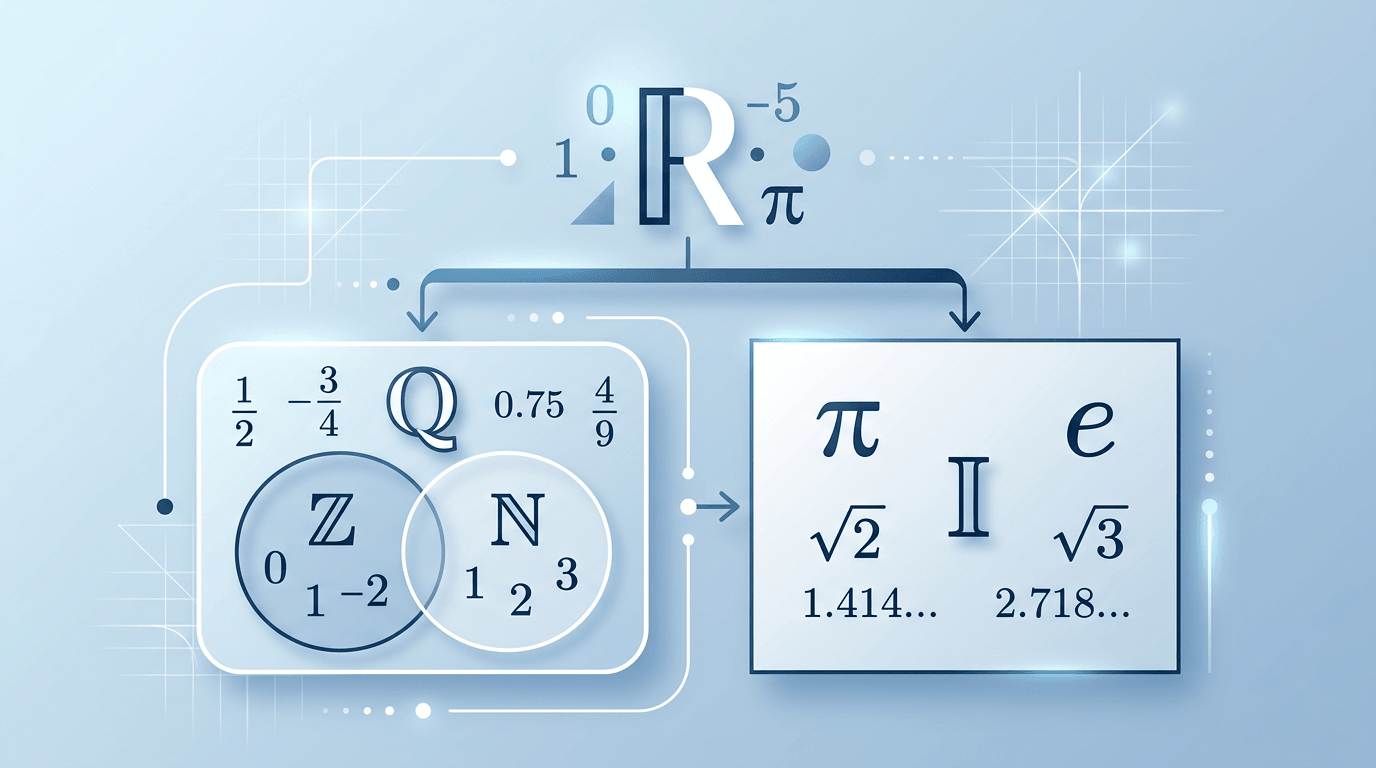
For a long time in human history, mathematicians believed that every single number could be written as a clean, simple ratio of two whole numbers. But then, a mathematical crisis occurred. Ancient thinkers discovered a class of numbers that completely defied this rule—numbers that could never, under any circumstances, be written as a fraction. These are irrational numbers.
In here, we will explore exactly what irrational numbers are, how we can identify them using their decimal representations, how they differ from rational numbers, and why they are fundamental to understanding the universe around us.
The Mathematical Definition of an Irrational Number
To understand what an irrational number is, we must first define its counterpart: the rational number. A rational number is any number that can be expressed as the ratio (or fraction) of two integers, written in the form:
a / b
where a and b are integers, and b is not equal to zero.
An irrational number, therefore, is literally "not rational." It is a real number that cannot be written as a simple fraction of two integers. No matter how hard you try, you cannot find two whole numbers that, when divided, equal exactly an irrational number.
The Ultimate Criterion: Decimal Representations
How can we look at a number and immediately tell whether it is rational or irrational? The most reliable tool we have is the number's decimal representation. When we convert a number into its decimal form—either through long division or by using a calculator—we will observe one of three distinct patterns in the digits after the decimal point:
Terminating (Sonlu) Decimals: The decimal representation comes to an end. For example, 1/4 becomes 0.25. Because it stops, it is a rational number.
Repeating (Devirli) Decimals: The decimal representation goes on forever, but it repeats a specific pattern of digits infinitely. For example, 1/3 becomes 0.3333... (often written as 0.3 with a bar over it), and 7/45 becomes 0.15555... (0.15 with a bar over the 5). Because it repeats a predictable pattern, it is a rational number.
Non-Terminating, Non-Repeating (Düzensiz Sonsuz) Decimals: The decimal representation goes on forever, but it never settles into a repeating pattern. The digits appear random and continue infinitely. This is the hallmark of an irrational number.
Obtaining Decimals: Division and Calculators
To analyze a number's classification, we must first find its decimal representation. We can do this in two primary ways:
1. The Long Division Method
For any fraction like 5/8, we can perform long division (dividing 5 by 8) to find its decimal value. In this case, 5 ÷ 8 = 0.625. Since the division ends with a remainder of zero, we have a terminating decimal, confirming that 5/8 is a rational number.
2. Using a Calculator
For more complex numbers, such as square roots, we rely on calculators to compute the decimals. Let's look at a few examples of what a calculator reveals:
√36: The calculator outputs exactly 6. Since 6 can be written as 6/1, it is a rational number.
√2: The calculator outputs 1.414213562373... The digits continue infinitely without repeating. This is an irrational number.
√3: The calculator outputs 1.7320508075688... Again, the digits continue infinitely without a repeating pattern. This is an irrational number.
Comparing Representations and Making a Judgment
Once you obtain the decimal representation of a number, you can compare it to our criteria to make a final judgment on its rationality. Let's look at a comparative table:
Number: 0.25 -> Decimal Type: Terminating -> Rational (can be written as 1/4)
Number: 0.3333... -> Decimal Type: Repeating -> Rational (can be written as 1/3)
Number: 1.414213... (√2) -> Decimal Type: Non-Repeating Infinite -> Irrational
Number: 3.141592... (π) -> Decimal Type: Non-Repeating Infinite -> Irrational
Through this comparison, we establish a firm mathematical rule: if the decimal expansion is infinite and does not repeat, the number cannot be expressed as a/b, making it strictly irrational.
Famous Examples of Irrational Numbers
Irrational numbers are not just rare mathematical anomalies; they are some of the most important constants in science and nature.
1. The Square Root of 2 (√2)
Historically, this was the very first irrational number discovered. If you draw a square with sides of length 1, the diagonal of that square will have a length of exactly √2 (according to the Pythagorean theorem). The Pythagoreans of ancient Greece were shocked to discover that this length could not be measured as a clean fraction.
2. Pi (π)
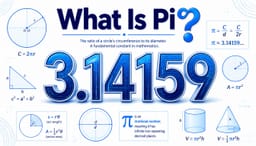
Pi is the ratio of a circle's circumference to its diameter. No matter how big or small a circle is, if you divide its perimeter by its width, you will always get π. Its decimal representation starts with 3.14159... and continues infinitely without ever repeating. Supercomputers have calculated Pi to trillions of digits, and still, no repeating pattern has ever been found.
3. Euler's Number (e)
Euler's number, approximately equal to 2.71828..., is the base of natural logarithms. It is a critical constant in calculus, economics (used to calculate compound interest), and physics (used to model exponential growth and decay).
Different Representations, Same Value
It is vital to remember that changing the way a number is written does not change its core mathematical value or identity. A rational number remains rational no matter how you write it. For example, the rational number 1/2 can be represented in many different ways:
As a standard fraction: 1/2
As an equivalent fraction: 2/4 or 50/100
As a decimal: 0.5
As a square root: 1 / √4 (which simplifies directly to 1/2)
All of these representations point to the exact same point on the number line. Similarly, writing an irrational number as "√2" or "1.414213..." does not change the fact that it is fundamentally irrational.
Summary of Key Takeaways
To master this topic, keep these core principles in mind:
Rational numbers can always be written as a fraction of two integers (a/b). Their decimals either stop (terminate) or repeat.
Irrational numbers cannot be written as a fraction of two integers. Their decimals go on forever without repeating.
Converting a number to its decimal form using division or a calculator is the most effective way to analyze and judge its classification.
Famous constants like √2, √3, π, and e are all irrational.
A number's classification as rational or irrational is an inherent property of the number itself, regardless of how we choose to write it.