In mathematics, this fundamental relationship introduces us to one of the most vital concepts in algebra and geometry: the square root. Whether you are calculating the distance between two points, designing a building, or exploring advanced physics, square roots are everywhere.
In this comprehensive guide, we will explore what a square root is, its physical and geometric origins, how to calculate it using different methods, and how to determine whether a square root is a rational or irrational number based on its decimal representation.
The Geometric Origin: The 'Square' in Square Root
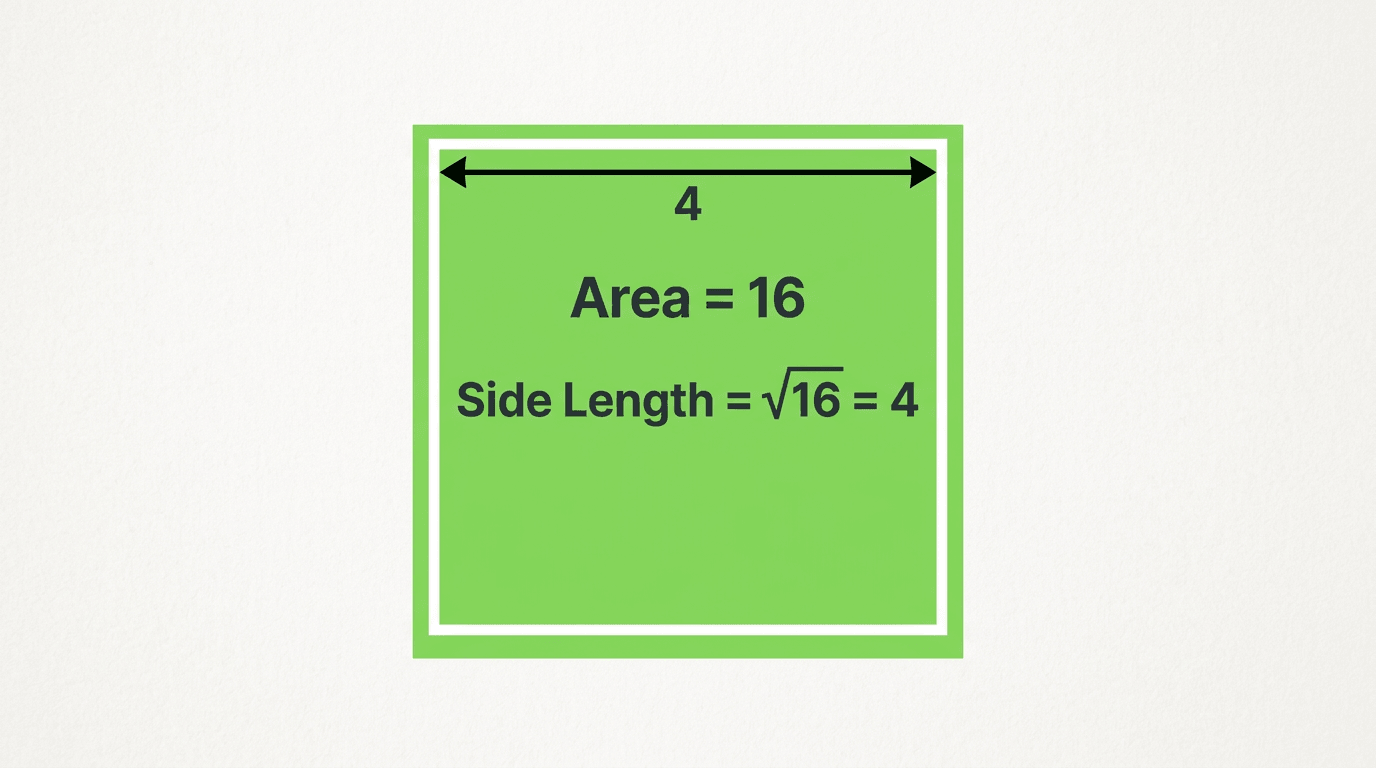
To truly understand what a square root is, we must look at its physical and geometric origins. The term "square" in "square root" is not an accident; it refers directly to the geometric shape of a square.
Imagine you have a physical square tile. The area of this square is calculated by multiplying its side length by itself. For example, if a square has a side length of 5 units, its area is:
Area = 5 × 5 = 25 square units
Now, let us reverse this process. Suppose someone hands you a square tile with an area of 36 square units and asks: "What is the length of one of its sides?" To answer this, you need to find a number that, when multiplied by itself, gives 36. That number is 6, because 6 × 6 = 36.
In this scenario, 6 is the square root of 36. The "root" is the foundational side length from which the entire "square" area grows.
The Algebraic Definition of a Square Root
In algebra, we express this relationship using symbols. The radical symbol (√) is used to represent the principal (positive) square root of a number.
If x is a non-negative real number, then the square root of x (written as √x) is the unique non-negative number y such that:
y² = x
For example:
√4 = 2, because 2² = 4
√81 = 9, because 9² = 81
√0 = 0, because 0² = 0
The Difference Between Positive and Negative Roots
An interesting algebraic detail arises when we solve equations like y² = 16. There are actually two numbers that satisfy this equation:
4 × 4 = 16
(-4) × (-4) = 16
Both 4 and -4 are square roots of 16. However, when we use the radical symbol √16, we are referring specifically to the principal square root, which is always the non-negative value (4). If we want to represent the negative square root, we place a negative sign in front of the radical: -√16 = -4.
How to Find and Calculate Square Roots
Not all square roots are as easy to find as √25 or √36. Mathematicians and scientists use several methods to calculate or approximate square roots depending on the tools available.
1. Prime Factorization (For Perfect Squares)
For numbers that are perfect squares (numbers whose square roots are whole numbers), we can use prime factorization. Let's find the square root of 144:
Find the prime factors of 144: 144 = 2 × 2 × 2 × 2 × 3 × 3
Group the identical factors into pairs: (2 × 2) × (2 × 2) × (3 × 3) = 2² × 2² × 3²
Take one number from each pair and multiply them: 2 × 2 × 3 = 12
Therefore, √144 = 12.
2. Manual Long Division Method
Before calculators existed, scientists used an algorithm similar to long division to calculate highly accurate square roots. This method allows you to find the digits of a square root one by one, even for numbers that do not have whole-number square roots.
3. Using Technology (Calculators and Computers)
In modern scientific practice, we use calculators or computer algorithms (such as the Babylonian method or Newton-Raphson iteration) to find square roots instantly. When you type "√2" into a calculator, it processes the value using these high-speed iterative algorithms to give you an extremely precise decimal approximation.
Evaluating Rational and Irrational Square Roots
One of the most important concepts in number theory is classifying numbers as either rational or irrational. We can use the decimal representation of square roots as our primary criterion to distinguish between them.
The Decimal Representation Criterion
When we convert a square root into its decimal form (using long division or a calculator), we will observe one of three behaviors in the digits after the decimal point:
Terminating Decimals: The decimal ends after a finite number of digits. (e.g., √0.25 = 0.5)
Repeating (Periodic) Decimals: The decimal goes on forever, but a specific block of digits repeats in a regular pattern. (e.g., √(1/9) = √0.1111... = 0.3333...)
Non-Terminating, Non-Repeating Decimals: The decimal goes on forever without ever establishing a repeating pattern. (e.g., √2 = 1.41421356...)
Rational Square Roots
If the decimal representation of a square root is terminating or repeating, the number can be written as a simple fraction in the form of a/b (where a and b are integers, and b ≠ 0). These are rational numbers.
Let's look at some examples:
√36: The decimal representation is 6.0 (terminating). It can be written as 6/1. Thus, it is rational.
√0.25: The decimal representation is 0.5 (terminating). It can be written as 1/2. Thus, it is rational.
√(4/9): The decimal representation is 0.6666... (repeating). It can be written as 2/3. Thus, it is rational.
Irrational Square Roots
If the decimal representation of a square root is non-terminating and non-repeating (irregularly infinite), the number cannot be written as a fraction a/b. These are irrational numbers.
Let's look at some examples:
√2: Using a calculator, we get 1.414213562373... The digits continue infinitely without any repeating pattern. It is irrational.
√3: The decimal representation is 1.732050807568... Because it is an irregular, non-terminating decimal, we cannot express it as a fraction. It is irrational.
Different Representations, Same Value
It is crucial to remember that changing how we write a number does not change its actual value or its classification. A rational number remains rational, and an irrational number remains irrational, no matter how we write it.
For example, the value 0.5 can be represented in multiple equivalent forms:
0.5 = 1/2 = 2/4 = √(1/4) = 1/√4
Each of these representations points to the exact same point on the number line. Similarly, whether we write the square root of two as √2 or as its decimal approximation 1.414213..., its mathematical nature as an irrational value remains completely unchanged.
Summary of Key Takeaways
The square root of a number is a value that, when multiplied by itself, equals the original number.
Geometrically, the square root of an area represents the side length of a physical square.
The symbol √ represents the positive (principal) square root of a number.
We can determine if a square root is rational or irrational by analyzing its decimal representation.
If the decimal is terminating or repeating, the number is rational (can be written as a/b).
If the decimal is non-terminating and non-repeating, the number is irrational (cannot be written as a/b).