In this comprehensive guide, we will explore what the Greatest Common Factor is, examine the foundational mathematical principles behind it, learn multiple step-by-step methods to find it, and look at how it applies to everyday scenarios.
Understanding the Fundamentals: What is a Factor?
Before defining the Greatest Common Factor, we must first understand what a "factor" is. In arithmetic, a factor is a whole number that divides another whole number completely, leaving a remainder of zero. In other words, if you can multiply two whole numbers together to get a third number, those two numbers are factors of the product.
Let us look at a simple example. What are the factors of 12? To find them, we look for all pairs of whole numbers that multiply together to make 12:
1 × 12 = 12
2 × 6 = 12
3 × 4 = 12
Therefore, the factors of 12 are 1, 2, 3, 4, 6, and 12. Every positive integer greater than 1 has at least two factors: 1 and itself.
What is a Common Factor?
When we compare the factors of two or more different numbers, we often find that they share some of the same factors. These shared factors are called common factors.
Let us compare the factors of 12 and 18:
Factors of 12: 1, 2, 3, 4, 6, 12
Factors of 18: 1, 2, 3, 6, 9, 18
By looking at both lists, we can identify the numbers that appear in both sets. The common factors of 12 and 18 are 1, 2, 3, and 6.
Defining the Greatest Common Factor (GCF)
The Greatest Common Factor (GCF) is simply the largest number among all the common factors of two or more numbers. It is the greatest positive integer that divides all the given numbers without leaving a remainder.
Looking back at our example of 12 and 18:
The common factors are 1, 2, 3, and 6.
The largest number in this list is 6.
Therefore, the GCF of 12 and 18 is 6. Mathematically, this can be written as: GCF(12, 18) = 6.
Note on Terminology: Depending on where you study, the Greatest Common Factor (GCF) may also be referred to as the Greatest Common Divisor (GCD) or the Highest Common Factor (HCF). These terms all refer to the exact same mathematical concept.
Methods to Find the Greatest Common Factor
There are several reliable methods to calculate the GCF of a set of numbers. The best method to use often depends on how large the numbers are.
Method 1: Listing All Factors
This is the most straightforward method and is highly effective for smaller numbers. To use this method:
List all the positive factors of each individual number.
Identify all the factors that are common to all lists.
Choose the largest number from those common factors.
Example: Find the GCF of 24 and 36.
Factors of 24: 1, 2, 3, 4, 6, 8, 12, 24
Factors of 36: 1, 2, 3, 4, 6, 9, 12, 18, 36
Common factors: 1, 2, 3, 4, 6, 12
GCF(24, 36) = 12
Method 2: Prime Factorization
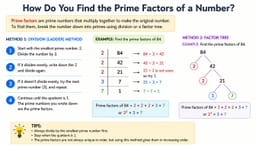
For larger numbers, listing all factors can become time-consuming and prone to errors. The prime factorization method breaks each number down into its building blocks: prime numbers. According to the Fundamental Theorem of Arithmetic, every integer greater than 1 is either a prime number itself or can be represented as a unique product of prime numbers.
To find the GCF using prime factorization:
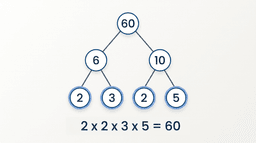
Find the prime factorization of each number (using a factor tree or division ladder).
Identify the prime factors that are common to all the numbers.
Multiply the common prime factors together, using the lowest power of each common prime factor that appears in the factorizations.
Example: Find the GCF of 90 and 120.
First, let us find the prime factorization of both numbers:
90 = 2 × 3 × 3 × 5 = 2 × 3² × 5
120 = 2 × 2 × 2 × 3 × 5 = 2³ × 3 × 5
Next, identify the common prime factors. Both numbers share the prime factors 2, 3, and 5. Now, we take the lowest power of each shared prime factor:
For 2: The lowest power is 2¹ (from 90)
For 3: The lowest power is 3¹ (from 120)
For 5: The lowest power is 5¹ (present in both)
Multiply these together: 2 × 3 × 5 = 30. Therefore, GCF(90, 120) = 30.
Method 3: The Euclidean Algorithm
For extremely large numbers, even prime factorization can be difficult. Over 2,000 years ago, the Greek mathematician Euclid developed an elegant and highly efficient algorithm to find the greatest common divisor of two integers. The Euclidean Algorithm is based on the principle that the GCF of two numbers also divides their difference.
To use the Euclidean Algorithm:
Divide the larger number by the smaller number and find the remainder.
Replace the larger number with the smaller number, and the smaller number with the remainder.
Repeat this division process until the remainder is 0.
The last non-zero remainder is the GCF.
Example: Find the GCF of 270 and 192.
Step 1: 270 ÷ 192 = 1 with a remainder of 78. (Equation: 270 = 1 × 192 + 78)
Step 2: Now, divide 192 by 78. 192 ÷ 78 = 2 with a remainder of 36. (Equation: 192 = 2 × 78 + 36)
Step 3: Now, divide 78 by 36. 78 ÷ 36 = 2 with a remainder of 6. (Equation: 78 = 2 × 36 + 6)
Step 4: Now, divide 36 by 6. 36 ÷ 6 = 6 with a remainder of 0. (Equation: 36 = 6 × 6 + 0)
Because the remainder has reached 0, the last non-zero remainder is our answer. Therefore, GCF(270, 192) = 6.
Important Mathematical Properties of the GCF
Understanding the mathematical properties of the GCF can help you solve problems much faster without doing extensive calculations:
Coprime Numbers: If the GCF of two numbers is 1, those numbers are said to be coprime or relatively prime. For example, GCF(8, 15) = 1. They do not share any factors other than 1, even though neither number is a prime number on its own.
GCF of Prime Numbers: The GCF of any two distinct prime numbers is always 1. For example, GCF(13, 17) = 1.
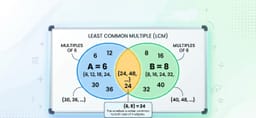
Relationship with LCM: There is a beautiful mathematical relationship between the Greatest Common Factor and the Least Common Multiple (LCM) of two numbers a and b:
GCF(a, b) × LCM(a, b) = a × b.
Real-World Applications of GCF
The GCF is not just an abstract concept; it has many practical applications in daily life, design, and engineering.
1. Simplifying Fractions
One of the most common academic uses of the GCF is reducing fractions to their simplest form. To simplify a fraction, you divide both the numerator (top) and the denominator (bottom) by their GCF.
For example, to simplify the fraction 24/36:
Find the GCF of 24 and 36, which is 12.
Divide the numerator: 24 ÷ 12 = 2.
Divide the denominator: 36 ÷ 12 = 3.
The simplified fraction is 2/3.
2. Equal Distribution and Grouping
Imagine you are planning an event and need to arrange items into identical packages or rows without having any items left over. The GCF tells you the maximum number of identical groups you can create.
Scenario: A teacher has 30 pens and 45 notebooks. She wants to divide them into identical school supply bags for her students. What is the maximum number of bags she can make so that every bag has the exact same contents and nothing is left over?
To solve this, we find the GCF of 30 and 45.
Factors of 30: 1, 2, 3, 5, 6, 10, 15, 30
Factors of 45: 1, 3, 5, 9, 15, 45
The GCF is 15.
The teacher can make a maximum of 15 identical bags. Each bag will contain 2 pens (30 ÷ 15) and 3 notebooks (45 ÷ 15).
3. Tiling and Grid Design
If a designer wants to cover a rectangular floor of specific dimensions with square tiles of the largest possible size without cutting any tiles, they must find the GCF of the length and width of the room. This ensures that the square tiles fit perfectly along both dimensions.
Key Takeaways
A factor is a whole number that divides another number evenly without a remainder.
The Greatest Common Factor (GCF) is the largest shared factor between two or more numbers.
For small numbers, listing factors is quick and easy. For medium numbers, prime factorization is highly reliable. For very large numbers, the Euclidean Algorithm is the most efficient mathematical tool.
The GCF is widely used to simplify fractions, solve division and distribution problems, and design balanced layouts.