Introduction to the Least Common Multiple (LCM)
Among the most fundamental concepts governing these interactions is the Least Common Multiple, commonly abbreviated as LCM. Whether you are dividing resources, scheduling events, or working with complex algebraic fractions, the LCM serves as a critical mathematical tool. This comprehensive guide will explore what the LCM is, break down the foundational concepts behind it, examine multiple methods to calculate it, and demonstrate its wide range of real-world applications.
Understanding the Fundamentals: Multiples and Common Multiples
To fully grasp the concept of the Least Common Multiple, we must first dissect the terms that build its name: multiple, common, and least.
What is a Multiple?
A multiple of a number is the product of that number and any integer. In simpler terms, when you skip-count by a specific number, you are listing its multiples. For example, the multiples of 4 are obtained by multiplying 4 by 1, 2, 3, 4, and so on:
4 × 1 = 4
4 × 2 = 8
4 × 3 = 12
4 × 4 = 16
4 × 5 = 20
Thus, the set of positive multiples of 4 is {4, 8, 12, 16, 20, 24, 28, 32, ...}. This set is infinite, meaning it goes on forever.
What is a Common Multiple?
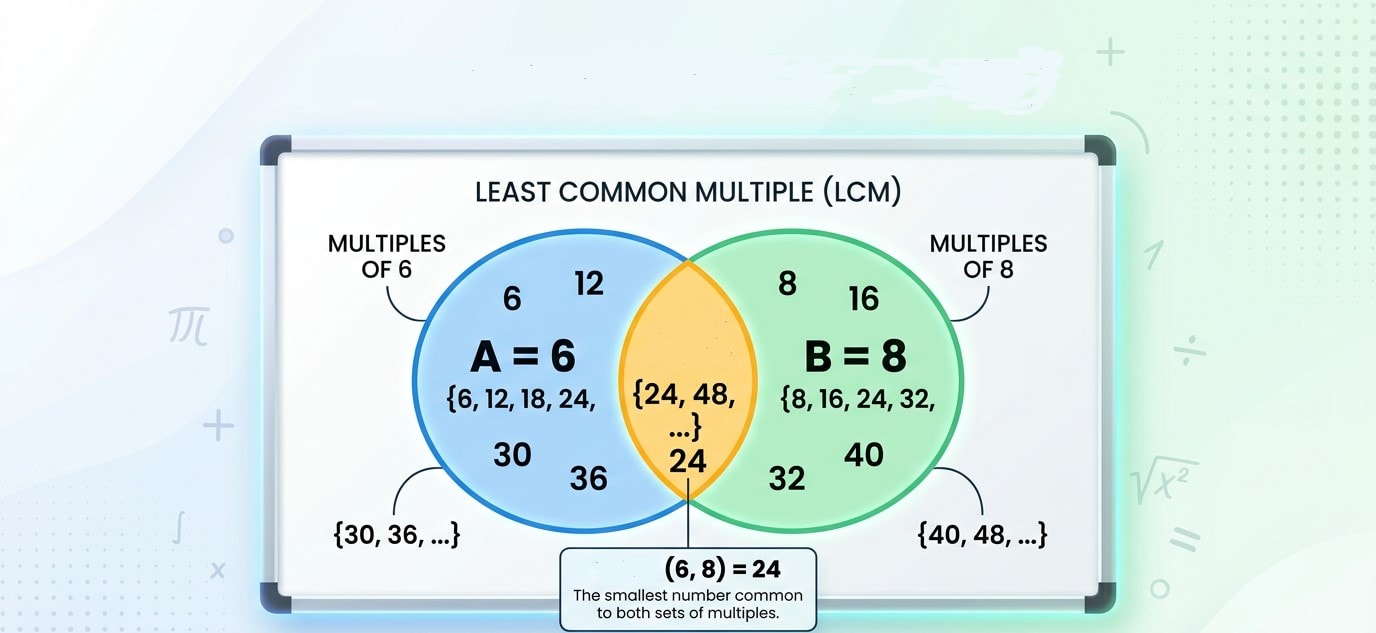
When we look at two or more different numbers, we can list their individual sets of multiples. A common multiple is a number that appears in the multiple lists of all the given numbers. It is a shared multiple.
Let us look at the multiples of 4 and 6 to find their common multiples:
Multiples of 4: {4, 8, 12, 16, 20, 24, 28, 32, 36, 40, ...}
Multiples of 6: {6, 12, 18, 24, 30, 36, 42, 48, ...}
By comparing these two sets, we can identify the numbers that appear in both lists. The common multiples of 4 and 6 are {12, 24, 36, 48, ...}.
Defining the Least Common Multiple (LCM)
Now that we have identified the common multiples, we can define the Least Common Multiple (LCM). The LCM of two or more non-zero integers is the smallest positive integer that is divisible by all the given numbers without leaving a remainder.
Looking back at our common multiples of 4 and 6, which are {12, 24, 36, 48, ...}, the smallest number in this set is 12. Therefore, the LCM of 4 and 6 is 12.
Note: While zero is technically a multiple of every integer (since any number multiplied by zero is zero), we exclude zero when finding the LCM. If zero were included, the least common multiple of any set of numbers would always be zero, rendering the concept useless for practical calculations.
How to Find the LCM: Step-by-Step Methods
Depending on the size of the numbers you are working with, different methods can be used to find the LCM. Let us examine the four most reliable and widely used techniques.
Method 1: Listing Multiples (The Direct Approach)
This is the most intuitive method and is highly effective for small numbers. It involves listing the multiples of each number until you find the first shared multiple.
Example: Find the LCM of 3, 5, and 10.
List the multiples of 3: {3, 6, 9, 12, 15, 18, 21, 24, 27, 30, 33, ...}
List the multiples of 5: {5, 10, 15, 20, 25, 30, 35, 40, ...}
List the multiples of 10: {10, 20, 30, 40, 50, ...}
Identify the smallest multiple common to all three lists: 30.
Therefore, LCM(3, 5, 10) = 30.
Method 2: Prime Factorization (The Algebraic Approach)
When dealing with larger numbers, listing multiples becomes inefficient and prone to errors. The prime factorization method is a powerful alternative that breaks each number down into its prime components.
Steps to find LCM using Prime Factorization:
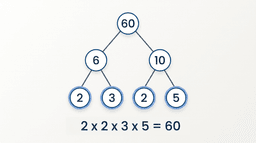
Find the prime factorization of each number (express them as products of prime numbers).
Write the prime factorization using exponents.
Identify all the unique prime factors present across all numbers.
For each unique prime factor, select the highest exponent that appears in any of the factorizations.
Multiply these highest-powered prime factors together to get the LCM.
Example: Find the LCM of 12 and 18.
First, find the prime factorizations:
12 = 2 × 2 × 3 = 22 × 31
18 = 2 × 3 × 3 = 21 × 32
The unique prime factors involved are 2 and 3. Now, select the highest power of each prime factor:
For prime factor 2, the powers are 22 and 21. The highest is 22.
For prime factor 3, the powers are 31 and 32. The highest is 32.
Multiply these values together: LCM = 22 × 32 = 4 × 9 = 36.
Method 3: The Division Method (The Algorithmic Approach)
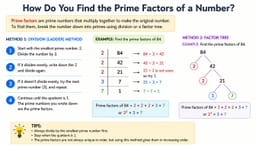
Also known as the grid or ladder method, this is a highly organized way to find the LCM of multiple numbers simultaneously using sequential prime division.
Example: Find the LCM of 20, 24, and 30.
Write the numbers in a row and divide them by the smallest prime number that can divide at least one of them. If a number is not divisible, simply carry it down to the next row.
Prime Divisor Numbers 2 20, 24, 30 2 10, 12, 15 2 5, 6, 15 3 5, 3, 15 5 5, 1, 5 — 1, 1, 1
Multiply all the prime divisors on the left: 2 × 2 × 2 × 3 × 5 = 120. Thus, LCM(20, 24, 30) = 120.
Method 4: The GCD/GCF Formula (The Analytical Approach)
If you already know the Greatest Common Divisor (GCD), also known as the Greatest Common Factor (GCF), of two numbers, you can easily calculate their LCM using an elegant mathematical relationship:
LCM(a, b) = (a × b) / GCD(a, b)
This formula states that the product of two numbers is equal to the product of their LCM and GCD.
Example: Find the LCM of 15 and 20.
Find the GCD of 15 and 20. The largest number that divides both 15 and 20 is 5. So, GCD(15, 20) = 5.
Apply the formula: LCM(15, 20) = (15 × 20) / 5
Calculate: LCM = 300 / 5 = 60.
Real-World Applications of LCM
The LCM is not just an abstract concept found in textbooks; it is a practical tool used to solve everyday problems involving cycles, synchronization, and fractions.
1. Adding and Subtracting Fractions
To add or subtract fractions with different denominators, you must find a common denominator. The most efficient common denominator is the Least Common Denominator (LCD), which is simply the LCM of the denominators. Using the LCM keeps the numbers as small as possible, simplifying calculations and reducing the risk of arithmetic errors.
2. Scheduling and Synchronizing Events
Whenever you need to determine when two or more events occurring at different intervals will happen at the same time, you are looking for the LCM.
Scenario: A red light flashes every 8 seconds, and a blue light flashes every 12 seconds. If they flash together right now, in how many seconds will they flash together again?
To solve this, we find the LCM of 8 and 12:
8 = 23
12 = 22 × 31
LCM = 23 × 31 = 8 × 3 = 24.
The lights will flash together again in 24 seconds.
3. Mechanical Gears and Rotations
Engineers use the LCM to design gear systems. If one gear has 16 teeth and an interlocking gear has 24 teeth, the LCM of 16 and 24 (which is 48) tells us how many tooth-engagements must occur before the gears return to their exact starting alignment.
Important Properties of LCM
Understanding these mathematical properties can help you solve LCM problems much faster:
Commutative Property: LCM(a, b) = LCM(b, a)
Associative Property: LCM(a, b, c) = LCM(LCM(a, b), c)
LCM of Coprime Numbers: If two numbers share no common factors other than 1 (meaning they are coprime), their LCM is simply their product. For example, LCM(5, 7) = 5 × 7 = 35.
LCM of Multiples: If one number is a multiple of another, the larger number is their LCM. For example, since 15 is a multiple of 5, LCM(5, 15) = 15.
Conclusion and Key Takeaways
The Least Common Multiple (LCM) is an indispensable mathematical concept with deep roots in number theory and endless practical utilities. By understanding the relationships between multiples, prime factorization, and common divisors, you can quickly navigate complex calculations. Keep these key takeaways in mind:
The LCM is the smallest non-zero positive integer divisible by all numbers in a given set.
For small numbers, listing multiples is the easiest method.
For larger numbers, prime factorization or the division method is highly recommended.
The LCM is crucial for finding common denominators in fractions and solving real-world scheduling or cycle synchronization problems.