Just as all physical objects are made of indivisible building blocks called atoms, composite numbers are built from indivisible mathematical blocks called prime numbers. Finding these fundamental building blocks is a process known as prime factorization.
Whether you are a student tackling middle school algebra, an aspiring computer scientist studying cryptography, or simply a math enthusiast, understanding how to find the prime factors of a number is an essential skill. In this comprehensive guide, we will explore the scientific and mathematical principles behind prime factors and master the most reliable methods to find them.
What Are Prime Factors?
Before we dive into the methods of finding prime factors, we must define our terms clearly:
Factors: The numbers that you multiply together to get another number. For example, the factors of 12 are 1, 2, 3, 4, 6, and 12.
Prime Numbers: Whole numbers greater than 1 that have exactly two factors: 1 and themselves. Examples include 2, 3, 5, 7, 11, 13, 17, and so on. Note that 2 is the only even prime number.
Composite Numbers: Whole numbers greater than 1 that have more than two factors. For example, 4, 6, 8, 9, and 10 are composite numbers.
Prime Factors: The factors of a number that are also prime numbers. For example, the factors of 12 are 1, 2, 3, 4, 6, and 12, but its prime factors are only 2 and 3.
The Fundamental Theorem of Arithmetic: Every integer greater than 1 is either a prime number itself or can be represented as a unique product of prime numbers, up to the order of the factors. This means that every composite number has one, and only one, unique "prime signature."
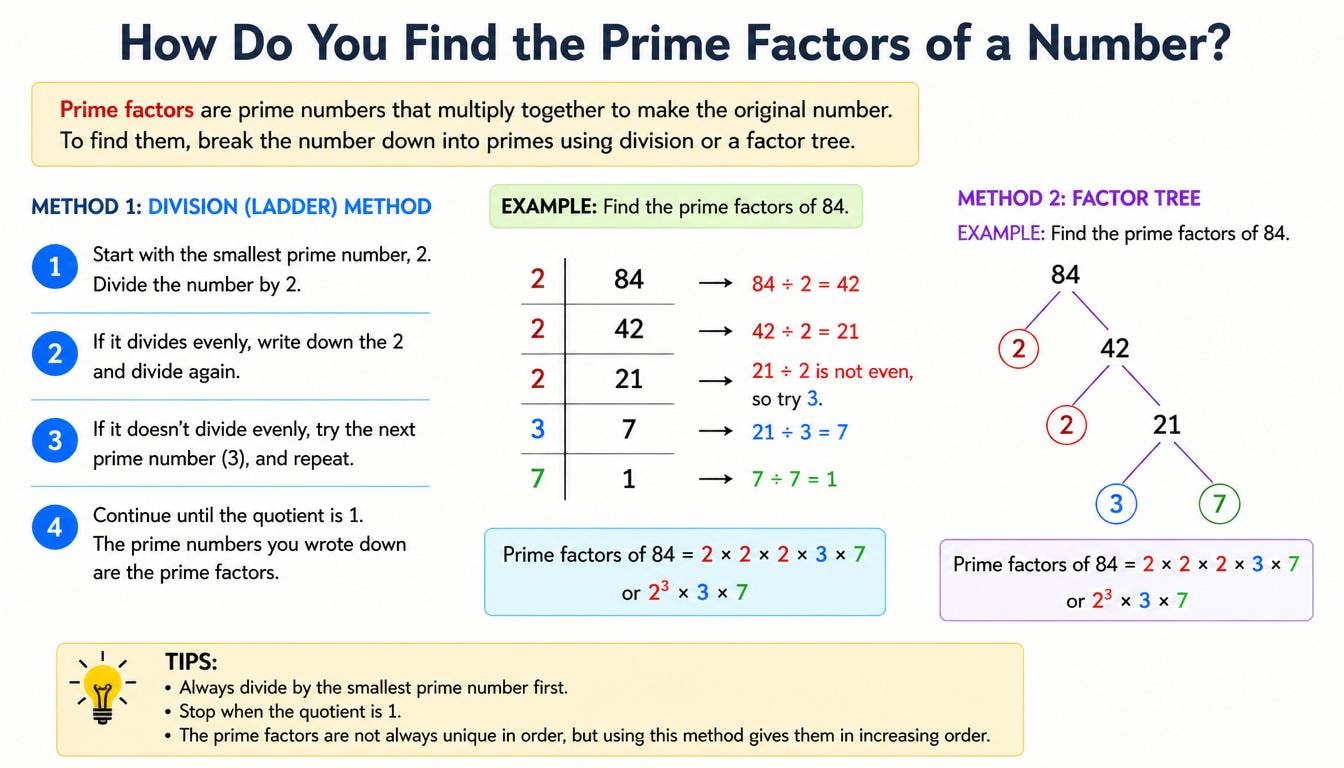
Method 1: The Prime Factor Tree Method
The factor tree is a visual and highly intuitive method of breaking down a composite number into its prime components. It is especially useful for visual learners and smaller to medium-sized numbers.
Step-by-Step Instructions for the Factor Tree
Write the number you want to factorize at the top of your page.
Branch out from this number with two lines, representing a pair of factors that multiply to get that number. (You can choose any two factors, excluding 1).
Look at the two new factors. If either factor is a prime number, circle it. This branch has reached its end.
If a factor is a composite number, draw two new branches from it and find two factors for it.
Repeat this process until every branch ends in a circled prime number.
Multiply all the circled prime numbers together. This product is the prime factorization of your original number.
Example: Finding the Prime Factors of 60 Using a Factor Tree
Let us find the prime factors of 60 using this visual method:
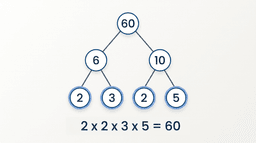
Start with 60.
Split 60 into two factors: 6 and 10 (since 6 x 10 = 60).
Examine 6 and 10. Neither is prime, so we must split both.
Split 6 into 2 and 3. Both 2 and 3 are prime numbers, so we circle them.
Split 10 into 2 and 5. Both 2 and 5 are prime numbers, so we circle them.
All active branches now end in circled primes: 2, 3, 2, and 5.
The prime factorization of 60 is written as: 2 x 2 x 3 x 5, which can be simplified using exponents as 22 x 3 x 5. The prime factors of 60 are 2, 3, and 5.
Method 2: The Division Method (The Prime Factor Algorithm)
Also known as the ladder method or division algorithm, this approach is highly structured, systematic, and perfect for larger numbers where drawing a tree might become messy.
Step-by-Step Instructions for the Division Method
Write down the number in a two-column grid (or ladder structure).
Divide the number by the smallest possible prime number that divides it completely without leaving a remainder (start testing with 2, then 3, then 5, etc.).
Write the prime divisor on the left side and the resulting quotient underneath your original number.
Repeat the process with the new quotient: divide it by its smallest prime factor.
Continue this cycle of division until the quotient becomes 1.
The numbers on the left column are the prime factors of your starting number.
Example: Finding the Prime Factors of 120 Using the Division Method
Let us systematically break down 120:
120 is even, so we divide by the smallest prime, 2.
120 / 2 = 6060 is even, so we divide by 2 again.
60 / 2 = 3030 is even, so we divide by 2 again.
30 / 2 = 1515 is odd, so it cannot be divided by 2. The next smallest prime is 3.
15 / 3 = 55 is a prime number, so we divide it by 5.
5 / 5 = 1Since we have reached 1, our calculations are complete.
Looking at our divisors on the left side, we have: 2, 2, 2, 3, and 5.
Therefore, the prime factorization of 120 is 2 x 2 x 2 x 3 x 5 (or 23 x 3 x 5). The prime factors of 120 are 2, 3, and 5.
Method 3: Trial Division (Scientific and Computational Approach)
For very large numbers, mathematicians and computer systems use a method called trial division. This method relies on an important mathematical property: if a number has a factor, at least one of those factors must be less than or equal to the square root of that number.
If we want to find the prime factors of a large number N:
Calculate the square root of N (let's call it √N).
Test division only using prime numbers up to √N.
If none of the prime numbers up to √N divide N evenly, then N itself is a prime number!
This scientific principle drastically reduces the amount of work required to determine if a large number is prime or to find its prime factors.
Why Do We Find Prime Factors? (Real-World Applications)
Prime factorization is not just an abstract classroom exercise; it is a foundational pillar of modern science and technology:
Cryptography (Security): When you make a secure transaction online, your data is protected by encryption algorithms like RSA. These algorithms rely on the mathematical reality that while it is extremely easy to multiply two massive prime numbers together, it is computationally almost impossible for a hacker to find the prime factors of the resulting massive composite number.
Simplifying Fractions: Finding the Greatest Common Divisor (GCD) and Least Common Multiple (LCM) of numbers becomes incredibly straightforward once you know their prime factors.
Acoustics and Physics: Prime numbers and prime factors help engineers design concert halls and gears with teeth counts that prevent harmonic resonance and uneven wear.
Key Takeaways
Every whole number greater than 1 is either a prime number or can be broken down into a unique set of prime factors.
The Factor Tree Method is best for visual learners and smaller numbers.
The Division Method is a systematic, algorithmic way to factorize any number step-by-step.
To find prime factors of any number efficiently, you only need to test divisors up to the square root of that number.