Imagine building a massive, intricate castle out of Lego bricks. No matter how large or complex your castle is, it is ultimately made up of individual, indivisible plastic bricks. In the world of mathematics, numbers work in a very similar way. Every single whole number greater than 1 is either a fundamental, indivisible building block itself, or it is built by multiplying these blocks together. These fundamental mathematical building blocks are called prime numbers.
In this comprehensive guide, we will explore the fascinating world of prime numbers. We will define what they are, look at how to identify them, discover historical tools like the Sieve of Eratosthenes, and learn how to break composite numbers down into their prime components using visual and algorithmic methods.
What is a Prime Number?
A prime number is a whole number greater than 1 that has exactly two distinct positive divisors: 1 and the number itself. This means that you cannot divide a prime number by any other number without leaving a remainder.
For example, let us look at the number 5. The only whole numbers that can divide 5 perfectly are 1 and 5. Therefore, 5 is a prime number. Now, let us look at the number 6. The numbers that can divide 6 perfectly are 1, 2, 3, and 6. Because it has more than two divisors, 6 is not a prime number; it is called a composite number.
Important Note: The number 1 is neither prime nor composite. To be a prime number, a number must have exactly two distinct factors. Since 1 only has one factor (itself), it does not fit the definition of a prime number. This distinction is crucial for keeping mathematical rules consistent.
Visualizing Prime Numbers: The Rectangular Area Representation
One of the easiest ways to understand the difference between prime and composite numbers is through visual geometry. Imagine you have a set of square tiles, and you want to arrange them to form a perfect rectangle.
If you have 12 tiles, you can arrange them in several different rectangular shapes:
A single row of 12 (1 x 12)
Two rows of 6 (2 x 6)
Three rows of 4 (3 x 4)
Because you can make multiple different rectangles with 12 tiles, 12 is a composite number. Its factors are 1, 2, 3, 4, 6, and 12.
Now, imagine you have 7 tiles. Try to arrange them into a perfect rectangle. You will find that there is only one way to do it:
A single row of 7 (1 x 7)
No other rectangular arrangement is possible without leaving empty spaces or leftover tiles. Because you can only represent 7 as a single, straight line of tiles, 7 is a prime number.
How to Find Prime Numbers: The Sieve of Eratosthenes
How do we find all the prime numbers in a large group of numbers, say from 1 to 100? Over 2,200 years ago, an ancient Greek mathematician named Eratosthenes of Cyrene created a simple, brilliant method to do exactly this. This method is called the Sieve of Eratosthenes.
Imagine a grid containing numbers from 1 to 100. We can find all the prime numbers by systematically filtering out (or "sieving") the composite numbers:
Cross out 1: Since 1 is not prime, we cross it out first.
Circle 2: 2 is the first prime number. Now, cross out every multiple of 2 after 2 (4, 6, 8, 10, etc.). All of these are even numbers and cannot be prime.
Circle 3: 3 is the next prime. Cross out every multiple of 3 that is not already crossed out (9, 15, 21, etc.).
Circle 5: (4 is already crossed out). 5 is prime. Cross out all remaining multiples of 5 (numbers ending in 5 or 0).
Circle 7: 7 is prime. Cross out all remaining multiples of 7 (such as 49, 77, 91).
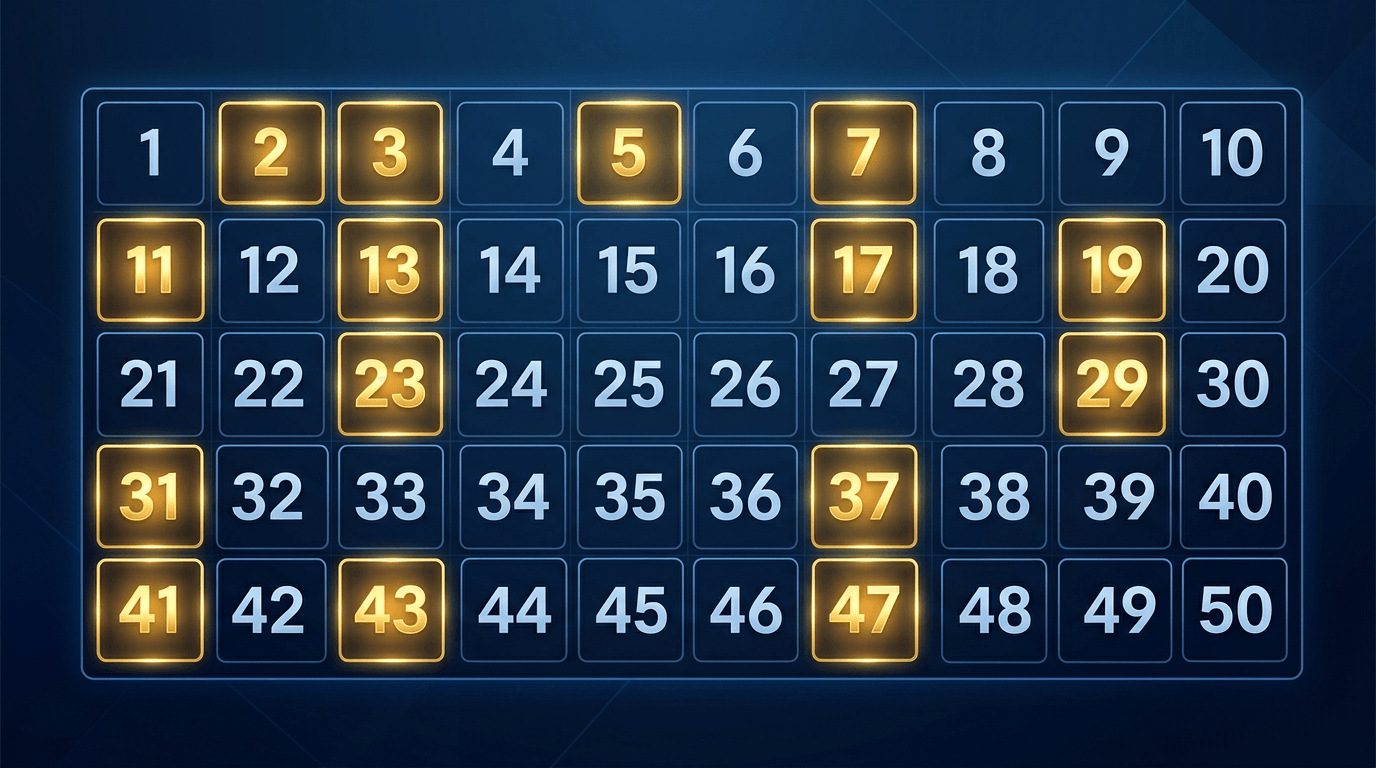
Once you have finished this process for the prime numbers up to the square root of 100 (which is 10), all the remaining uncrossed numbers on your grid are prime numbers! Through this simple activity, you can discover that there are exactly 25 prime numbers between 1 and 100: 2, 3, 5, 7, 11, 13, 17, 19, 23, 29, 31, 37, 41, 43, 47, 53, 59, 61, 67, 71, 73, 79, 83, 89, and 97.
What Are Prime Factors?
Every composite number can be broken down into a product of prime numbers. This is known as the Fundamental Theorem of Arithmetic. The prime numbers that multiply together to form a composite number are called its prime factors.
For example, let us look at the composite number 12. We can write 12 as 2 x 2 x 3. Because 2 and 3 are prime numbers, we have successfully broken 12 down into its prime factors. We can also write this using exponents: 22 x 3.
Methods for Prime Factorization
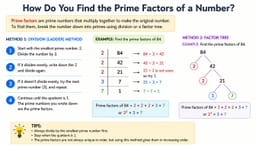
There are two highly effective visual tools used to find the prime factors of any natural number: the Prime Factor Tree and the Prime Factor Division Ladder (Algorithm).
1. The Prime Factor Tree
A prime factor tree is a diagram that helps you split a number into its factors step-by-step until only prime numbers remain at the ends of the "branches." Let us find the prime factors of 36 using a factor tree:
Write down the number 36.
Choose any two factors of 36 to start your branches. Let's use 6 and 6 (since 6 x 6 = 36).
Look at your two new branches. Is 6 a prime number? No, so we must split both 6s.
Split the first 6 into 2 x 3. Both 2 and 3 are prime numbers, so we circle them. These branches stop here.
Split the second 6 into 2 x 3. Circle these as well.
Collect all the circled prime numbers at the ends of your branches: 2, 2, 3, and 3.
The prime factorization of 36 is 2 x 2 x 3 x 3, which can be written as 22 x 32.
2. The Prime Factor Division Ladder (Algorithm)
The division ladder is a structured, vertical method. It is highly efficient for larger numbers. Let us find the prime factors of 60 using this algorithm:
Write the number 60 and draw a vertical line to its right.
Divide 60 by the smallest possible prime number, which is 2. Write the prime 2 on the right side of the line, and the result (30) on the left side, directly under 60.
Repeat the process for 30. Divide 30 by 2. Write 2 on the right, and 15 on the left.
Now look at 15. It cannot be divided by 2. The next smallest prime is 3. Divide 15 by 3. Write 3 on the right, and 5 on the left.
Now look at 5. Since 5 is a prime number, divide it by 5. Write 5 on the right, and 1 on the left.
Once you reach 1 on the left side, your division ladder is complete!
The numbers on the right side of the line are your prime factors: 2, 2, 3, and 5. Therefore, the prime factorization of 60 is 2 x 2 x 3 x 5, or 22 x 3 x 5.
Fascinating Properties of Prime Numbers
Prime numbers have unique characteristics that have puzzled and excited mathematicians for centuries:
The Only Even Prime: The number 2 is the only even prime number in existence. Every other even number is a multiple of 2, making it composite.
Primes are Infinite: There is no such thing as the "largest" prime number. The ancient mathematician Euclid proved that prime numbers go on forever.
Coprime Numbers: Two numbers are said to be coprime (or relatively prime) if their only common positive factor is 1. For example, 8 and 9 are not prime numbers, but they are coprime to each other because they share no common factor other than 1.
Key Takeaways
Understanding prime numbers is essential for advanced mathematics, algebra, and even real-world technologies like computer encryption and cybersecurity. Here are the core concepts to remember:
A prime number is a whole number greater than 1 that only has two factors: 1 and itself.
Composite numbers can be broken down into a unique set of prime factors.
You can use tools like the Sieve of Eratosthenes to easily filter out prime numbers from a group.
The Prime Factor Tree and the Division Ladder are excellent methods to decompose any number into its prime building blocks.