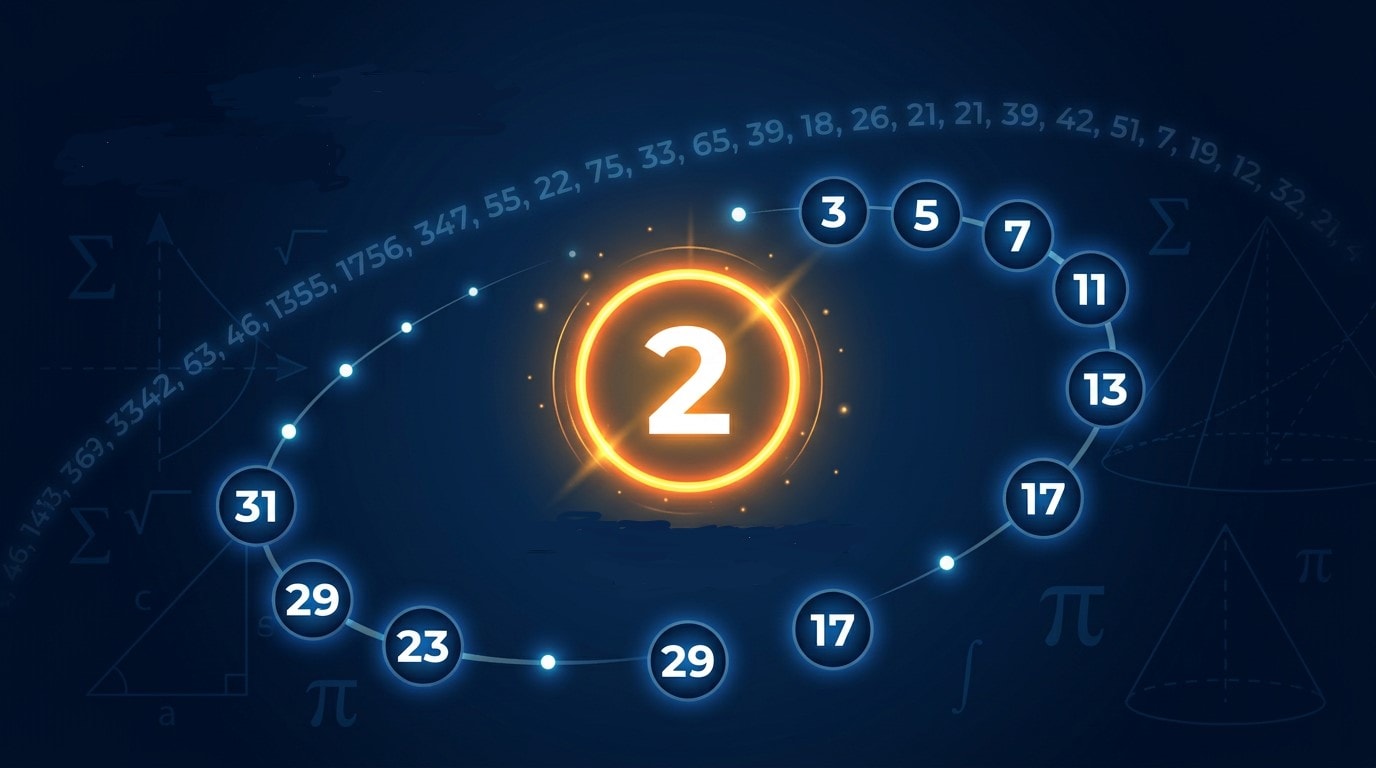
Just as physical matter is built from indivisible chemical elements, every whole number greater than 1 can be broken down into a unique product of prime numbers. But among these fundamental numerical building blocks, one question frequently arises for students, educators, and curious minds alike: What is the smallest prime number?
The short and definitive answer is 2. However, the reasons behind this answer, the mathematical rules that govern it, and the unique properties of this number open up a rich scientific discussion. In this comprehensive guide, we will explore why 2 holds this special title, why other numbers like 0 and 1 are excluded, and why the number 2 is one of the most unique entities in all of mathematics.
Understanding the Definition of a Prime Number
To understand why 2 is the smallest prime number, we must first look at the precise scientific definition of a prime number. In mathematics, a prime number is defined as a natural number (a positive integer) greater than 1 that has exactly two distinct positive divisors: 1 and the number itself.
Let us break down this definition into its core criteria:
It must be a positive integer: Prime numbers belong to the set of natural numbers (1, 2, 3, 4, ...).
It must be greater than 1: By definition, the number 1 is excluded from being prime.
It must have exactly two divisors: These divisors must be 1 and the number itself. No other whole number can divide it without leaving a remainder.
If a positive integer greater than 1 has more than two divisors, it is classified as a composite number. For example, the number 4 is composite because its divisors are 1, 2, and 4.
Why the Number 2 is the Smallest Prime Number
When we apply the mathematical definition of prime numbers to the sequence of natural numbers starting from the beginning, we can evaluate each number step-by-step:
Is 0 prime? No. Prime numbers must be positive integers greater than 1. Furthermore, 0 has infinitely many divisors, as any non-zero number divides 0.
Is 1 prime? No. While 1 is only divisible by 1 and itself, these two divisors are not "distinct." The definition requires exactly two different divisors. (We will explore the deeper scientific reasons for excluding 1 later in this article).
Is 2 prime? Yes! The number 2 is greater than 1. Its only positive divisors are 1 and 2. Since it has exactly two distinct positive divisors, it meets all the criteria perfectly.
Because 2 is the first number in the sequence of natural numbers to meet these criteria, it is universally recognized as the smallest prime number.
Why Isn't the Number 1 Considered Prime?
For centuries, the status of the number 1 fluctuated among mathematicians. Some ancient and medieval scholars considered 1 to be prime, or even the "source" of all numbers rather than a number itself. However, modern mathematics strictly excludes 1 from the list of prime numbers. This is not an arbitrary choice; it is a necessity for maintaining mathematical consistency.
The primary scientific reason 1 is not considered prime is the Fundamental Theorem of Arithmetic. This fundamental theorem states that every integer greater than 1 is either a prime number itself or can be represented as a unique product of prime numbers, up to the order of the factors.
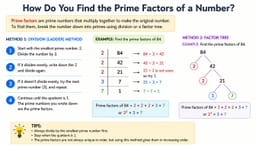
The Fundamental Theorem of Arithmetic: Every positive integer greater than 1 can be written as a product of prime numbers in only one way (excluding the order of the factors). For example, the number 12 can only be factored as 2 multiplied by 2 multiplied by 3 (2 x 2 x 3).
If we allowed the number 1 to be classified as a prime number, this uniqueness would completely break down. We could write the prime factorization of 12 in infinitely many ways:
12 = 2 x 2 x 3
12 = 2 x 2 x 3 x 1
12 = 2 x 2 x 3 x 1 x 1
12 = 2 x 2 x 3 x 1 x 1 x 1...
To preserve the uniqueness of prime factorization—which is vital for advanced algebra, number theory, and cryptography—mathematicians defined prime numbers to strictly exclude the number 1. Therefore, 1 is classified neither as prime nor as composite; it is referred to as a "unit." This leaves 2 as the undisputed starting point of the prime numbers.
The Unique Properties of the Number 2
As the smallest prime number, 2 possesses several fascinating and unique properties that set it apart from all other primes in existence.
1. The Only Even Prime Number
Perhaps the most famous property of 2 is that it is the only even prime number. By definition, an even number is any integer that is divisible by 2. If any other even number (such as 4, 6, 8, 10, or 2,000,452) were to be considered prime, it would fail the test because it would have at least three divisors: 1, itself, and 2.
Because of this, every other prime number in the infinite sequence of primes must be an odd number (such as 3, 5, 7, 11, 13, and so on). This unique status has led mathematicians to jokingly refer to 2 as "the oddest prime," because it is the only one that is even!
2. The Building Block of Even Numbers
Since 2 is the only even prime, it serves as the essential foundation for all even numbers. According to Goldbach's Conjecture—one of the oldest and most famous unsolved problems in number theory—every even integer greater than 2 can be expressed as the sum of two prime numbers. For example:
4 = 2 + 2
6 = 3 + 3
8 = 3 + 5
10 = 5 + 5 (or 3 + 7)
Without the number 2 acting as the smallest prime, our entire understanding of how even and odd numbers interact within arithmetic would be fundamentally altered.
Historical Context: How Ancient Mathematicians Viewed the Smallest Prime
The study of prime numbers dates back thousands of years to ancient civilizations. The ancient Egyptians had some knowledge of primes, but it was the ancient Greeks who first studied them systematically.
Around 300 BC, the Greek mathematician Euclid published his work Elements, in which he proved that there are infinitely many prime numbers. Euclid’s proof is still taught in universities today for its elegant simplicity. In his work, Euclid recognized the fundamental nature of 2 as the starting point of these infinite numbers.
Later, in the 3rd century BC, another Greek mathematician named Eratosthenes developed a simple algorithm for finding prime numbers known as the Sieve of Eratosthenes. In this method, you write out a grid of numbers and systematically cross out the multiples of each prime, starting with the multiples of the smallest prime: 2. Since 2 is the first prime, all of its multiples (4, 6, 8, 10...) are crossed out first as composite numbers, leaving the remaining primes uncovered.
Why Negative Numbers Are Not Prime
Sometimes, students ask whether negative numbers like -2, -3, or -5 can be considered prime numbers. Strictly speaking, in standard elementary and intermediate mathematics, prime numbers are defined only within the set of positive integers (natural numbers).
In advanced abstract algebra, mathematicians study rings and fields where they define "primes" more broadly. In the ring of integers, numbers like -2 are considered "associates" of the prime number 2. However, to avoid complexity and maintain a clear, structured system for arithmetic, the scientific standard limits prime numbers to positive integers. Therefore, negative numbers are excluded, keeping 2 as the absolute smallest prime.
Summary of Key Takeaways
To consolidate your understanding of the smallest prime number, let us review the most important facts:
The smallest prime number is 2. It is the very first positive integer that has exactly two distinct divisors: 1 and itself.
The number 1 is not prime. Excluding 1 preserves the uniqueness of prime factorization, which is a core foundation of mathematics.
The number 2 is the only even prime number. All other even numbers are divisible by 2, making them composite. Consequently, all other prime numbers are odd.
Prime numbers must be positive. Negative integers and fractions are not included in the standard definition of prime numbers.
Understanding that 2 is the smallest prime number is more than just a trivia fact; it is a gateway to understanding how numbers are structured, how theorems are constructed, and how modern systems like computer cryptography secure our digital world using these unique numerical building blocks.