Just as biological organisms are composed of basic cells, and physical matter is built from fundamental atoms, composite numbers are constructed from specific, indivisible numerical building blocks. These fundamental building blocks are known as prime factors.
Understanding what a prime factor is, how to identify it, and how to break a number down into its prime components is one of the most critical milestones in arithmetic and number theory. This comprehensive guide will explore the concept of prime factors from the ground up, examining their definitions, mathematical properties, visualization methods, and real-world applications.
1. The Foundations: Primes and Factors
Before we can define a prime factor, we must first dissect the two words that make up the term: prime and factor.
What is a Prime Number?
A prime number is a whole number greater than 1 that has exactly two distinct positive divisors: 1 and itself. In other words, a prime number cannot be divided evenly by any other number except 1 and the number itself. Examples of prime numbers include 2, 3, 5, 7, 11, 13, 17, and 19.
Important Note: The number 1 is not a prime number. By definition, a prime number must have exactly two distinct divisors. Since 1 only has one divisor (itself), it is classified as neither prime nor composite. The number 2 is the smallest prime number and the only even prime number.
What is a Factor?
A factor (or divisor) of a whole number is another whole number that divides it completely without leaving a remainder. For example, if we take the number 12, we can divide it evenly by several numbers:
12 ÷ 1 = 12
12 ÷ 2 = 6
12 ÷ 3 = 4
12 ÷ 4 = 3
12 ÷ 6 = 2
12 ÷ 12 = 1
Therefore, the factors of 12 are 1, 2, 3, 4, 6, and 12. These factors can also be represented as factor pairs: (1, 12), (2, 6), and (3, 4). Geometrically, we can represent these factors as the dimensions of a rectangle with an area of 12. A rectangle of 12 square units can be arranged as 1 by 12, 2 by 6, or 3 by 4.
2. Defining the Prime Factor
Now we can combine these two concepts. A prime factor of a given natural number is a factor of that number that is also a prime number.
Let us look back at our list of factors for the number 12: 1, 2, 3, 4, 6, and 12. Out of this list, which numbers are prime?
1 is not prime.
2 is prime.
3 is prime.
4 is composite (2 × 2).
6 is composite (2 × 3).
12 is composite (2 × 2 × 3).
Thus, the prime factors of 12 are 2 and 3.
3. The Fundamental Theorem of Arithmetic
To truly appreciate the significance of prime factors, we must turn to one of the cornerstones of mathematics: The Fundamental Theorem of Arithmetic (sometimes called the Unique Factorization Theorem). This theorem states:
Every integer greater than 1 is either a prime number itself or can be represented as a unique product of prime numbers, up to the order of the factors.
This means that any composite number can be broken down into a multiplication string of prime numbers, and this combination is absolutely unique to that number. It acts like a mathematical fingerprint or DNA. No two different numbers share the exact same set of prime factors multiplied together.
For example, let us look at the prime factorization of 12:
12 = 2 × 2 × 3
We can write this more compactly using exponents: 12 = 22 × 3. No other number in the universe has the prime factorization of 22 × 3.
4. Historical Context: The Sieve of Eratosthenes
Historically, identifying prime numbers was the first step toward finding prime factors. Around 200 BCE, the ancient Greek mathematician, astronomer, and geographer Eratosthenes of Cyrene devised a simple, elegant algorithm to identify all prime numbers up to a given limit. This method is called the Sieve of Eratosthenes.
Imagine a hundred chart (a grid containing numbers from 1 to 100):
Cross out 1, as it is not prime.
Circle 2 (the first prime) and cross out every multiple of 2 (4, 6, 8, 10, etc.).
Circle 3 (the next prime) and cross out every multiple of 3 that is not already crossed out (9, 15, 21, etc.).
Circle 5 (the next prime) and cross out all its remaining multiples (25, 35, etc.).
Circle 7 (the next prime) and cross out its remaining multiples (49, 77, 91, etc.).
Continue this process. Once you reach the square root of the limit (for 100, that is 10), all remaining uncrossed numbers on the grid are prime numbers.
Using this "sieve" or filter, we isolate the pure prime numbers, which we can then use to determine the prime factors of any composite number within that range.
5. How to Find Prime Factors: Step-by-Step Methods
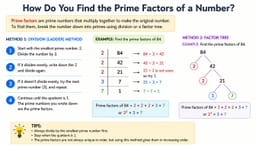
There are two primary systematic methods used to break down a composite number into its prime factors: the Factor Tree Method and the Division Algorithm (or Ladder Method).
Method A: The Factor Tree
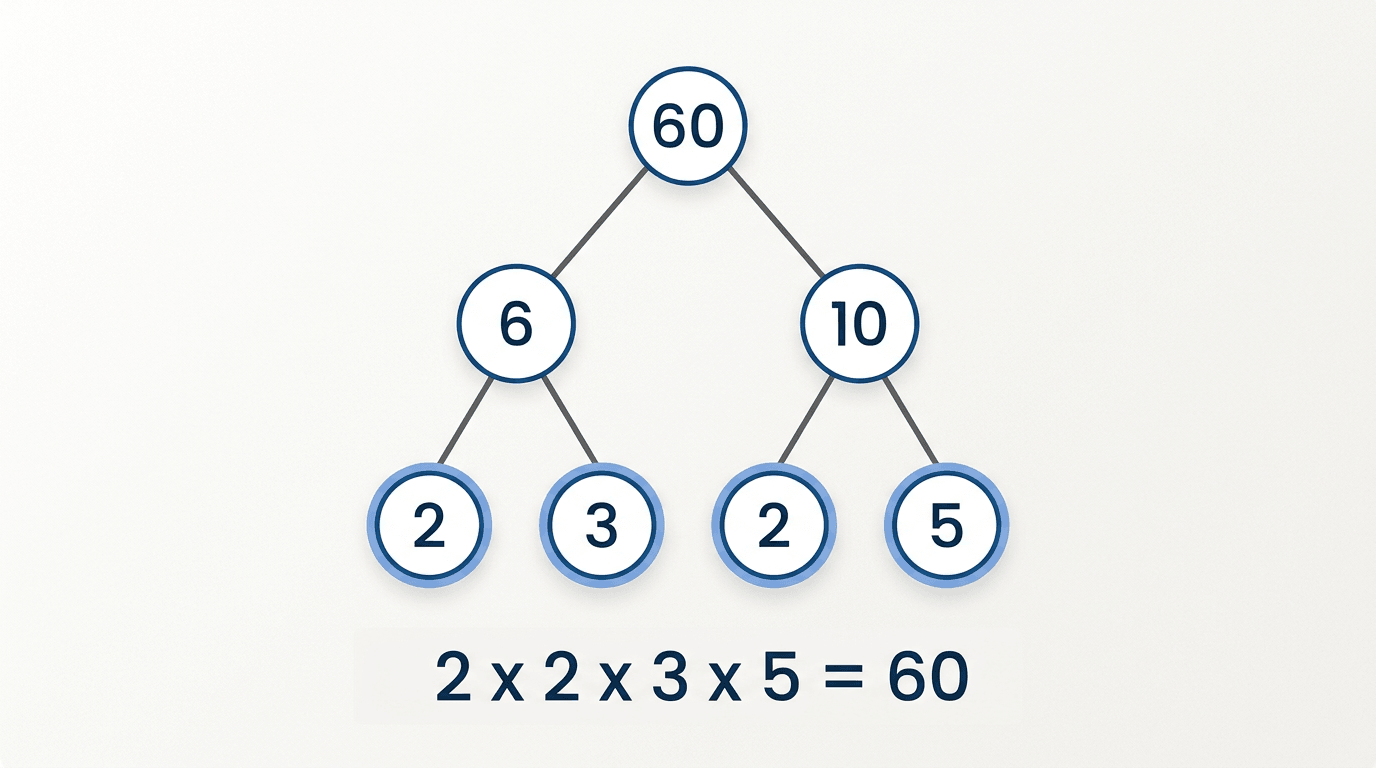
The factor tree is a visual representation that branches out as you break a number down into its factor pairs. Here is how to construct one for the number 60:
Write the number 60 at the top.
Choose any two factors of 60 to form the first branches. Let's choose 6 and 10 (since 6 × 10 = 60).
Examine the two branches. Are they prime? No, both 6 and 10 are composite.
Break down 6 into its factors: 2 and 3. Since 2 and 3 are prime, circle them and stop branching here.
Break down 10 into its factors: 2 and 5. Since 2 and 5 are prime, circle them and stop branching here.
Collect all the circled prime numbers at the ends of the branches: 2, 3, 2, and 5.
Thus, the prime factorization of 60 is: 2 × 2 × 3 × 5, which can be written as 22 × 3 × 5.
Method B: The Division Algorithm / Ladder Method
The division algorithm is a sequential, vertical method that is highly structured and particularly useful for very large numbers. It involves dividing the number systematically by the smallest possible prime numbers.
Let us perform the division algorithm for the number 90:
Write down the number 90. Draw a vertical line to its right.
Find the smallest prime number that divides 90. Since 90 is even, that prime is 2.
Write 2 on the right side of the line, and write the result of the division (90 ÷ 2 = 45) directly under 90.
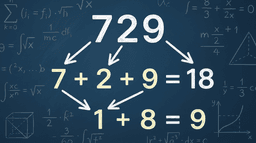
Now, find the smallest prime that divides 45. 45 is odd, so 2 does not work. The next prime is 3. Since 4 + 5 = 9, 45 is divisible by 3.
Write 3 on the right, and the result (45 ÷ 3 = 15) under 45.
Find the smallest prime that divides 15. That is 3. Write 3 on the right, and the result (15 ÷ 3 = 5) under 15.
Find the smallest prime that divides 5. That is 5. Write 5 on the right, and the result (5 ÷ 5 = 1) under 5.
Once you reach 1 on the left side, you are finished.
The numbers on the right side of the vertical line are your prime factors: 2, 3, 3, and 5. Therefore, the prime factorization of 90 is: 2 × 32 × 5.
6. Why are Prime Factors Important? Real-World Applications
Prime factorization is not just an abstract classroom exercise. It has profound applications in advanced mathematics, computer science, and modern daily life.
Cryptography and Digital Security
Every time you make an online purchase, log into your email, or send a secure message, you are relying on prime factors. Modern encryption algorithms, such as RSA cryptography, rely on a simple mathematical asymmetry: it is incredibly easy for a computer to multiply two massive prime numbers together to get a giant composite number, but it is extraordinarily difficult and time-consuming for even the most powerful supercomputers to reverse-engineer that giant composite number back into its unique prime factors.
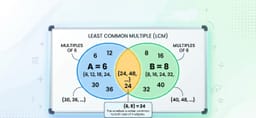
Finding the Greatest Common Divisor (GCD) and Least Common Multiple (LCM)
Prime factors make it simple to find the GCD and LCM of two or more numbers, which is essential for simplifying fractions and solving complex algebraic equations.
GCD: Identify the common prime factors of both numbers and multiply the lowest power of those common factors.
LCM: Take the highest power of all prime factors present in either number and multiply them together.
7. Conclusion: Key Takeaways
To summarize the essential concepts of prime factors:
A prime number has only two factors: 1 and itself.
A factor is a whole number that divides another whole number completely.
A prime factor is a factor that is also a prime number.
The Fundamental Theorem of Arithmetic proves that every composite number can be uniquely expressed as a product of prime factors.
You can find prime factors visually using a Factor Tree or sequentially using the Division Algorithm.
Prime factors serve as the foundation for critical modern technologies, including computer security and cryptography.