In this comprehensive guide, we will explore the divisibility rule for 10 from the ground up. We will look at its basic definition, examine the mathematical proof behind it using place value and modular arithmetic, explore how it connects to other prime factors, and work through detailed examples to solidify your understanding.
The Core Rule: How to Identify Divisibility by 10
At its simplest level, the divisibility rule for 10 can be stated in one straightforward sentence:
A whole number is divisible by 10 if and only if its last digit (the units digit) is 0.
If a number ends in any other digit—1, 2, 3, 4, 5, 6, 7, 8, or 9—it is not evenly divisible by 10. When you attempt to divide such a number by 10, you will always be left with a remainder, and that remainder will be exactly equal to the last digit of the original number.
The Mathematical Foundation: Our Decimal System
To truly understand why this rule works, we must look at the foundation of our numbering system. Humans primarily use the decimal system, also known as the base-10 positional numeral system. In this system, the value of each digit in a number depends entirely on its position, or "place value."
Let us break down a generic four-digit number, which we can represent as abcd. In terms of place value, this number is written as:
(a × 1000) + (b × 100) + (c × 10) + (d × 1)
Notice how each place value is a power of 10:
The thousands place: 1000 (which is 10 cubed)
The hundreds place: 100 (which is 10 squared)
The tens place: 10 (which is 10 to the power of 1)
The ones/units place: 1 (which is 10 to the power of 0)
Now, let us analyze this expression in terms of divisibility by 10. We can rewrite the expression by factoring out 10 from all the terms except for the last one (the ones place):
10 × (100a + 10b + c) + d
The term 10 × (100a + 10b + c) is guaranteed to be a multiple of 10 because it is explicitly multiplied by 10. Any integer multiplied by 10 is divisible by 10. Therefore, the divisibility of the entire number depends entirely on the remaining term, d, which is the units digit.
If d = 0, then the entire expression is a multiple of 10, meaning the number is perfectly divisible by 10. If d is any other digit (1 through 9), that digit becomes the remainder when the number is divided by 10.
Proof Using Modular Arithmetic
For students interested in more advanced mathematics, we can prove this rule using modular arithmetic. Modular arithmetic is a system of arithmetic for integers, where numbers "wrap around" when reaching a certain value—the modulus.
Let N be any positive integer. We can express N in base-10 as:
N = a_n(10^n) + a_{n-1}(10^{n-1}) + ... + a_1(10^1) + a_0(10^0)
Where each a_i is a digit between 0 and 9. We want to find the value of N modulo 10 (written as N mod 10). To do this, we can evaluate each term of the polynomial modulo 10:
Since 10 ≡ 0 (mod 10), any positive power of 10 is also congruent to 0 modulo 10:
10^k ≡ 0 (mod 10) for all k ≥ 1.
Substituting this back into our polynomial expression for N:
N ≡ a_n(0) + a_{n-1}(0) + ... + a_1(0) + a_0(1) (mod 10)
N ≡ a_0 (mod 10)
This elegant proof shows that any integer N is congruent to its units digit (a_0) modulo 10. For N to be divisible by 10, it must be congruent to 0 modulo 10. Therefore, a_0 must equal 0. This mathematically cements the rule.
The Prime Factorization Connection: 2 and 5
Another helpful way to view the divisibility rule for 10 is by looking at its prime factors. The prime factorization of 10 is:
10 = 2 × 5
Because 2 and 5 are coprime (they share no common factors other than 1), a number is divisible by 10 if and only if it is divisible by both 2 and 5. Let us look at the individual rules for these two prime numbers:
Divisibility Rule for 2: The number must be even, meaning its last digit must be 0, 2, 4, 6, or 8.
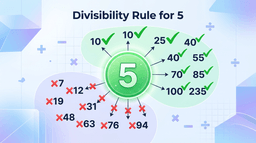
Divisibility Rule for 5: The last digit of the number must be either 0 or 5.
For a number to satisfy both rules simultaneously, its last digit must belong to both sets of requirements. The only digit that is both even (divisible by 2) and ends in 0 or 5 (divisible by 5) is 0. Thus, the intersection of these two rules naturally yields the rule for 10.
Step-by-Step Examples
Let us apply this rule to a few different numbers to see how quickly and efficiently it works in practice.
Example 1: Analyzing the number 4,530
We want to determine if 4,530 is divisible by 10.
Step 1: Identify the last digit of the number. The units digit of 4,530 is 0.
Step 2: Apply the rule. Since the last digit is 0, the number is divisible by 10.
Verification: 4,530 ÷ 10 = 453. The result is a whole number, confirming our rule works.
Example 2: Analyzing the number 78,945
We want to determine if 78,945 is divisible by 10.
Step 1: Identify the last digit of the number. The units digit of 78,945 is 5.
Step 2: Apply the rule. Since the last digit is not 0, the number is not divisible by 10.
Verification: 78,945 ÷ 10 = 7894.5 (or 7894 with a remainder of 5). The division results in a decimal, confirming it is not evenly divisible.
Example 3: Analyzing a very large number: 9,182,736,450
Even with massive numbers, the rule remains incredibly fast.
Step 1: Look directly at the very last digit, ignoring all other digits to the left. The units digit is 0.
Step 2: Since the units digit is 0, the entire ten-digit number is divisible by 10.
The Practical Utility of the Rule
The divisibility rule for 10 is not just an abstract mathematical trick; it is highly practical in everyday life and advanced studies:
Simplifying Fractions: If you have a fraction like 130/200, recognizing that both numbers end in 0 allows you to instantly divide both the numerator and denominator by 10, simplifying it to 13/20.
Percentage Calculations: Calculating 10% of a number is a common task. Knowing that dividing by 10 simply shifts the decimal point one place to the left makes mental math incredibly fast.
Unit Conversions: In the metric system, conversions are based on powers of 10 (e.g., millimeters to centimeters, or grams to kilograms). Understanding divisibility by 10 helps you quickly assess and convert measurements.
Key Takeaways
To summarize, here are the vital points to remember about the divisibility rule for 10:
A number is divisible by 10 if and only if its final digit is 0.
The rule works because our number system is base-10, meaning every place value higher than the units place is naturally a multiple of 10.
Mathematically, this can be proven using place value expansion or modular arithmetic, where N ≡ a_0 (mod 10).
Because 10 is the product of the prime numbers 2 and 5, any number divisible by 10 must also satisfy the divisibility rules for both 2 and 5.