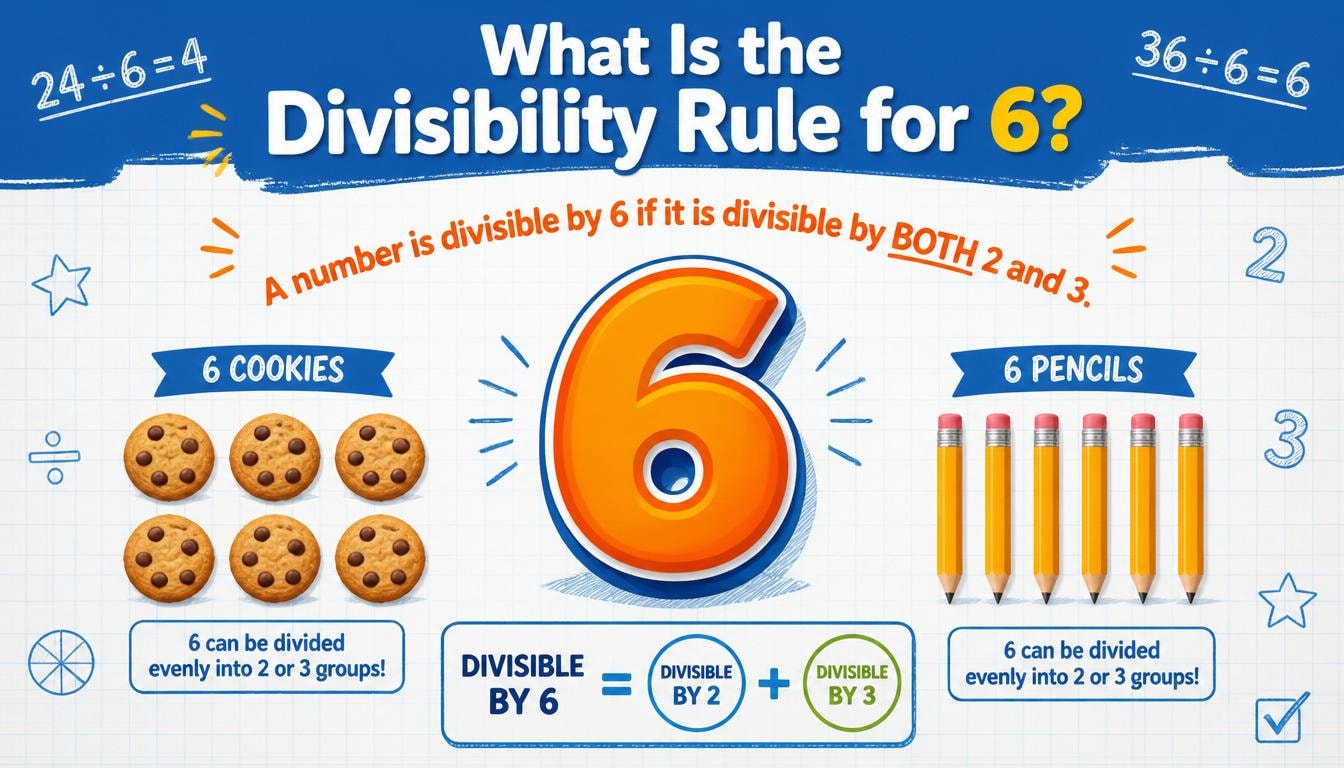
In the study of arithmetic and number theory, divisibility rules serve as powerful shortcuts. They allow us to determine whether one integer can be divided by another without performing the actual, often tedious, long division process. Among these rules, the divisibility rule for 6 is one of the most interesting and practical. Because 6 is a composite number, its divisibility rule is a beautiful combination of two fundamental rules: the rule for 2 and the rule for 3.
The Core Rule of Divisibility for 6
The rule for determining if a number is divisible by 6 is remarkably straightforward:
A whole number is divisible by 6 if and only if it is divisible by both 2 and 3.
This means that for any given integer to be a multiple of 6, it must satisfy two distinct conditions simultaneously:
Condition 1: The number must be even (divisible by 2).
Condition 2: The sum of the number's digits must be divisible by 3 (divisible by 3).
If a number fails either of these tests, it cannot be divided evenly by 6. If it passes both, it is guaranteed to be divisible by 6.
The Mathematical Foundation: Why Does This Rule Work?
To understand why this rule works, we must look at the prime factorization of the number 6. The number 6 is a composite number, and its prime factors are 2 and 3 (since 2 multiplied by 3 equals 6).
In number theory, there is a fundamental theorem regarding coprime factors. If two numbers, let's call them a and b, are coprime (meaning their greatest common divisor is 1), then any number that is divisible by both a and b is also divisible by their product, a times b.
Since 2 and 3 are both prime numbers, their greatest common divisor is 1. Therefore, they are coprime. Applying the theorem:
Let a = 2 and b = 3.
The product of a and b is 2 * 3 = 6.
Thus, if a number is divisible by both 2 and 3, it must also be divisible by 6.
Step-by-Step Guide to Applying the Rule
Let's break down the process of testing a number for divisibility by 6 into clear, actionable steps.
Step 1: Check for Divisibility by 2 (The Even Test)
Look at the very last digit (the ones place) of the number. For a number to be divisible by 2, it must be an even number. This means the last digit must be one of the following:
0, 2, 4, 6, or 8
If the number ends in an odd digit (1, 3, 5, 7, or 9), you can stop immediately. The number is not divisible by 6.
Step 2: Check for Divisibility by 3 (The Digit Sum Test)
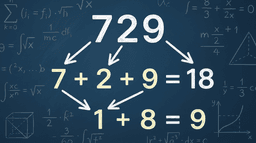
If the number passes the first step, you then add all the individual digits of the number together. If the resulting sum is a multiple of 3 (or if you keep adding the digits of the sum until you get a single digit that is 3, 6, or 9), then the original number is divisible by 3.
Step 3: Draw Your Conclusion
If both Step 1 and Step 2 are successful, the number is divisible by 6.
Detailed Examples with Explanations
Let us look at several examples to see this rule in action across different types of numbers.
Example 1: Testing the number 324
Step 1 (Divisibility by 2): The last digit of 324 is 4. Since 4 is even, the number is divisible by 2. (Pass)
Step 2 (Divisibility by 3): Add the digits of 324: 3 + 2 + 4 = 9. Since 9 is divisible by 3, the number is divisible by 3. (Pass)
Conclusion: Since 324 is divisible by both 2 and 3, it is divisible by 6. (Verification: 324 / 6 = 54).
Example 2: Testing the number 507
Step 1 (Divisibility by 2): The last digit of 507 is 7. Since 7 is odd, the number is not divisible by 2. (Fail)
Conclusion: We do not even need to check the sum of the digits. Because it failed the first test, 507 is not divisible by 6.
Example 3: Testing the number 812
Step 1 (Divisibility by 2): The last digit is 2, which is even. (Pass)
Step 2 (Divisibility by 3): Add the digits: 8 + 1 + 2 = 11. Since 11 is not divisible by 3, the number is not divisible by 3. (Fail)
Conclusion: Even though the number is even, it fails the divisibility test for 3. Therefore, 812 is not divisible by 6.
Example 4: Testing a Large Number (1,234,560)
Let's try a much larger number to demonstrate how efficient this rule is compared to long division.
Step 1: The last digit is 0, which is even. (Pass)
Step 2: Add the digits: 1 + 2 + 3 + 4 + 5 + 6 + 0 = 21. Since 21 is divisible by 3 (2 + 1 = 3), the number is divisible by 3. (Pass)
Conclusion: 1,234,560 is divisible by 6.
Advanced Perspective: Modular Arithmetic
For students interested in advanced mathematics, we can express this rule using modular arithmetic. Let N be any positive integer.
The divisibility rules state that:
N is congruent to 0 modulo 2 (written as: N ≡ 0 (mod 2))
and
N is congruent to 0 modulo 3 (written as: N ≡ 0 (mod 3))
According to the Chinese Remainder Theorem, because the moduli 2 and 3 are pairwise coprime, these two congruences can be combined into a single congruence modulo their product:
N ≡ 0 (mod 2 * 3) which simplifies to N ≡ 0 (mod 6)
This elegant mathematical proof guarantees that the rule is absolute and works for every single integer in existence.
Common Errors to Avoid
Forgetting to check both rules: Many students see an even number and assume it is divisible by 6, or see a number divisible by 3 and assume it is divisible by 6. Remember, both conditions must be met.
Miscalculating the sum of digits: Take your time when adding digits, especially for very long numbers. One small addition error can lead to the wrong conclusion.
Key Takeaways
The divisibility rule for 6 requires a number to be divisible by both 2 and 3.
To test for 2, ensure the number ends in 0, 2, 4, 6, or 8.
To test for 3, ensure the sum of all digits is a multiple of 3.
This compound rule works because 2 and 3 are coprime factors of 6.