Among the most useful and elegant shortcuts in arithmetic are divisibility rules. These rules allow us to quickly determine whether one number can be divided by another without performing the tedious process of long division. While some rules are straightforward—such as checking if a number ends in an even digit to determine if it is divisible by 2—others possess a deeper, almost magical mathematical property.
The divisibility rule for 9 is one of these fascinating rules. It is elegant, simple to use, and deeply rooted in the properties of our base-10 number system. In this comprehensive guide, we will explore exactly what the divisibility rule for 9 is, examine the scientific and mathematical proof behind why it works, walk through step-by-step examples, and discover its practical applications in everyday mathematics.
The Rule Defined
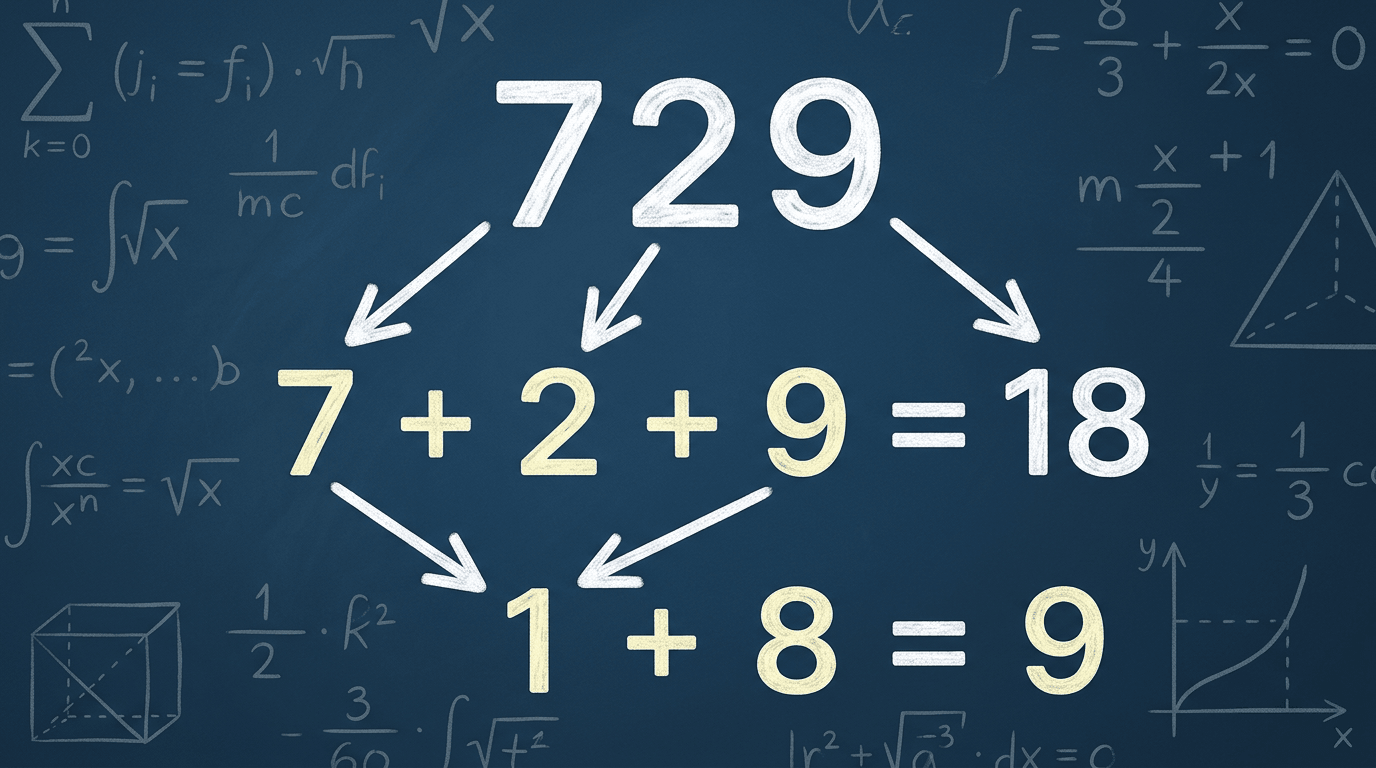
The divisibility rule for 9 states: A whole number is completely divisible by 9 if and only if the sum of its digits is divisible by 9.
If the sum of the digits of a number is a multiple of 9 (such as 9, 18, 27, 36, 45, etc.), then the original number itself can be divided by 9 with no remainder. If the sum is not a multiple of 9, the original number is not divisible by 9. Furthermore, the remainder you get when you divide the sum of the digits by 9 is exactly the same as the remainder you get when you divide the original number by 9.
Step-by-Step Examples
To fully understand how this rule is applied, let us look at several examples ranging from simple to complex numbers.
Example 1: A Three-Digit Number
Let us test the number 162.
Identify the individual digits of the number: 1, 6, and 2.
Add these digits together: 1 + 6 + 2 = 9.
Check if the sum (9) is divisible by 9. Since 9 divided by 9 is exactly 1 with no remainder, the sum is divisible by 9.
Therefore, the number 162 is divisible by 9. We can verify this with basic division: 162 / 9 = 18.
Example 2: A Large Multi-Digit Number
Let us test a much larger number: 2,845,314.
Extract the digits: 2, 8, 4, 5, 3, 1, and 4.
Sum the digits: 2 + 8 + 4 + 5 + 3 + 1 + 4 = 27.
Check if the sum (27) is divisible by 9. Since 27 / 9 = 3 (a whole number), 27 is indeed divisible by 9.
Therefore, the number 2,845,314 is divisible by 9. Let us verify: 2,845,314 / 9 = 316,146.
Example 3: A Non-Divisible Number
Let us test the number 538.
Extract the digits: 5, 3, and 8.
Sum the digits: 5 + 3 + 8 = 16.
Check if the sum (16) is divisible by 9. Since 16 is not a multiple of 9 (9 * 1 = 9, 9 * 2 = 18), the sum is not divisible by 9.
Therefore, 538 is not divisible by 9. If we perform the division, we get 538 / 9 = 59 with a remainder of 7. Notice that if we divide the sum of the digits (16) by 9, we also get a remainder of 7 (16 = 9 * 1 + 7). This is a beautiful property of the rule!
Why Does It Work? The Mathematical Proof
While knowing the rule is useful, understanding why it works elevates our mathematical comprehension. The secret behind the divisibility rule for 9 lies in our base-10 positional numeral system. Every number we write is actually a shorthand representation of powers of 10.
Let us express a general four-digit number, ABCD, in its expanded algebraic form:
Value of ABCD = (A * 1000) + (B * 100) + (C * 10) + D
We can rewrite the powers of 10 (10, 100, 1000) as a sum involving 9, 99, 999, and so on. Notice that:
10 = 9 + 1
100 = 99 + 1
1000 = 999 + 1
Now, let us substitute these expressions back into our expanded equation:
Value of ABCD = A * (999 + 1) + B * (99 + 1) + C * (9 + 1) + D
Using the distributive property of multiplication, we can expand this further:
Value of ABCD = (999 * A + A) + (99 * B + B) + (9 * C + C) + D
Let us regroup the terms to separate the parts multiplied by 9, 99, or 999 from the original digits:
Value of ABCD = [999 * A + 99 * B + 9 * C] + (A + B + C + D)
Now, let us analyze the two parts of this expression:
The first part, [999 * A + 99 * B + 9 * C], is guaranteed to be divisible by 9 because every term inside the brackets is a multiple of 9 (since 9, 99, and 999 are all divisible by 9).
The second part, (A + B + C + D), is simply the sum of the digits of our original number.
For the entire number to be divisible by 9, the second part (the sum of the digits) must also be divisible by 9. If it is, then the sum of two numbers divisible by 9 will also be divisible by 9. This algebraic proof works for any whole number of any size, from two digits to infinity!
The Concept of "Casting Out Nines" and Digital Roots
The divisibility rule for 9 is closely related to a mathematical concept known as the digital root. The digital root of a natural number is the single-digit value obtained by an iterative process of summing digits, on each iteration using the result from the previous iteration to calculate a new digit sum, until a single-digit number is reached.
For example, to find the digital root of 6,589:
Step 1: 6 + 5 + 8 + 9 = 28
Step 2: 2 + 8 = 10
Step 3: 1 + 0 = 1
The digital root of 6,589 is 1. If a number has a digital root of 9, it is completely divisible by 9.
A historical technique called "casting out nines" uses this property to double-check the results of addition, subtraction, multiplication, and division. By replacing large numbers with their digital roots, mathematicians and bookkeepers could quickly verify their calculations before the invention of modern calculators.
Practical Applications of the Rule
Why is the divisibility rule for 9 so important to learn? It has several practical, real-world applications:
Accounting and Bookkeeping (Detecting Transposition Errors): A transposition error occurs when two adjacent digits are accidentally swapped (for example, writing 54). A unique mathematical property of transposition errors is that the difference between the correct number and the incorrect number is always a multiple of 9. If an accountant's books do not balance, and the discrepancy is divisible by 9, they immediately look for a transposition error.
Mental Math and Speed Calculations: Being able to instantly tell if a number is divisible by 9 helps students and professionals simplify fractions, find prime factorizations, and estimate answers mentally without wasting time on long division.
Computer Science and Cryptography: Divisibility checks and digit-summing algorithms form the basis of simple error-detecting codes, checksums, and validation algorithms used to ensure data integrity during transmission.
Key Takeaways
A number is divisible by 9 if the sum of its individual digits is divisible by 9.
This rule works because our number system is base-10, and 10 is always 1 more than 9.
The remainder of any number divided by 9 is equal to the remainder of its digit sum divided by 9.
The rule is highly useful for verifying arithmetic calculations, identifying bookkeeping errors, and developing strong mental math skills.