Numbers are the foundation of mathematics, serving as the language through which we describe the universe. Among the various classifications of numbers, irrational numbers stand out as one of the most fascinating and counterintuitive concepts. Discovered in ancient Greece, these numbers challenged the fundamental belief that everything in nature could be expressed as a ratio of whole numbers.
By definition, an irrational number is any real number that cannot be expressed as a fraction a/b, where a and b are integers and b is not equal to zero. In this comprehensive guide, we will explore the unique physical, mathematical, and structural properties of irrational numbers, providing students and mathematics enthusiasts with a deep understanding of how these numbers behave.
1. Decimal Representation: Non-Terminating and Non-Periodic
The most practical way to distinguish an irrational number from a rational one is by looking at its decimal expansion. While rational numbers either terminate (like 1/4 = 0.25) or repeat in a regular pattern (like 1/3 = 0.3333...), irrational numbers do neither.
Non-Terminating: The digits after the decimal point go on forever without ever coming to an end.
Non-Periodic (Non-Repeating): There is no repeating block of digits that occurs systematically. Even if certain sequences repeat by chance, no infinite repeating pattern exists.
For example, consider the square root of 2 (approx. 1.41421356...) or Pi (approx. 3.14159265...). No matter how many trillions of digits scientists calculate, these numbers never develop a repeating cycle, nor do they ever stop.
2. Algebraic vs. Transcendental Irrational Numbers
Not all irrational numbers are created equal. Mathematicians classify them into two distinct categories based on whether they can be solutions to polynomial equations with rational coefficients:
Algebraic Irrational Numbers
These are irrational numbers that serve as roots (solutions) to non-zero polynomial equations with rational coefficients. For example, the square root of 2 is an algebraic irrational number because it is a solution to the equation: x² - 2 = 0. Similarly, the cube root of 5 is algebraic because it satisfies x³ - 5 = 0.
Transcendental Irrational Numbers
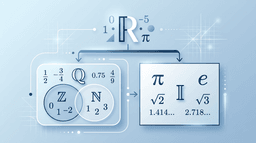
These are numbers that are "transcendental" because they cannot be defined as the root of any non-zero polynomial equation with rational coefficients. They transcend algebraic operations. The most famous examples are:
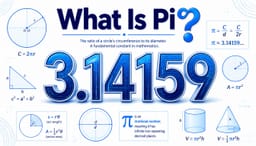
Pi (π): The ratio of a circle's circumference to its diameter (approx. 3.14159).
Euler's Number (e): The base of natural logarithms, crucial in calculus and compound interest calculations (approx. 2.71828).
3. Arithmetic and Closure Properties
When performing basic arithmetic operations (addition, subtraction, multiplication, and division) with irrational numbers, we observe unique algebraic behaviors. Unlike rational numbers, irrational numbers are not closed under these operations.
Operations Between a Rational and an Irrational Number
When you combine a rational number (except zero in multiplication/division) with an irrational number, the result is always irrational:
Addition/Subtraction: 3 (rational) + square root of 2 (irrational) = 3 + square root of 2 (irrational).
Multiplication/Division: 5 (rational) × Pi (irrational) = 5Pi (irrational).
Operations Between Two Irrational Numbers
When you perform arithmetic operations on two irrational numbers, the result is unpredictable; it can be either rational or irrational:
Addition: Adding the square root of 2 and negative square root of 2 gives 0, which is a rational number. However, adding the square root of 2 to the square root of 3 yields an irrational sum.
Multiplication: Multiplying the square root of 2 by itself yields 2, which is rational. Conversely, multiplying the square root of 2 by the square root of 3 yields the square root of 6, which is irrational.
4. Density on the Real Number Line
The real number line is incredibly crowded, and irrational numbers play a major role in this. One of the key topological properties of irrational numbers is their density.
The Density Property: Between any two distinct real numbers on the number line, no matter how close they are, there exists an infinite number of irrational numbers.
This means that if you pick two numbers, say 1.000001 and 1.000002, you can find infinitely many irrational numbers packed tightly between them. The same is true for rational numbers, illustrating that both sets are densely distributed across the real number system.
5. Uncountability: The Vastness of Irrationals
While both rational and irrational numbers are dense and infinite, they do not share the same "size" of infinity. This groundbreaking concept was proved by mathematician Georg Cantor in the late 19th century.
Cantor proved that the set of rational numbers is countable, meaning they can be put into a one-to-one correspondence with the natural numbers (1, 2, 3...). However, the set of real numbers (and by extension, irrational numbers) is uncountable.
This leads to a profound scientific conclusion: almost all real numbers are irrational. If you were to randomly select a point on the real number line, the probability of choosing a rational number is exactly zero, while the probability of choosing an irrational number is 100%.
6. Infinite Continued Fraction Representation
Another elegant property of irrational numbers lies in their continued fraction expansion. A continued fraction is an expression obtained through an iterative process of representing a number as the sum of its integer part and the reciprocal of another number.
Rational Numbers: Always have a finite continued fraction expansion.
Irrational Numbers: Always have an infinite continued fraction expansion.
Furthermore, quadratic irrationals (irrational numbers that are roots of quadratic equations, like the square root of 2 or the Golden Ratio) have periodic (repeating) infinite continued fractions. Transcendental numbers, like Pi, have infinite continued fractions that never repeat in a periodic cycle.
Summary of Key Takeaways
Understanding the properties of irrational numbers is essential for advanced mathematics and physics. Here is a quick summary of what makes them unique:
They cannot be written as a simple fraction of two integers.
Their decimal representations are infinite and never repeat in a pattern.
They can be algebraic (like square root of 3) or transcendental (like Pi and e).
Operating on two irrationals can result in either a rational or an irrational number.
They are uncountably infinite, making up the vast majority of the real number line.
They possess infinite continued fraction expansions.
By studying these properties, we gain insight into the continuous nature of space, time, and the mathematical framework that structures our universe.