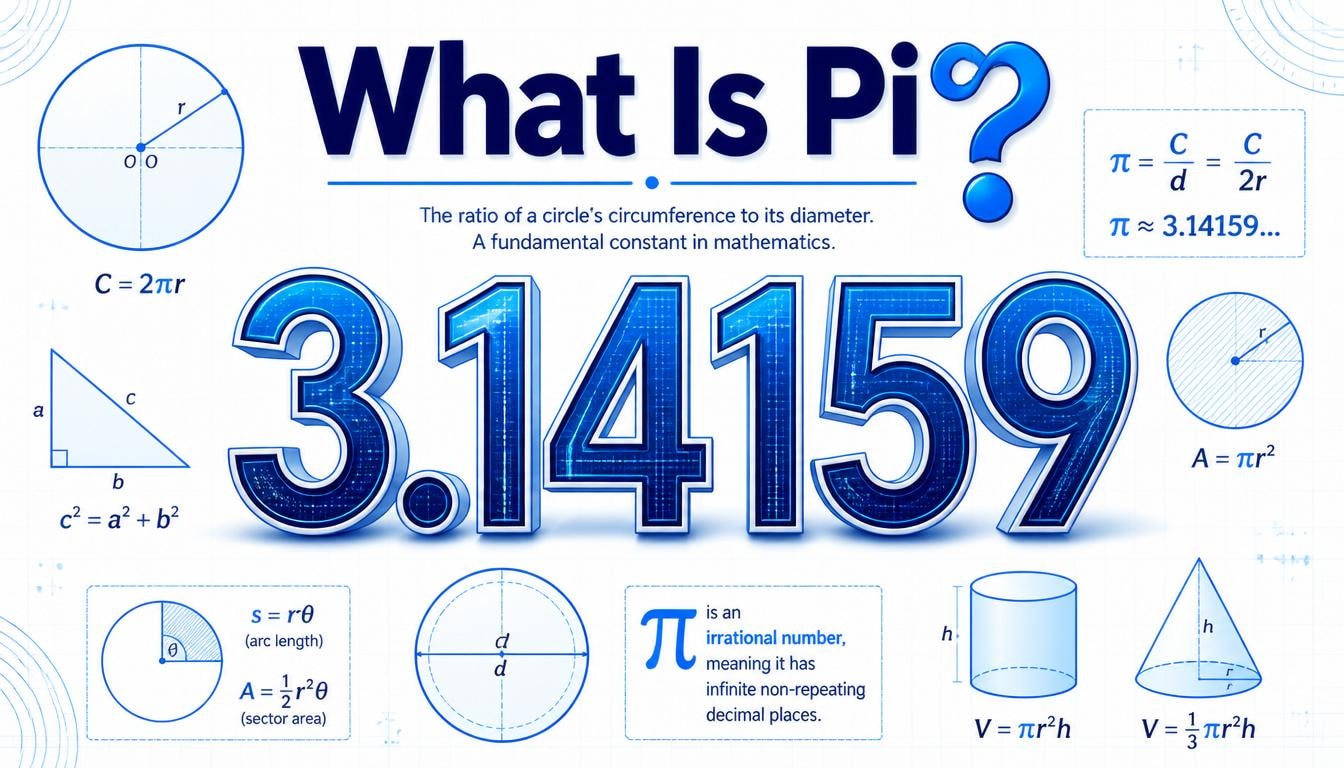
Whether you are looking at a tiny coin, a bicycle wheel, or a massive planet orbiting a star, they all share a fundamental mathematical constant: Pi (π). Pi is perhaps the most famous, intriguing, and widely discussed number in the history of mathematics.
In this comprehensive guide, we will dive deep into the world of Pi. We will explore what it represents, how it is defined geometrically, why it is classified as an irrational and transcendental number, and how mathematicians throughout history have calculated its infinite digits. If you have ever wanted to truly understand the science and mystery behind this mathematical superstar, you are in the right place.
The Geometric Definition of Pi
At its core, Pi is a ratio. To understand it, we only need to look at the basic anatomy of a circle. Any circle, regardless of its size, has two key measurements:
Circumference (C): The total distance around the edge of the circle (its perimeter).
Diameter (d): The straight-line distance across the circle, passing directly through its center.
If you measure the circumference of any circle and divide it by its diameter, you will always get the exact same number. This constant ratio is what we call Pi. Mathematically, we express this relationship as:
π = C / d
This means that the circumference of a circle is always slightly more than three times its diameter. If you stretch a rope across a circle's diameter, you would need just over three of those ropes to wrap completely around the outside of the circle. This rule applies universally, from a microscopic atom to a supermassive black hole.
The Decimal Representation: Is Pi Rational or Irrational?
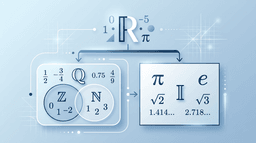
To understand the true nature of Pi, we must look at how numbers are classified based on their decimal representations. In mathematics, numbers are generally divided into two main categories: rational numbers and irrational numbers. We can determine which category a number belongs to by analyzing its decimal form.
1. Rational Numbers
A rational number is any number that can be written as a simple fraction (a/b), where both 'a' and 'b' are integers, and 'b' is not zero. When we convert a rational number into a decimal, we notice a clear pattern. The decimal representation of a rational number will always do one of two things:
Terminate (End): For example, the fraction 1/4 becomes 0.25. The decimal stops completely.
Repeat (Periodicity): For example, the fraction 1/3 becomes 0.3333... (where the digit 3 repeats infinitely), and the fraction 15/99 becomes 0.151515... (where the block '15' repeats infinitely).
2. Irrational Numbers
An irrational number is a number that cannot be written as a simple fraction of two integers. When we look at the decimal representation of an irrational number, we find two distinct characteristics:
Non-terminating: The digits go on forever without stopping.
Non-repeating (Irregular): There is no repeating pattern or block of digits that cycles infinitely.
Applying the Criteria to Pi
When we calculate the decimal representation of Pi, we get:
π = 3.1415926535897932384626433832795...
As you can see, the decimal representation of Pi is completely irregular and infinite. There is no point at which the numbers start repeating in a predictable cycle, nor does the decimal ever come to an end. Because it has an irregular, infinite decimal representation, Pi is an irrational number. It is mathematically impossible to write Pi exactly as a simple fraction like a/b.
While we often use approximations like 22/7 or 3.14 in school and everyday calculations, these are just close estimates. They are not the exact value of Pi. In fact, 22/7 is equal to 3.142857..., which differs from Pi starting at the third decimal place.
The Transcendental Nature of Pi
Pi is not just irrational; it belongs to an even more exclusive club of numbers known as transcendental numbers. This was proven in 1882 by the German mathematician Ferdinand von Lindemann.
A transcendental number is a number that is not the root of any non-zero polynomial equation with rational coefficients. In simpler terms, you cannot write an equation using basic algebra (addition, subtraction, multiplication, division, powers, and roots) that will output Pi as an exact solution. This proof solved a famous ancient Greek puzzle called "squaring the circle," proving once and for all that it is physically impossible to construct a square with the exact same area as a given circle using only a compass and a straightedge.
How Do We Calculate Pi?
Since Pi cannot be written as a fraction and its decimals go on forever, how do we actually know what those digits are? Over thousands of years, mathematicians have developed increasingly clever ways to calculate Pi.
1. The Geometric Method (Archimedes' Polygon Method)
Around 250 BCE, the ancient Greek mathematician Archimedes developed the first rigorous algorithm for approximating Pi. He drew a regular polygon inside a circle (inscribed) and another polygon outside the circle (circumscribed). By calculating the perimeters of these polygons, he knew that the circle's actual circumference must lie somewhere in between.
Archimedes started with a simple hexagon (6 sides) and gradually increased the number of sides. By the time he reached a 96-sided polygon, he successfully proved that Pi is between 223/71 (approximately 3.1408) and 22/7 (approximately 3.1429). This was an extraordinary achievement for his time.
2. Infinite Series
With the development of calculus in the 17th century, mathematicians discovered infinite series—mathematical formulas that add up an infinite sequence of numbers to approach an exact value. One famous example is the Leibniz formula for Pi:
π / 4 = 1 - 1/3 + 1/5 - 1/7 + 1/9 - 1/11 + ...
While this formula is beautiful in its simplicity, it is incredibly slow. To get just five correct decimal places of Pi, you would have to add up hundreds of thousands of terms. Other, much faster series, such as the Nilakantha series, were developed to speed up calculations:
π = 3 + 4/(2x3x4) - 4/(4x5x6) + 4/(6x7x8) - ...
3. Modern Supercomputers and Algorithms
Today, we no longer calculate Pi by hand. Computer scientists use incredibly powerful supercomputers and highly optimized algorithms, such as the Chudnovsky algorithm, to calculate Pi to mind-boggling precision. Recently, researchers successfully calculated Pi to over 100 trillion digits! These massive calculations are not just for show; they are used to test the processing speed, memory, and stability of new supercomputers.
Why Is Pi So Important in Science?
Pi is not just a curiosity for mathematicians; it is woven into the very fabric of our universe. It appears in formulas across physics, engineering, and astronomy, even in places that have nothing to do with physical circles.
Cosmology and Space Exploration: NASA uses Pi to calculate spacecraft trajectories, determine the sizes of planets, and map out orbits. Using just 15 decimal places of Pi is enough for NASA to calculate interplanetary travel with extreme accuracy.
Wave Physics and Signal Processing: Waves—such as light waves, sound waves, and radio signals—are represented mathematically using sine and cosine functions. Because these functions are periodic, their formulas rely heavily on Pi. Every time you use your smartphone, GPS, or Wi-Fi, Pi is working behind the scenes.
Einstein's General Theory of Relativity: Pi appears in Einstein's field equations, which describe how mass and energy warp the fabric of spacetime, creating gravity.
Key Takeaways
To wrap up our journey into the world of Pi, let's review the most important concepts:
Pi is a constant ratio: It represents the circumference of any circle divided by its diameter (π = C/d).
Pi is an irrational number: Its decimal representation (3.14159...) goes on forever without ending and without repeating in a regular pattern. This distinguishes it from rational numbers, which have terminating or repeating decimals.
Pi is transcendental: It cannot be solved using basic algebraic equations, which means you cannot "square a circle" using traditional geometric tools.
Pi is essential to modern science: From calculating planetary orbits to transmitting wireless data, Pi is a vital tool in understanding and navigating our physical world.
The next time you look at a circle, remember that you are looking at a shape governed by an infinite, non-repeating number that connects the abstract beauty of mathematics with the physical reality of our universe.