Numbers are the foundation of how we understand, measure, and organize the world around us. From counting the steps we take to calculating the distance between galaxies, numbers help us make sense of our reality. When we first learn to count as children, we begin with the natural numbers: 1, 2, 3, and so on. However, as we encounter more complex real-world situations, these simple counting numbers quickly become insufficient. What happens when we owe someone money? How do we measure temperatures below freezing? How do we describe the location of a submarine deep beneath the ocean surface? To answer these questions, we must expand our mathematical horizon to a crucial set of numbers: integers.
Defining the Integer
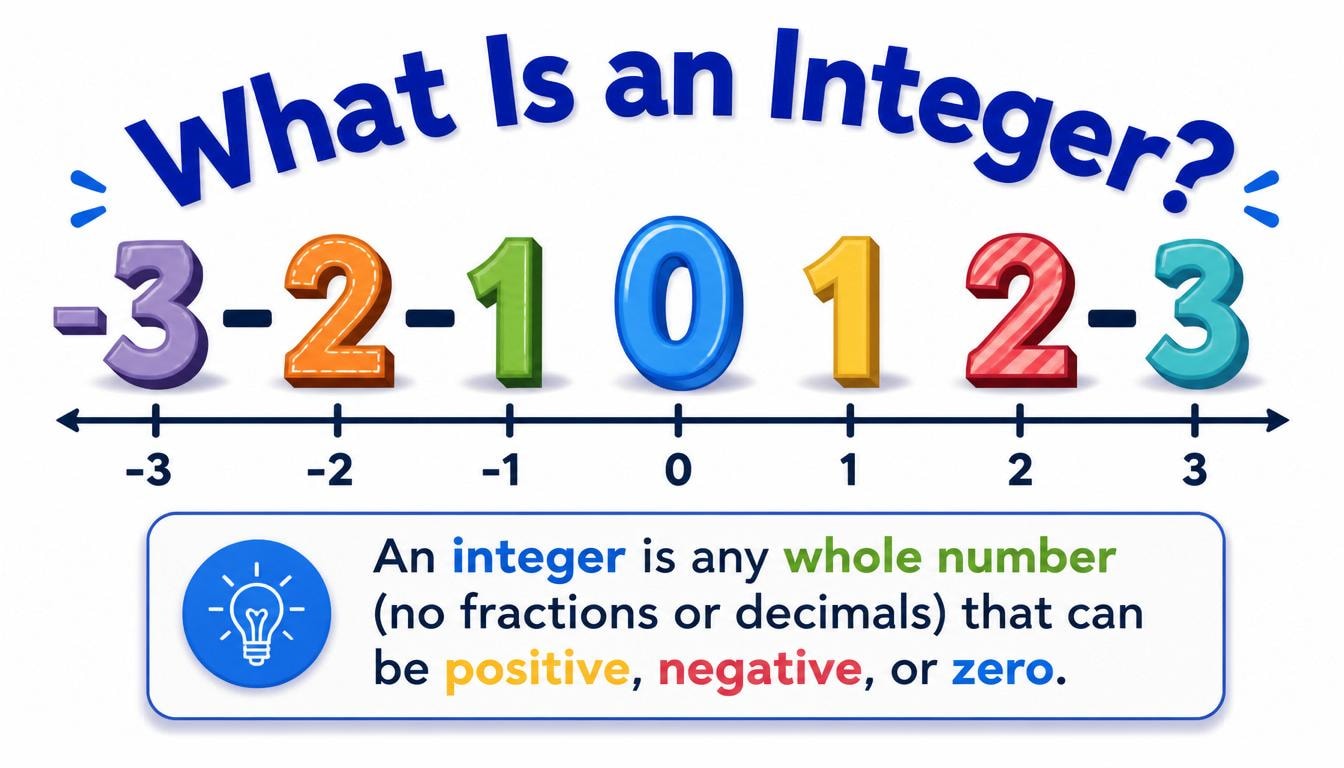
An integer is a whole number that can be positive, negative, or zero. In mathematics, the set of all integers is represented by the bold letter Z (which originates from the German word Zahlen, meaning "numbers"). Unlike fractions or decimals, integers do not contain fractional parts. For example, 5, -12, 0, and 987 are all integers, while 3.5, 1/2, and -0.75 are not.
We can categorize the set of integers into three distinct groups:
Positive Integers: These are the counting numbers greater than zero (1, 2, 3, 4, ...). They represent quantities that are gained, added, or positioned above a baseline.
Negative Integers: These are the opposites of the positive integers, located below zero (-1, -2, -3, -4, ...). They represent deficits, losses, or positions below a baseline.
Zero (0): Zero is a unique integer. It is neither positive nor negative; instead, it serves as the neutral origin or reference point from which all other integers are measured.
Integers in the Real World
Integers are not just abstract symbols written on a blackboard; they are deeply embedded in our daily lives. Whenever a situation involves direction, opposites, or a reference point, we use integers to model it. Let us explore some of the most common real-world contexts where integers are indispensable:
1. Temperature (Hot and Cold)
Thermometers rely entirely on the concept of integers. On the Celsius scale, 0°C represents the freezing point of water. Temperatures warmer than freezing are represented by positive integers (e.g., +25°C on a warm summer day), while temperatures colder than freezing are represented by negative integers (e.g., -10°C during a harsh winter night). Here, zero acts as a critical physical baseline.
2. Altitude and Depth (Elevation)
When measuring geographical features, sea level is designated as the absolute zero baseline. Mountains, cities, and flying aircraft are positioned at positive elevations above sea level (e.g., Mount Everest stands at approximately 8,848 meters). Conversely, trenches, submarine pathways, and underground caves are located at negative elevations below sea level (e.g., the Mariana Trench reaches depths of nearly -11,000 meters).
3. Finance (Debts, Assets, and Transactions)
In economics and personal finance, integers help keep track of the flow of money. Earnings, profits, and deposits are represented by positive integers, indicating an increase in wealth. On the other hand, debts, losses, expenses, and withdrawals are represented by negative integers. If you have 60, your balance drops to -$10, indicating you are in debt.
4. Elevators and Building Floors
In modern architecture, especially in buildings with underground parking garages, elevators utilize integers. The ground floor or lobby is usually designated as floor 0. Upper floors are represented by positive integers (1, 2, 3, ...), while underground basement levels are labeled with negative integers (-1, -2, -3, ...).
Key Insight: In all of these real-world examples, the presence of direction and a reference point (zero) is what makes integers necessary. Without negative integers, we would struggle to mathematically distinguish between climbing up a mountain and diving deep into the ocean.
Visualizing Integers: The Number Line
The most powerful visual tool for understanding integers is the number line. A number line can be drawn horizontally or vertically, providing a clear geometric representation of how integers relate to one another in terms of size and direction.
The Horizontal Number Line
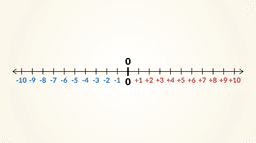
On a horizontal number line, zero is placed directly in the center. As you move to the right of zero, the numbers increase in value and are positive. As you move to the left of zero, the numbers decrease in value and are negative:
... ← -4 ← -3 ← -2 ← -1 ← 0 → +1 → +2 → +3 → +4 → ...
This visualization teaches us two fundamental rules of integers:
Any number to the right of another number is always larger. For example, 1 is larger than -3, and -2 is larger than -5.
The further a negative number is from zero to the left, the smaller its actual value is.
The Vertical Number Line
A vertical number line works exactly like a thermometer or an elevator panel. Zero is in the middle, positive integers extend upward, and negative integers extend downward. This is highly intuitive for physical contexts like height, depth, and temperature.
Expanding Beyond Integers: The Need for Rational Numbers
While integers allow us to solve many problems, they still have limitations. Let's look at an empty number line and pick two consecutive integers, such as 1 and 2. Is there any integer between them? The answer is no; integers are discrete steps. There is no "whole number" between 1 and 2.
Now, consider a simple algebraic equation:
2x = 1
If we restrict ourselves only to the set of integers, this equation has no solution. There is no integer that we can multiply by 2 to get 1. To solve this problem and describe quantities that fall between the whole steps of the number line, we must expand our number system once again. This brings us to the set of rational numbers.
A rational number is any number that can be expressed as a fraction of two integers, where the denominator is not zero. When we introduce rational numbers, we discover that they perfectly fill the spaces between our integers on the number line. For instance, the solution to 2x = 1 is x = 1/2 (or 0.5), which lies exactly halfway between the integers 0 and 1.
The Relationship Between Sets
It is important to understand that every integer is also a rational number. Why? Because any integer can be written as a fraction with a denominator of 1. For example, the integer 5 can be written as 5/1, and the integer -3 can be written as -3/1. Therefore, the set of integers is completely contained within the larger set of rational numbers.
The Concept of Absolute Value
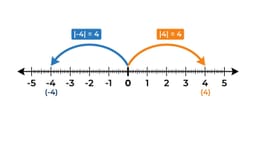
Another critical concept closely tied to integers is absolute value. In simple terms, the absolute value of a number is its distance from zero on the number line, regardless of direction. Because distance is always a physical measurement, absolute value is always positive or zero; it can never be negative.
Mathematically, we represent absolute value using vertical bars. For example:
The absolute value of 5 is written as |5| = 5.
The absolute value of -5 is written as |-5| = 5.
Both 5 and -5 are exactly 5 units away from zero on the number line, meaning they have the same absolute value despite pointing in opposite directions.
Real-World Applications of Absolute Value
Absolute value is incredibly useful when we care about the magnitude of a difference or distance, rather than the direction. Consider these scenarios:
Helicopter Rescue: Suppose a rescue helicopter is flying at an altitude of 300 meters above a hospital, and a submarine is navigating 300 meters below the hospital (at -300 meters). Both the helicopter and the submarine are at an equal distance of 300 meters from the hospital's ground level. Their physical distance is the absolute value of their positions: |300| = |-300| = 300.
Manufacturing Quality Control: Imagine a factory machine designed to package coffee into exactly 100-gram bags. If Machine A packages a bag at 102 grams (+2 grams error) and Machine B packages a bag at 97 grams (-3 grams error), we use absolute value to determine which machine is performing more accurately. The absolute error of Machine A is |+2| = 2 grams, and the absolute error of Machine B is |-3| = 3 grams. Since 2 is less than 3, Machine A is operating with less error.
Conclusion: Key Takeaways
Understanding integers is a major milestone in mathematical literacy. By moving beyond simple counting, we gain the tools necessary to describe opposites, balances, and physical dimensions accurately. Here are the core concepts to remember:
Integers consist of positive whole numbers, negative whole numbers, and zero.
Zero is the neutral reference point; it is neither positive nor negative.
The number line is a powerful tool to visualize integers, where values increase to the right (or upward) and decrease to the left (or downward).
When integers are insufficient to describe fractional parts, we expand our system to rational numbers. Every integer is a subset of the rational numbers.
Absolute value measures a number's distance from zero, representing magnitude without regard to direction, and is always non-negative.