Natural numbers are the absolute foundation of mathematics. From the moment we learn to count our first toys to the complex calculations used in modern computer science, natural numbers guide our understanding of the physical world. But what exactly are these numbers, and what mathematical rules govern how they behave? In this comprehensive guide, we will explore the fundamental properties of natural numbers, their scientific definition, and how they form the bedrock of arithmetic.
What Are Natural Numbers?
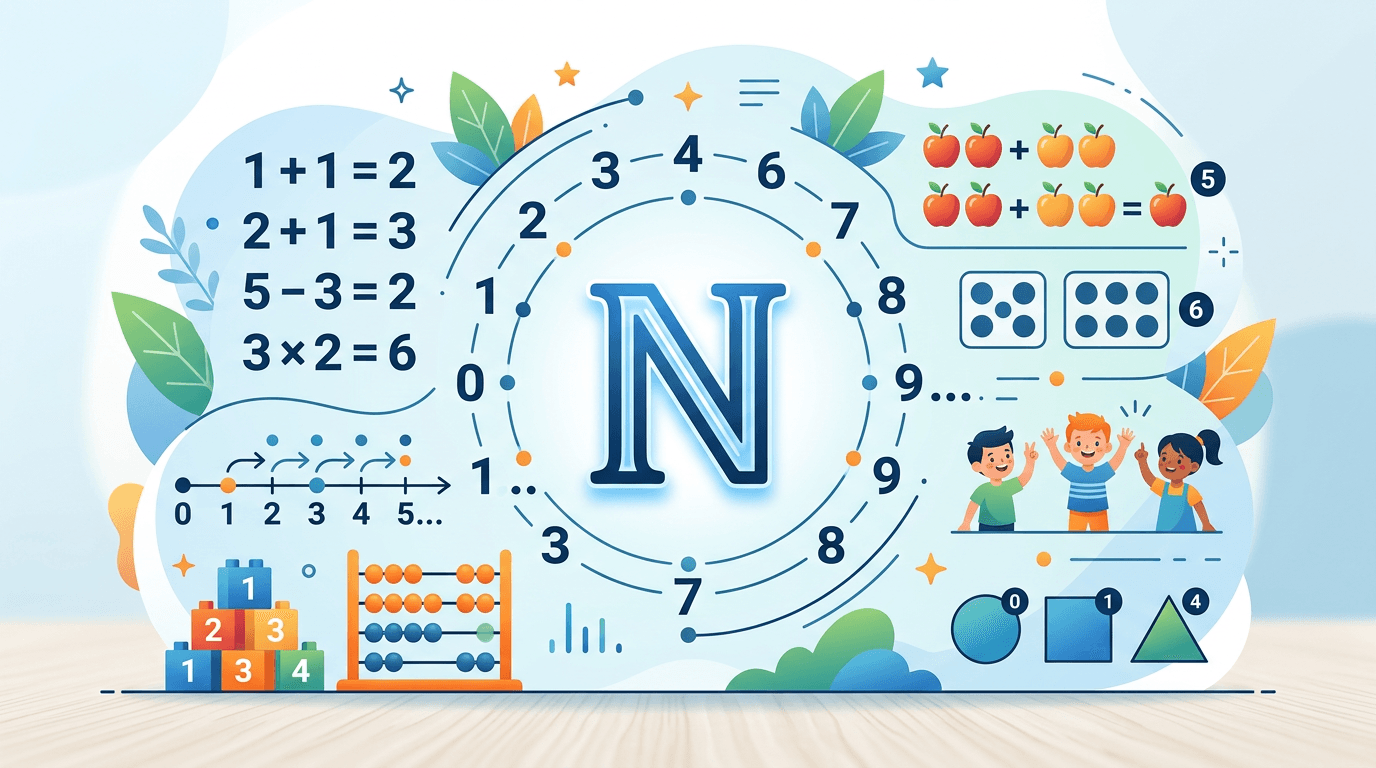
Broadly speaking, natural numbers are the positive integers we use for counting and ordering. In mathematical notation, the set of natural numbers is represented by the symbol N. There are two primary conventions regarding where natural numbers begin:
Counting Numbers: The set starting from 1: {1, 2, 3, 4, 5, ...}
Whole Numbers (Set Theory): The set including zero, starting from 0: {0, 1, 2, 3, 4, ...}
For the purposes of general arithmetic and school curricula, natural numbers are most commonly defined as the positive integers starting from 1. Historically, these numbers arose naturally in human civilizations to count physical objects like sheep, crops, or days.
The Peano Axioms: The Scientific Foundation
In the late 19th century, the Italian mathematician Giuseppe Peano formulated a set of logical rules, known as the Peano Axioms, to rigorously define natural numbers. These axioms establish that:
1 is a natural number.
Every natural number has a unique successor (the next number, which is also a natural number).
1 is not the successor of any natural number.
Different natural numbers have different successors.
If a property holds for 1, and holds for the successor of any number for which it holds, then it holds for all natural numbers (the principle of mathematical induction).
These simple logical rules guarantee that the sequence of natural numbers is infinite, ordered, and continuous.
The Fundamental Properties of Natural Numbers
When we perform arithmetic operations—addition, subtraction, multiplication, and division—on natural numbers, they behave according to specific mathematical laws. Let's examine these core properties in detail.
1. The Closure Property
The closure property states that if you perform an operation on any two natural numbers, the result will also be a natural number.
Closure under Addition: If a and b are natural numbers, then a + b is always a natural number. For example, 5 + 3 = 8 (8 is a natural number).
Closure under Multiplication: If a and b are natural numbers, then a × b is always a natural number. For example, 4 × 6 = 24 (24 is a natural number).
Important Note: Natural numbers are not closed under subtraction or division. For example, 3 - 5 = -2 (not a natural number), and 2 ÷ 5 = 0.4 (not a natural number). This limitation is what historically forced mathematicians to expand the number system to include integers and rational numbers.
2. The Commutative Property
The word "commutative" comes from "commute," meaning to move around. This property states that changing the order of the numbers does not change the final result.
Commutative Property of Addition: For any natural numbers a and b, a + b = b + a.
Example: 12 + 8 = 20, and 8 + 12 = 20.Commutative Property of Multiplication: For any natural numbers a and b, a × b = b × a.
Example: 7 × 5 = 35, and 5 × 7 = 35.
Just like closure, this property does not apply to subtraction (10 - 4 is not equal to 4 - 10) or division (12 ÷ 3 is not equal to 3 ÷ 12).
3. The Associative Property
The associative property deals with how numbers are grouped using parentheses. It states that when performing addition or multiplication on three or more natural numbers, the grouping of the numbers does not affect the final outcome.
Associative Property of Addition: For any natural numbers a, b, and c, (a + b) + c = a + (b + c).
Example: (2 + 3) + 4 = 5 + 4 = 9, and 2 + (3 + 4) = 2 + 7 = 9.Associative Property of Multiplication: For any natural numbers a, b, and c, (a × b) × c = a × (b × c).
Example: (2 × 3) × 4 = 6 × 4 = 24, and 2 × (3 × 4) = 2 × 12 = 24.
4. The Distributive Property
The distributive property links addition and multiplication together. It states that multiplying a sum by a number gives the same result as multiplying each addend individually by the number and then adding them together.
Formally: a × (b + c) = (a × b) + (a × c)
Let's look at an example to see how this works:
Suppose we have: 3 × (4 + 5)
Using standard order of operations: 3 × 9 = 27
Using the distributive property: (3 × 4) + (3 × 5) = 12 + 15 = 27
This property is incredibly useful in algebra for simplifying complex equations and expanding expressions.
5. Identity Properties
An identity element is a number that, when combined with another number under a specific operation, leaves that number unchanged.
Multiplicative Identity: The number 1 is the multiplicative identity for natural numbers. For any natural number a, a × 1 = a.
Example: 99 × 1 = 99.Additive Identity (If 0 is included): If the set of natural numbers is defined to include 0, then 0 is the additive identity because a + 0 = a. If the set starts at 1, there is no additive identity within the set.
Order Properties of Natural Numbers
Beyond basic arithmetic operations, natural numbers have structural properties related to their order on the number line.
The Law of Trichotomy
For any two natural numbers a and b, exactly one of the following relationships must be true:
a < b (a is less than b)
a = b (a is equal to b)
a > b (a is greater than b)
This property guarantees that natural numbers can always be arranged in a strict, linear order.
The Well-Ordering Principle
The Well-Ordering Principle is a fundamental axiom of arithmetic. It states that every non-empty subset of natural numbers contains a least (smallest) element.
For example, if you take any random group of natural numbers, such as {42, 17, 89, 5, 23}, there will always be a single, clearly defined smallest number (in this case, 5). While this seems obvious, it does not hold true for other number systems like negative integers, rational numbers, or real numbers (for instance, there is no "smallest" positive rational number).
Summary of Key Takeaways
Understanding the properties of natural numbers is essential for advancing in mathematics. Here is a quick reference summary:
Closure: True for addition and multiplication; false for subtraction and division.
Commutative: True for addition (a+b = b+a) and multiplication (a×b = b×a).
Associative: True for addition and multiplication when grouping three or more numbers.
Distributive: Multiplication distributes over addition: a(b+c) = ab + ac.
Identity: 1 is the multiplicative identity.
Well-Ordering: Every non-empty set of natural numbers has a unique smallest member.
By mastering these properties, students and math enthusiasts gain a deeper appreciation of how numbers interact, paving the way for algebraic reasoning, number theory, and scientific problem-solving.