Introduction to Division of Natural Numbers
Division is one of the four fundamental arithmetic operations, alongside addition, subtraction, and multiplication. At its core, dividing natural numbers is the process of splitting a whole quantity into equal parts or determining how many times one number is contained within another. Whether you are distributing assets, sharing food among friends, or calculating scientific rates, division is an indispensable tool in both daily life and rigorous scientific analysis.
Natural numbers are the positive integers we use for counting (1, 2, 3, 4, and so on). In some mathematical contexts, zero is also included in this set. Understanding how to divide these numbers is the gateway to more advanced mathematical concepts, including fractions, decimals, ratios, and algebra. This comprehensive guide will explore the physical meaning, mathematical rules, and step-by-step methods for dividing natural numbers.
The Anatomy of Division: Key Terms
Before diving into the calculations, it is essential to understand the vocabulary of division. Every division problem consists of four main components:
Dividend: The total quantity or number that you want to divide or split up.
Divisor: The number of equal groups you are creating, or the size of each group. It is the number you are dividing by.
Quotient: The primary result of the division. It represents how many items are in each group, or how many times the divisor fits into the dividend.
Remainder: The amount left over when the dividend cannot be divided equally by the divisor. In the set of natural numbers, the remainder is always a whole number strictly less than the divisor.
The Division Identity: We can express the relationship between these terms using the following formula:
Dividend = (Divisor × Quotient) + Remainder
Conceptual Models of Division
To truly understand division, it helps to visualize it physically. Mathematicians categorize division into two distinct conceptual models: partitive division and quotitive division.
1. Partitive Division (Fair Sharing)
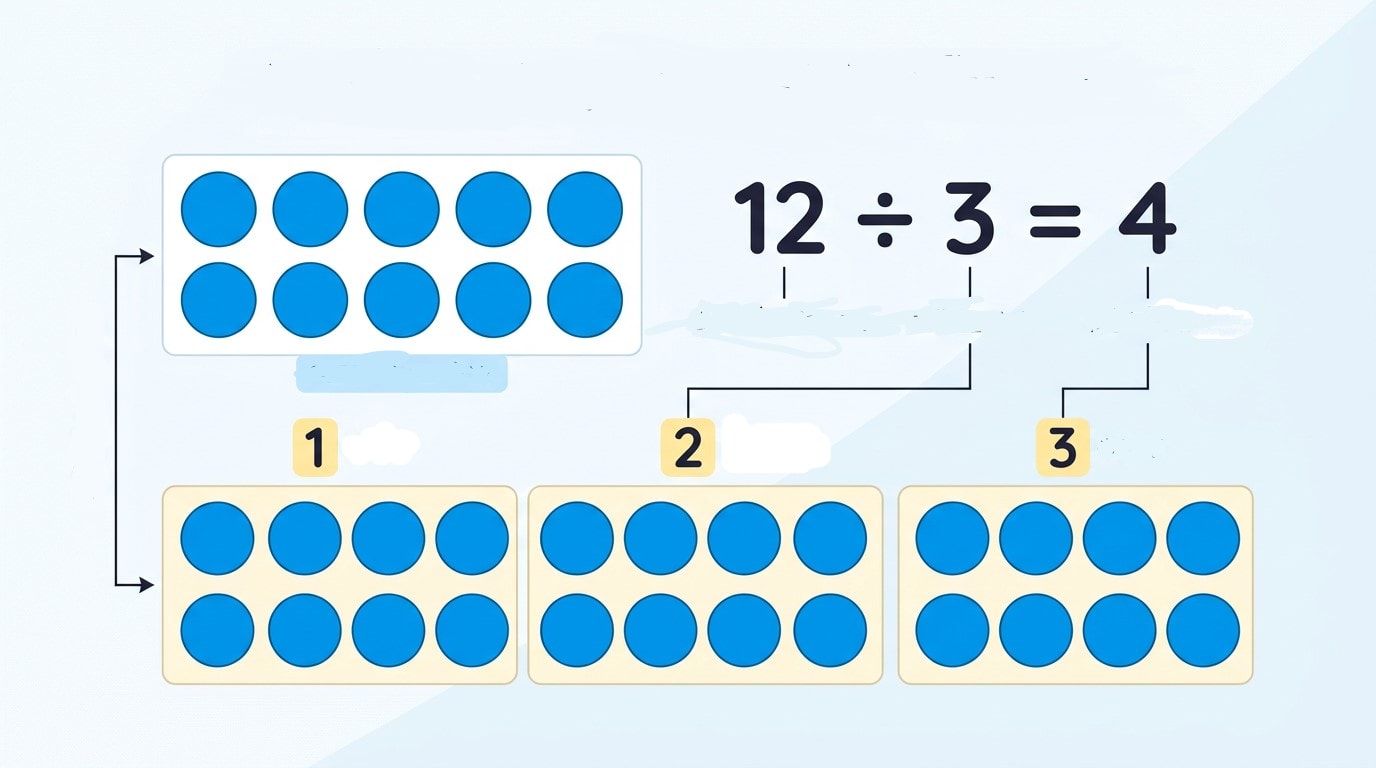
In partitive division, you know the total number of items (the dividend) and the number of groups you want to create (the divisor). Your goal is to find out how many items go into each group (the quotient).
Example: You have 12 apples and want to distribute them equally among 3 children. Here, 12 is the dividend and 3 is the divisor. By distributing them one by one, you find that each child receives 4 apples. Thus, 4 is the quotient.
2. Quotitive Division (Measurement or Grouping)
In quotitive division, you know the total number of items (the dividend) and the size of each group (the divisor). Your goal is to find out how many such groups you can make (the quotient).
Example: You have 12 apples, and you want to pack them into bags where each bag holds exactly 4 apples. Here, 12 is the dividend and 4 is the divisor. By grouping them, you find you can fill exactly 3 bags. Thus, 3 is the quotient.
The Standard Long Division Algorithm
When dealing with larger natural numbers, mental math is often insufficient. The standard long division algorithm is a highly reliable, step-by-step process used to solve complex division problems. It relies on four simple steps repeated in a cycle: Divide, Multiply, Subtract, and Bring Down (DMSB).
Step-by-Step Example: Divide 745 by 3
Let us walk through the division of 745 (dividend) by 3 (divisor) using the long division algorithm:
Step 1: Divide
Look at the first digit of the dividend (7). How many times does 3 go into 7? It goes 2 times. Write "2" above the 7 in the quotient space.Step 2: Multiply
Multiply the quotient digit (2) by the divisor (3). 2 × 3 = 6. Write "6" directly under the 7.Step 3: Subtract
Subtract 6 from 7. 7 - 6 = 1. Write "1" below the line.Step 4: Bring Down
Bring down the next digit of the dividend, which is 4. Your new temporary number is 14.Repeat the Cycle (Divide)
How many times does 3 go into 14? It goes 4 times (since 3 × 4 = 12). Write "4" in the quotient space next to the 2.Repeat (Multiply)
Multiply 4 by 3. 4 × 3 = 12. Write "12" under the 14.Repeat (Subtract)
Subtract 12 from 14. 14 - 12 = 2. Write "2" below the line.Repeat (Bring Down)
Bring down the final digit of the dividend, which is 5. Your new temporary number is 25.Final Cycle (Divide)
How many times does 3 go into 25? It goes 8 times (since 3 × 8 = 24). Write "8" in the quotient space.Final Cycle (Multiply & Subtract)
Multiply 8 by 3 to get 24. Subtract 24 from 25 to get 1.
Since there are no more digits to bring down, the division is complete. The quotient is 248 and the remainder is 1.
We can verify this using our division identity: 745 = (3 × 248) + 1. Since 3 × 248 = 744, and 744 + 1 = 745, our calculation is mathematically correct.
Important Rules and Properties of Division
Division behaves differently from addition and multiplication. Here are the essential mathematical properties of division you must keep in mind:
1. Division by Zero is Undefined
In mathematics, you cannot divide any natural number by zero. If you try to divide 5 by 0, you are asking, "How many groups of zero do I need to make 5?" No matter how many zeros you add together, you will never reach 5. Therefore, division by zero has no logical solution and is strictly undefined.
2. Division by One
Any natural number divided by 1 yields the original number itself. For any natural number 'a', a ÷ 1 = a. This is because splitting a quantity into one single group leaves the quantity completely intact.
3. Division of a Number by Itself
Any non-zero natural number divided by itself equals 1. For any natural number 'a' (where 'a' is not 0), a ÷ a = 1. Physically, if you have 'a' items and share them among 'a' people, each person gets exactly 1 item.
4. Division is Non-Commutative
Unlike addition (2 + 3 = 3 + 2) and multiplication (4 × 5 = 5 × 4), order matters in division. For example, 8 ÷ 4 is equal to 2, but 4 ÷ 8 does not equal 2. Therefore, a ÷ b is not equal to b ÷ a.
Conclusion
Dividing natural numbers is a systematic process of sharing, grouping, and partitioning. By mastering the terms (dividend, divisor, quotient, and remainder) and practicing the step-by-step long division algorithm, you can solve any division problem with ease. Keep practicing with different numbers, verify your answers using multiplication, and remember the unique rules of division to build a solid mathematical foundation!