Imagine you are standing on the ground floor of a modern shopping mall. You step into the elevator, intending to go to the parking garage below. You press the button labeled '-2'. As the elevator descends, you are transitioning from the familiar world of positive counting numbers into the fascinating realm of negative numbers. But what exactly are negative integers, and why do we need them?
For centuries, early human civilizations got by using only natural numbers (1, 2, 3...) to count their livestock, crops, and possessions. However, as trade, science, and mathematics evolved, humanity realized that counting forwards was only half the story. We needed a way to represent deficits, opposite directions, and values below a designated starting point. This realization birthed the concept of negative integers.
1. Defining Negative Integers
To understand negative integers, we must first look at the broader family of numbers. The set of integers, denoted by the symbol Z (from the German word Zahlen, meaning 'numbers'), consists of three main parts:
Positive Integers: The counting numbers greater than zero {1, 2, 3, 4, ...}.
Zero (0): The neutral origin that is neither positive nor negative.
Negative Integers: The opposites of the positive integers, located to the left of zero on a horizontal number line {-1, -2, -3, -4, ...}.
A negative integer is defined mathematically as a real number that is less than zero. They are always written with a minus sign (-) preceding the numeral. This minus sign serves a dual purpose: it acts as an operator for subtraction and as a signifier of direction, indicating that the value is below the neutral baseline of zero.
2. Real-World Contexts: Why Negative Integers Matter
Abstract math concepts can sometimes feel disconnected from reality. However, negative integers are deeply embedded in our daily lives. Here are some of the most common physical and scientific contexts where negative integers are indispensable:
A. Temperature Scales
When you watch the winter weather forecast, you might hear that the temperature in Alaska has dropped to -15 degrees Celsius. In this context, 0°C is not the absence of temperature; it is simply the freezing point of water. Any temperature colder than this freezing point is represented using negative integers. Scientists also study 'absolute zero' (-273.15°C or 0 Kelvin), which is the theoretical limit where all molecular motion stops. Understanding temperatures below zero is crucial for thermodynamics, meteorology, and daily survival in cold climates.
B. Elevation and Depth
Geographers use sea level as the baseline of zero elevation. High mountain peaks, like Mount Everest, have positive elevations (e.g., +8,848 meters). Conversely, deep ocean trenches or land areas below sea level are represented with negative integers. For instance, the shore of the Dead Sea lies at approximately -430 meters. This clear distinction of positive for height and negative for depth makes mapping and geological studies highly intuitive.
C. Finance: Debt, Income, and Expenses
In economics and personal finance, negative integers represent money owed or spent. If you have 70, your balance becomes -20. Income is represented by positive values, while expenses, losses, and liabilities are represented by negative values.
D. Time and Baselines
In history, we use BCE (Before Common Era) and CE (Common Era) to organize timelines. If we treat the transition year as zero, historical events before that year can be conceptualized as negative points on a timeline. Similarly, during space rocket launches, mission control uses a countdown: 'T-minus 10 seconds' represents -10 seconds before the ignition (which is time zero).
3. Visualizing Negative Integers
To build a strong mental model of negative integers, mathematicians rely on two primary visual aids: the number line and integer chips.
The Number Line (Horizontal and Vertical)
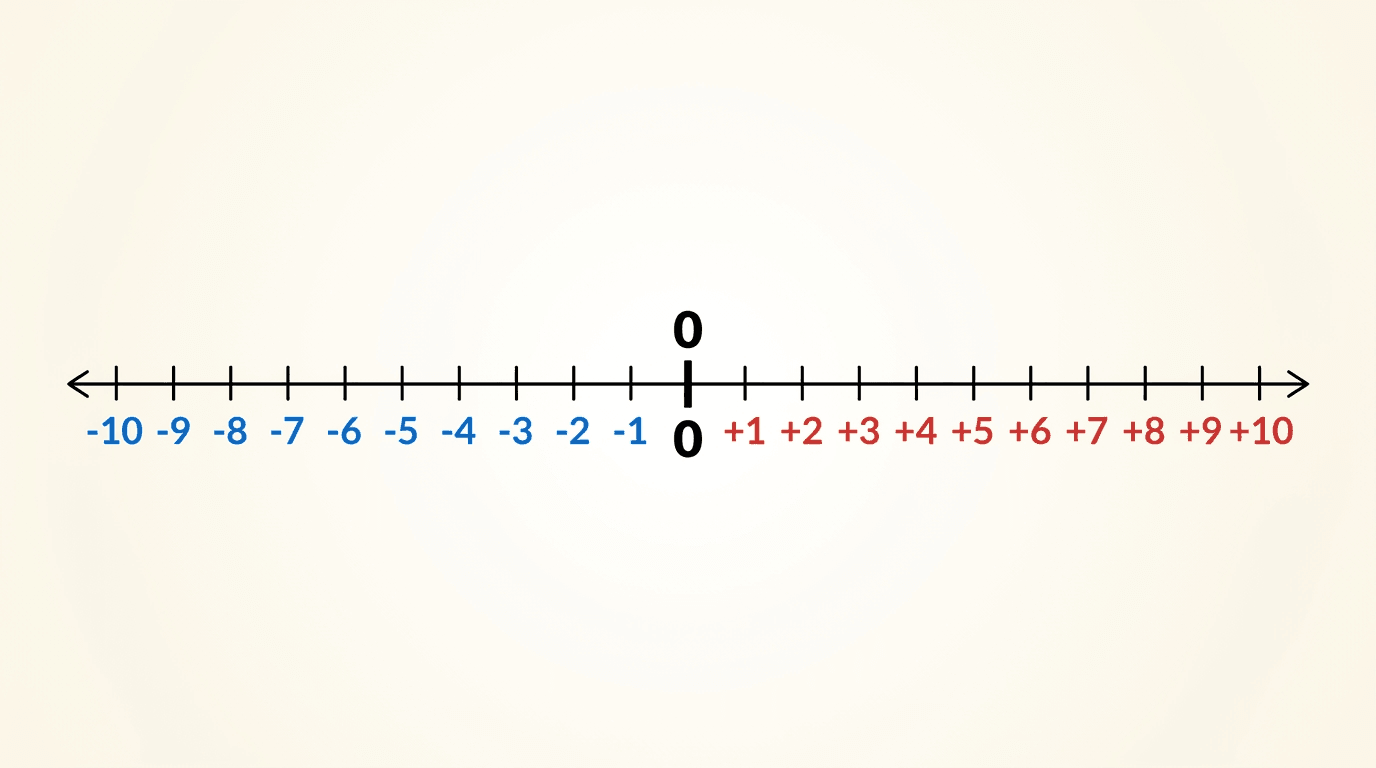
The number line is the ultimate tool for understanding the relationship between numbers. On a horizontal number line:
Zero sits right in the center, acting as the origin or 'mirror.'
Positive integers extend infinitely to the right.
Negative integers extend infinitely to the left.
As you move from left to right on the number line, the values always increase. This means that -1 is actually greater than -5, because -1 is further to the right (closer to zero and positive territory). A vertical number line works similarly, with positive integers going up (like climbing a ladder) and negative integers going down (like diving underwater).
Key Insight: The negative sign indicates direction, while the numeral represents magnitude. Therefore, -100 is a 'larger' negative value in terms of magnitude, but it represents a 'smaller' value algebraically than -1.
Integer Chips
Another hands-on way to conceptualize integers is through integer chips or counters. Typically, red chips represent negative units (-1) and yellow chips represent positive units (+1). When a positive chip and a negative chip are paired together, they neutralize each other, creating what mathematicians call a 'zero pair' (+1 + -1 = 0). This model is highly effective for learning how to add, subtract, multiply, and divide signed numbers.
4. Expanding the Horizon: From Integers to Rational Numbers
Once we master integers, a natural mathematical question arises: What lies between these whole numbers? If you look at the space between 0 and 1, or between -1 and -2, you will find infinitely many numbers that cannot be written as whole integers.
Consider the simple algebraic equation: 2x = -1. If we only had integers, this equation would have no solution, because there is no whole integer that you can multiply by 2 to get -1. To solve this, we must expand our number system to include rational numbers.
A rational number is any number that can be expressed as the quotient or fraction a/b of two integers, where the numerator a is an integer and the denominator b is a non-zero integer. Just like integers, rational numbers can be negative. For example, -0.5 (or -1/2) is a negative rational number that lies exactly halfway between 0 and -1 on the number line.
By understanding that integers are just a subset of rational numbers (since any integer n can be written as n/1), students can seamlessly map any fractional or decimal value onto the number line, recognizing that every single rational number corresponds to an exact, unique point on that line.
5. The Concept of Absolute Value
When dealing with negative integers, we often need to talk about their 'size' or distance without worrying about their direction. This is where absolute value comes into play.
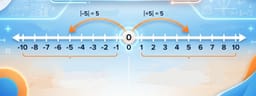
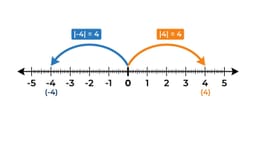
The absolute value of a number is its distance from zero on the number line, regardless of direction. Because distance is always physical and positive (or zero), the absolute value of any number is always non-negative. We represent absolute value using vertical bars: |-5| = 5 and |5| = 5.
Real-Life Applications of Absolute Value
Why do we need absolute value? Consider these practical scenarios:
Tracking Distance: If a rescue helicopter is flying 3 kilometers east of a hospital (+3) and an ambulance is driving 3 kilometers west of the hospital (-3), both are exactly 3 kilometers away from the hospital. Their direction is opposite, but their absolute distance is the same: |+3| = |-3| = 3.
Manufacturing and Quality Control: Imagine a factory machine that packages coffee into 100-gram bags. If Machine A packages a bag at 101 grams (+1 gram error) and Machine B packages a bag at 98 grams (-2 grams error), we use absolute value to measure the magnitude of the error. Machine A has an absolute error of |+1| = 1 gram, while Machine B has an absolute error of |-2| = 2 grams. Machine A is performing with less error, even though Machine B's raw error value is negative.
Estimation Errors: When students estimate the weight of objects in class, the error is calculated as the absolute difference between the estimate and the actual weight. Whether you overestimate or underestimate, the error is always discussed as a positive quantity of units missed.
6. Key Takeaways and Summary
Negative integers are not just abstract mathematical inventions; they are essential tools that allow us to describe our world accurately. Here is a summary of what we have explored:
Definition: Negative integers are whole numbers less than zero, representing opposites, deficits, or downward directions.
Real-World Utility: They are used daily in tracking temperatures below freezing, measuring ocean depths, managing financial debts, and recording time countdowns.
Visualization: They exist to the left of zero on horizontal number lines and below zero on vertical number lines.
Expansion: Integers can be expanded into negative rational numbers (fractions and decimals) to fill the gaps between whole values.
Absolute Value: Absolute value measures a number's distance from zero, stripping away its negative sign to focus solely on magnitude.
By mastering negative integers and understanding how they fit into the broader spectrum of rational numbers, you unlock the door to higher-level mathematics, physics, and financial literacy. The next time you step into a basement elevator or check a freezing weather forecast, you'll know exactly how these powerful numbers keep our world in perfect balance!