In mathematics, numbers tell us two crucial pieces of information: how much (magnitude) and which way (direction). However, there are many real-world scenarios where the direction is completely irrelevant. For instance, if you ask someone how far they walked today, they might say "5 kilometers." They rarely specify whether they walked 5 kilometers north, south, east, or west. In this context, only the distance matters.
This fundamental concept of measuring "distance without direction" is the core of absolute value. When applied to integers, absolute value provides a mathematical tool to strip away the positive or negative sign of a number, leaving only its pure magnitude. In this comprehensive guide, we will explore the definition, physical meaning, algebraic properties, and real-world applications of absolute value in integers.
The Geometric Concept: Distance on a Number Line
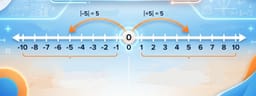
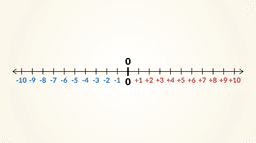
To understand absolute value, the most effective tool is the visual representation of integers on a number line. Let us set up a standard horizontal number line where the integer 0 acts as our starting point, or the origin. Positive integers lie to the right of zero, while negative integers lie to the left.
By definition, the absolute value of an integer is its distance from zero on the number line. Because distance is a physical measurement, it can never be negative. You cannot walk a distance of -3 meters; whether you walk forward or backward, you are still covering a positive physical distance of 3 meters.
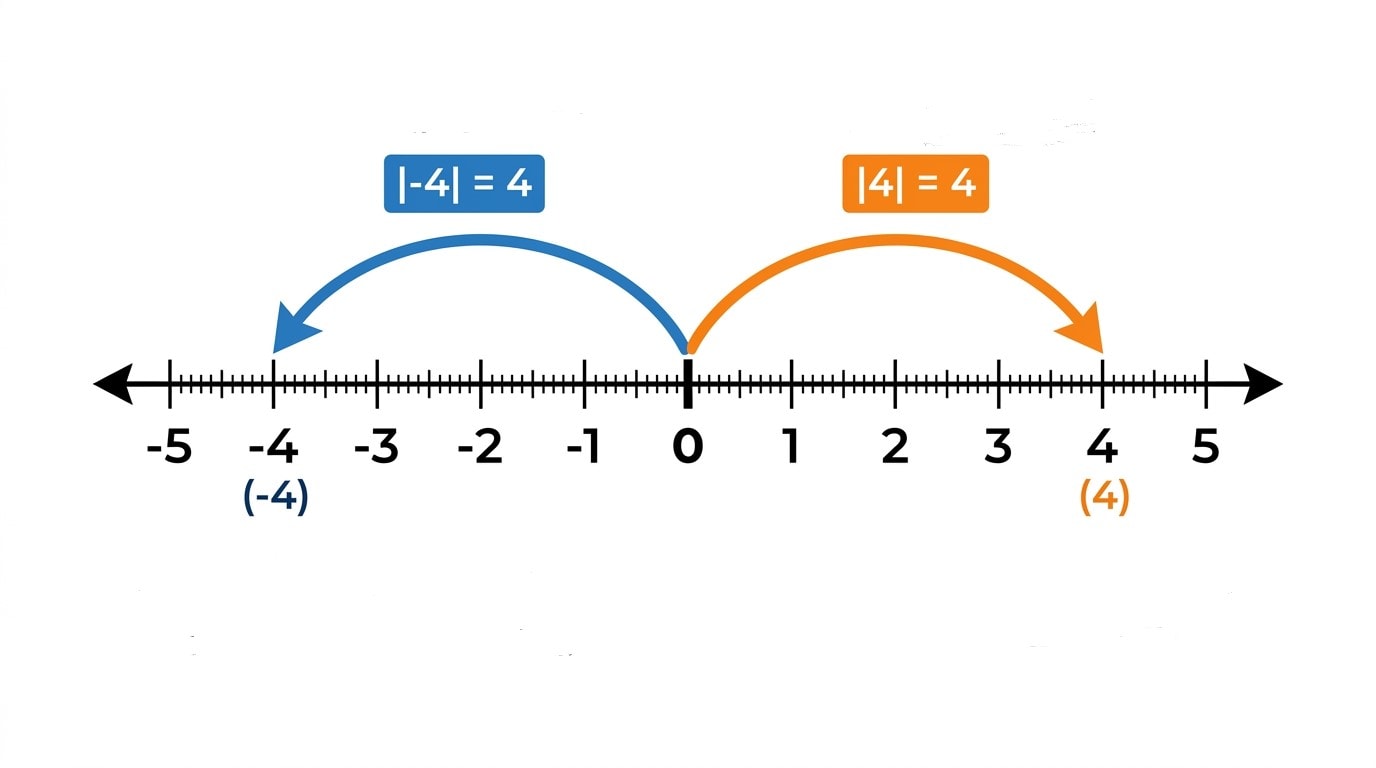
Let us look at two specific integers on our number line: 4 and -4.
To reach 4 from 0, you must move 4 units to the right. The distance is 4.
To reach -4 from 0, you must move 4 units to the left. The distance is also 4.
Even though 4 and -4 point in opposite directions, they are exactly the same distance away from the origin. Therefore, their absolute values are identical.
Mathematical Notation and Definition
In mathematics, we represent the absolute value of a number by enclosing it within two vertical bars. For any integer represented by the variable x, its absolute value is written as |x|.
Using this notation, we can express our previous number line example mathematically:
|4| = 4 (read as "the absolute value of 4 is 4")
|-4| = 4 (read as "the absolute value of -4 is 4")
|0| = 0 (since zero is exactly 0 units away from itself)
The Piecewise Algebraic Definition
While the geometric definition is intuitive, algebra requires a precise symbolic definition. We define the absolute value of an integer x using a piecewise function:
|x| = x, if x is greater than or equal to 0
|x| = -x, if x is less than 0
At first glance, the second part of this definition can be confusing. Students often ask, "If absolute value is always positive, why is there a negative sign in front of the x?"
Let us demystify this with an example. Suppose x is a negative integer, such as -7. Since -7 is less than 0, we must apply the second rule: |x| = -x. Substituting -7 into the formula gives us:
|-7| = -(-7)
In mathematics, the negative of a negative integer is positive. Therefore, -(-7) becomes 7. The algebraic definition is simply a formal way of saying: "If the number is already positive or zero, leave it alone. If the number is negative, multiply it by -1 to make it positive."
Real-World Applications of Absolute Value
Absolute value is not just an abstract mathematical trick; it is deeply embedded in physical sciences, engineering, and daily life. Let us look at several key scenarios where absolute value is essential.
1. Altitude and Depth
In geography and aviation, sea level is designated as the baseline zero. Elevations above sea level are represented by positive integers, while depths below sea level are represented by negative integers.
Imagine a helicopter hovering at +150 meters directly above a submarine cruising at -150 meters. If we want to know how far each vehicle is from the surface of the ocean, we use absolute value:
Helicopter's distance from sea level: |+150| = 150 meters
Submarine's distance from sea level: |-150| = 150 meters
Both vehicles are at an equal absolute distance of 150 meters from the ocean's surface, despite being in completely opposite environments.
2. Quality Control and Error Margins
In manufacturing, precision is everything. Suppose a factory machine is programmed to package exactly 100 grams of coffee into each bag. Because no physical process is perfect, some bags will weigh slightly more, and others will weigh slightly less.
Let us evaluate two bags of coffee:
Bag A contains 102 grams of coffee. The error is +2 grams.
Bag B contains 98 grams of coffee. The error is -2 grams.
To determine which machine is performing better, a quality control engineer is interested in the size of the error, not its direction. By taking the absolute value of the errors, the engineer sees that both bags deviate from the target weight by exactly 2 grams:
|+2| = 2 and |-2| = 2
This allows the factory to calculate the average absolute deviation to monitor and calibrate their machinery effectively.
3. Temperature Deviations
In chemistry and meteorology, absolute value helps us analyze temperature differences. Consider a laboratory experiment that must be conducted at exactly 0 degrees Celsius. If the temperature fluctuates to +5 degrees Celsius or drops to -5 degrees Celsius, the absolute deviation from the required baseline is 5 degrees in both directions. Understanding these absolute limits is critical for maintaining experimental integrity.
4. Physics: Speed vs. Velocity
In physics, there is a distinct difference between speed and velocity. Velocity is a vector quantity, meaning it has both magnitude and direction. If a car moves forward at 25 meters per second, its velocity is +25 m/s. If it reverses at the same rate, its velocity is -25 m/s.
Speed, on the other hand, is a scalar quantity that only measures how fast the object is moving, regardless of direction. Speed is defined as the absolute value of velocity:
Speed = |Velocity|
Therefore, whether the car is moving forward or backward, its speed is |25| = |-25| = 25 m/s.
Fundamental Properties of Absolute Value
To work effectively with absolute value in algebraic equations, you must understand its core mathematical properties. Here are the most important rules governing absolute value for any integers a and b:
Non-negativity: |a| ≥ 0. The absolute value of any integer is always greater than or equal to zero. It can never be negative.
Identity: |a| = 0 if and only if a = 0. The only number whose absolute value is zero is zero itself.
Symmetry: |-a| = |a|. Opposite numbers have the same absolute value because they are equidistant from zero.
Multiplicativity: |a * b| = |a| * |b|. The absolute value of a product is equal to the product of the absolute values. For example, |(-3) * 4| = |-12| = 12, which is the same as |-3| * |4| = 3 * 4 = 12.
Triangle Inequality: |a + b| ≤ |a| + |b|. The absolute value of the sum of two integers is always less than or equal to the sum of their individual absolute values. Let us test this with an example:
Let a = 5 and b = -3.
Left side: |a + b| = |5 + (-3)| = |2| = 2
Right side: |a| + |b| = |5| + |-3| = 5 + 3 = 8
Since 2 ≤ 8, the triangle inequality holds true!
Common Pitfalls and Mistakes to Avoid
Even though absolute value is a simple concept, students frequently fall into common traps. Recognizing these pitfalls early will save you from making algebraic errors in the future.
The "Variable Sign" Trap
A very common misconception is thinking that |-x| must always equal x. This is only true if x is a positive number. If x is negative, then |-x| = -x.
For example, let x = -5. Then:
|-x| = |-(-5)| = |5| = 5
If we had blindly written "|-x| = x", our answer would have been -5, which is incorrect because an absolute value cannot be negative. Always treat variables with caution!
Treating Absolute Value Bars as Parentheses
Absolute value bars do act as grouping symbols, meaning you must perform operations inside them first. However, they do not behave like standard parentheses when it comes to signs.
Consider the expression: |3 - 8|
Correct Method: Simplify inside the bars first. 3 - 8 = -5. Now take the absolute value: |-5| = 5.
Incorrect Method: Distributing the absolute value. Thinking |3 - 8| is the same as |3| - |8| = 3 - 8 = -5. This is incorrect!
Key Takeaways
As you continue your mathematical journey, keep these foundational points in mind:
Absolute value represents the distance of a number from zero on a number line.
Because it measures physical distance, absolute value is always non-negative (positive or zero).
The mathematical symbol for absolute value consists of two vertical bars: |x|.
Opposite integers, such as -10 and +10, have the exact same absolute value of 10.
Absolute value is widely used in science, manufacturing, and physics to calculate deviations, errors, altitudes, and speeds.
By mastering absolute value with integers, you build a solid bridge toward algebra, coordinate geometry, and real-world scientific analysis. Next time you look at a negative number, remember: its sign is just its direction, but its absolute value is its true strength!