When we first learn to count as children, we begin with a simple sequence: one, two, three, four, and so on. Without realizing it, we are taking our very first steps into the vast and elegant world of mathematics using positive integers. These numbers are the bedrock of arithmetic, algebra, and number theory. But what exactly are positive integers, how do they behave, and why are they so fundamental to both advanced mathematics and our daily lives?
In this comprehensive guide, we will explore the definition of positive integers, their mathematical properties, how they are represented on the number line, their real-world applications, and how they connect to other number systems like whole numbers, negative integers, and rational numbers.
Defining Positive Integers
In mathematics, an integer is a whole number that can be positive, negative, or zero. Therefore, positive integers are the subset of integers that are strictly greater than zero. They represent whole, undivided units and do not contain any fractional or decimal parts.
The set of positive integers is infinite, starting at 1 and continuing indefinitely:
{1, 2, 3, 4, 5, 6, 7, ...}
Mathematical Notation
Mathematicians use specific symbols to represent different sets of numbers. The set of all integers is denoted by the bold letter Z (which comes from the German word Zahlen, meaning 'numbers'). To specify only the positive integers, we use a superscript plus sign:
Z⁺ = {1, 2, 3, 4, ...}
Positive Integers vs. Natural Numbers
There is often confusion between positive integers and natural numbers (denoted by N). In many mathematical contexts, natural numbers are defined exactly the same as positive integers: the counting numbers starting from 1. However, in some fields of mathematics (such as set theory and computer science), zero is included in the set of natural numbers. To avoid ambiguity:
Positive Integers (Z⁺): Always starts at 1. Zero is strictly excluded.
Natural Numbers (N): May or may not include 0, depending on the author's definition.
Whole Numbers: Typically defined as the set of non-negative integers, which explicitly includes zero {0, 1, 2, 3, ...}.
Visualizing Positive Integers on the Number Line
One of the most powerful tools for understanding numbers is the number line. A number line is a straight line where every point corresponds to a real number. It provides a visual representation of order, distance, and direction.
The Horizontal Number Line
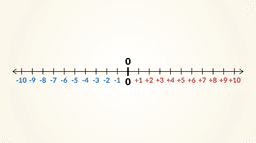
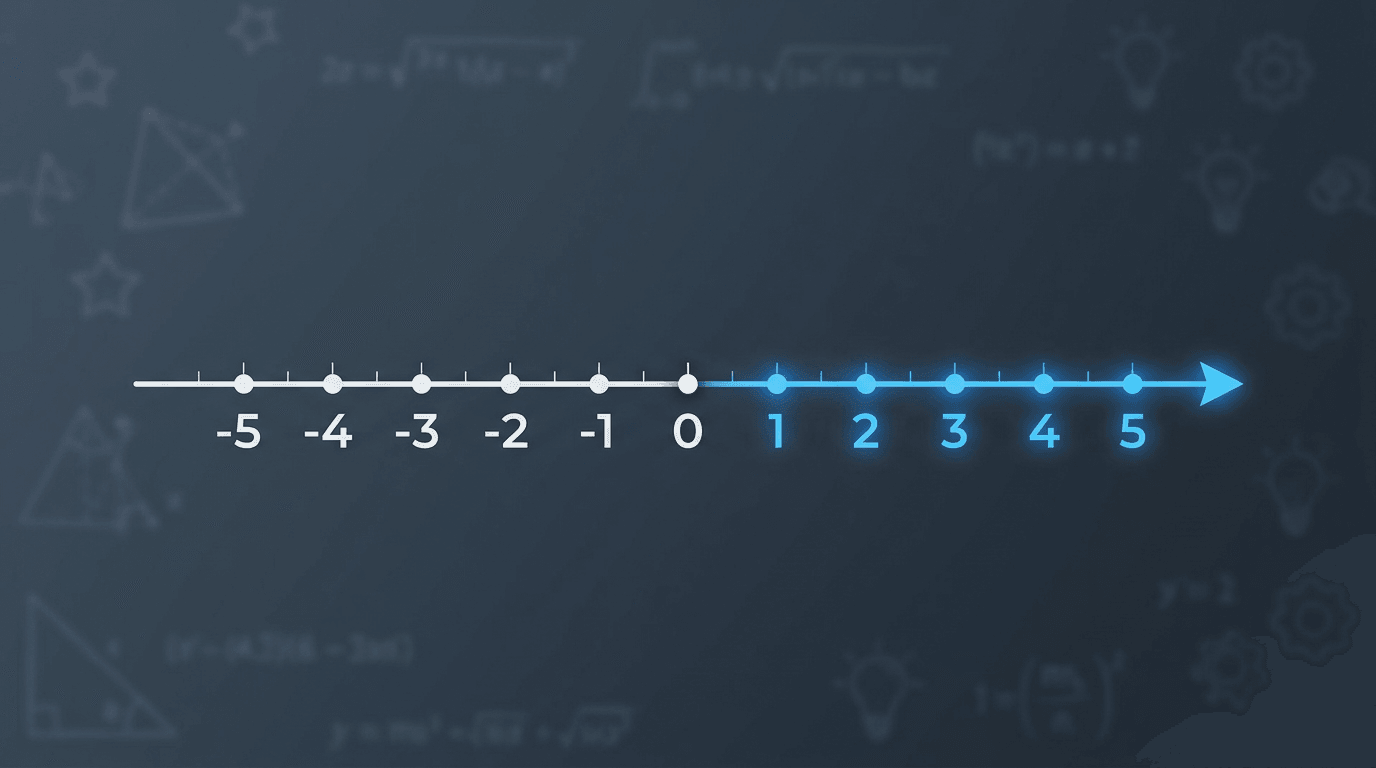
On a standard horizontal number line, we place a starting point called the origin, which represents the number 0. Zero acts as the neutral boundary. When we move to the right of zero, we enter the domain of positive numbers. Each positive integer is represented by a distinct, evenly spaced point:
The number 1 is located one unit to the right of 0.
The number 2 is located two units to the right of 0 (and one unit to the right of 1).
The sequence continues indefinitely to the right, indicated by an arrow.
The Vertical Number Line
We can also represent numbers on a vertical number line. In this orientation, the origin (0) is in the middle, and positive integers are plotted upward. Moving up represents an increase in value, while moving down represents a decrease. This is particularly useful for real-world contexts like altitude or temperature.
Real-World Contexts and the Importance of Direction
Positive integers are not just abstract symbols; they are deeply rooted in how we perceive and measure our physical reality. To fully appreciate them, we must look at how they compare to their opposites (negative integers) through real-world scenarios where magnitude and direction matter.
Elevation and Depth: When measuring altitude, sea level is treated as the baseline or zero. The height of a mountain peak (e.g., 2,500 meters above sea level) is represented as a positive integer. Conversely, the depth of an ocean trench is represented as a negative integer.
Temperature: On a thermometer, 0 degrees (Celsius or Fahrenheit) is a specific reference point. Temperatures warmer than freezing are represented by positive integers (e.g., +25°C), while temperatures below zero are represented by negative integers (e.g., -5°C).
Finance (Income vs. Expense): Positive integers represent financial gains, income, or account balances. If you deposit $100 into your bank account, it is represented as a positive change (+100). If you spend money or incur debt, it is represented as a negative change (-100).
Elevators and Floors: In a building, the ground floor is often designated as floor 0 or L. The floors above the ground are represented by positive integers (1, 2, 3, ...), while underground parking levels are represented by negative integers (-1, -2, -3).
Core Algebraic Properties of Positive Integers
Positive integers obey specific algebraic laws that govern how they interact under basic arithmetic operations like addition, subtraction, multiplication, and division.
1. Closure Properties
A set of numbers is said to be 'closed' under an operation if performing that operation on any two numbers in the set always produces a number that is also in that set.
Closure under Addition: If you add any two positive integers, the sum is always a positive integer. For example, 5 + 8 = 13 (which is a positive integer).
Closure under Multiplication: If you multiply any two positive integers, the product is always a positive integer. For example, 4 * 6 = 24 (which is a positive integer).
Non-Closure under Subtraction: The set of positive integers is not closed under subtraction. If you subtract a larger positive integer from a smaller one (e.g., 3 - 5), the result is -2, which is a negative integer, moving us outside the set of positive integers.
Non-Closure under Division: The set is also not closed under division. Dividing 2 by 3 results in 2/3, which is a fraction (rational number), not an integer.
2. The Well-Ordering Principle
An essential and unique property of positive integers is the Well-Ordering Principle. This principle states that every non-empty set of positive integers contains a least (smallest) element. For example, in the set of all positive integers, the smallest element is 1. This property is fundamental to mathematical proofs, particularly those involving mathematical induction.
Extending Positive Integers: From Integers to Rational Numbers
While positive integers are incredibly useful, they are not sufficient for every mathematical situation. Throughout history, human curiosity and practical needs forced mathematicians to expand the number system.
The Need for Negative Integers
As mentioned in the closure properties, subtracting a larger number from a smaller one (like 2 - 5) cannot be solved using only positive integers. To solve such equations, mathematicians introduced negative integers (the additive inverses of positive integers) and zero. This completed the set of all integers (Z).
The Shift to Rational Numbers
Even with negative integers and zero, division remains a challenge. For instance, if you want to divide 1 apple equally between 2 people, the share of each person cannot be expressed as an integer. We need a number that lies exactly halfway between 0 and 1 on the number line.
This scenario introduces rational numbers. A rational number is any number that can be expressed as the quotient or fraction p/q of two integers, where the numerator p is an integer and the denominator q is a non-zero integer.
Every positive integer is also a rational number because any integer n can be written as n/1. For example, the positive integer 5 is equal to the rational number 5/1. Thus, the set of positive integers is a subset of the rational numbers.
Understanding Distance and Absolute Value
When we discuss numbers on a number line, we often want to talk about their 'size' or 'magnitude' regardless of their direction. This is where the concept of absolute value comes in.
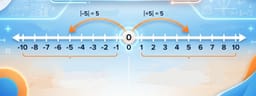
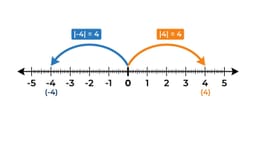
The absolute value of a number is its distance from zero on the number line. Since distance is always non-negative, the absolute value of a number is always positive (or zero).
The mathematical symbol for absolute value is two vertical bars: |x|.
The absolute value of 5 is written as |5|, which equals 5 because it is 5 units away from 0.
The absolute value of -5 is written as |-5|, which also equals 5 because it is also exactly 5 units away from 0, just in the opposite direction.
In real-world applications, absolute value is crucial for calculating error margins, tolerances, and physical distances where direction does not alter the physical quantity itself.
Key Takeaways
Definition: Positive integers are whole numbers strictly greater than zero: {1, 2, 3, 4, ...}. They are represented by the symbol Z⁺.
Zero is Neutral: Zero is neither positive nor negative; it serves as the origin or boundary on the number line.
Number Line: Positive integers lie to the right of zero on a horizontal number line and above zero on a vertical number line.
Closure: Positive integers are closed under addition and multiplication, but not under subtraction or division.
Extensions: Positive integers are a foundational subset of broader number systems, including integers, rational numbers, and real numbers.
Absolute Value: Measures the distance of any number from zero, yielding a positive value that represents magnitude without direction.