Introduction to Integers
In the vast landscape of mathematics, numbers serve as the fundamental building blocks for understanding the universe. While we begin our mathematical journey with natural numbers (1, 2, 3...) used for counting, we quickly realize that these numbers are insufficient for expressing many real-world phenomena. To describe a sub-zero temperature, a bank debt, or depth below sea level, we need a more comprehensive system. This is where integers come into play.
Represented by the bold letter Z (derived from the German word Zahlen, meaning "numbers"), the set of integers includes all positive whole numbers, negative whole numbers, and zero. Formally, we define the set as: Z = {..., -3, -2, -1, 0, 1, 2, 3, ...}. Understanding the properties of integers is crucial, as they form the algebraic foundation for algebra, number theory, and advanced science.
Real-World Contexts: Why Do We Need Integers?
Before diving into abstract mathematical properties, it is essential to understand how integers manifest in our daily lives. Integers allow us to express direction, magnitude, and relative positions using positive and negative signs. Here are several key real-world contexts:
Temperature: On a Celsius thermometer, 0 represents the freezing point of water. Temperatures above freezing are positive integers (e.g., +30 degrees on a hot summer day), while temperatures below freezing are negative integers (e.g., -10 degrees during a winter storm).
Elevation and Depth: Sea level serves as our reference point, or "absolute zero." A mountain peak reaching 2,000 meters above sea level is represented as +2000, while a submarine trench 500 meters below sea level is represented as -500.
Financial Transactions: Earnings, income, and profits are represented by positive integers, whereas debts, expenses, and losses are represented by negative integers. If you have 50 dollars, your balance is +50; if you owe someone 20 dollars, your financial state is -20.
Elevators: In a building, the ground floor is typically designated as floor 0. Floors above ground are positive integers (1, 2, 3...), while underground parking levels are negative integers (-1, -2...).
Time: In history, we use BCE (Before Common Era) and CE (Common Era) to designate time relative to a starting point. In physics and space exploration, a countdown is represented as negative seconds (e.g., T-minus 10 seconds, or -10), while the time after launch is positive.
The Core Algebraic Properties of Integers
Integers obey specific algebraic rules under the operations of addition, subtraction, multiplication, and division. These rules are known as the mathematical properties of integers.
1. The Closure Property
A set is said to be "closed" under an operation if performing that operation on any two elements in the set always produces an element that is also in that set.
Addition: The sum of any two integers is always an integer. For example, 5 + (-8) = -3, and both 5, -8, and -3 are integers.
Subtraction: The difference between any two integers is always an integer. For example, (-3) - 7 = -10. This is a significant property because natural numbers are not closed under subtraction (e.g., 3 - 5 is not a natural number).
Multiplication: The product of any two integers is always an integer. For example, (-4) x (-5) = 20.
Division: Integers are not closed under division. Dividing one integer by another does not always yield an integer. For example, 1 divided by 2 is 0.5, which is a fractional or rational number, not an integer.
2. The Commutative Property
The commutative property states that the order in which we perform an operation on two numbers does not change the result.
Addition: For any two integers a and b, a + b = b + a. Example: 4 + (-9) = -5, and (-9) + 4 = -5.
Multiplication: For any two integers a and b, a x b = b x a. Example: (-3) x 6 = -18, and 6 x (-3) = -18.
Note: Subtraction and division are not commutative. For instance, 5 - 3 is not equal to 3 - 5.
3. The Associative Property
The associative property states that when performing an operation on three or more numbers, the grouping of the numbers does not affect the final outcome.
Addition: For any integers a, b, and c, (a + b) + c = a + (b + c). Example: [2 + (-3)] + 5 = -1 + 5 = 4, and 2 + [(-3) + 5] = 2 + 2 = 4.
Multiplication: For any integers a, b, and c, (a x b) x c = a x (b x c). Example: [(-2) x 3] x 4 = -6 x 4 = -24, and (-2) x [3 x 4] = -2 x 12 = -24.
Note: Subtraction and division are not associative.
4. The Distributive Property
The distributive property links multiplication and addition/subtraction. It states that multiplying a sum by a number gives the same result as multiplying each addend individually by the number and then adding the products together.
Formally: a x (b + c) = (a x b) + (a x c)
Example: -2 x (3 + 5) = -2 x 8 = -16. Using the distributive property: (-2 x 3) + (-2 x 5) = -6 + (-10) = -16. This property is foundational for algebraic expansion and factoring.
5. Identity Elements
An identity element is a special number that, when combined with another number in an operation, leaves that number unchanged.
Additive Identity: The integer 0 is the additive identity. For any integer a, a + 0 = a. Adding zero to a number does not change its value.
Multiplicative Identity: The integer 1 is the multiplicative identity. For any integer a, a x 1 = a. Multiplying a number by one preserves its identity.
6. Inverse Elements
An inverse element undoes the effect of an operation to return to the identity element.
Additive Inverse: For every integer a, there exists an integer -a such that a + (-a) = 0. The additive inverse of a number is its opposite on the number line. For example, the additive inverse of 7 is -7, and the additive inverse of -12 is 12.
Multiplicative Inverse: Integers do not have multiplicative inverses within the set of integers (except for 1 and -1). The multiplicative inverse of an integer a is 1/a, which is a fraction and therefore belongs to the set of rational numbers.
The Number Line: Visualizing Integers
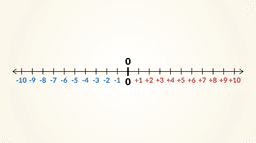
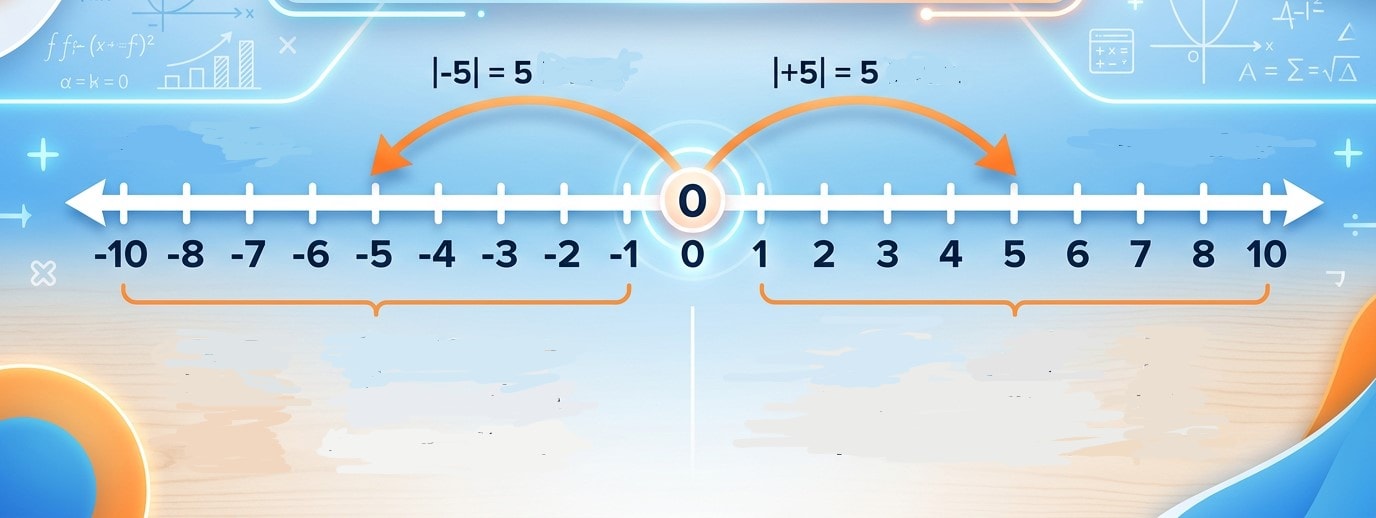
The number line is an indispensable visual tool for understanding integers. It is a straight line where every point corresponds to a real number. For integers, we mark equal intervals starting from a central reference point: zero.
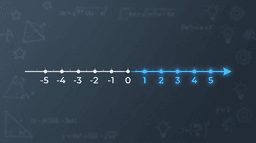
The number line can be drawn horizontally or vertically. On a horizontal number line, positive integers lie to the right of zero, and negative integers lie to the left. On a vertical number line, positive integers are placed above zero, and negative integers are placed below.
As you move from left to right on a horizontal number line, the values of the integers increase. Conversely, as you move from right to left, the values decrease. This visual representation helps us understand inequalities: for example, -5 is less than -2 because -5 lies to the left of -2 on the number line.
An important characteristic of the set of integers on the number line is that they are discrete. Between any two consecutive integers (such as 2 and 3), there is no other integer. This leads to a natural question: what happens when we need to measure values that fall between these whole units?
Extending Integers to Rational Numbers
While integers are highly useful, they are not sufficient for every mathematical scenario. Consider the simple algebraic equation:
2x = 1
If we restrict ourselves to the set of integers, this equation has no solution. There is no integer that we can multiply by 2 to get 1. To solve such equations and to represent fractional quantities (like half a cup of sugar or 1.5 kilometers), we must extend our number system from integers to rational numbers.
A rational number is any number that can be expressed as the quotient or fraction p/q of two integers, a numerator p and a non-zero denominator q (since division by zero is undefined). The set of rational numbers is denoted by the letter Q (for quotient).
The Relationship Between Integers and Rational Numbers
Every single integer is also a rational number. Any integer 'a' can be written as the fraction a/1. For example, the integer 5 can be written as 5/1, and -3 can be written as -3/1. Therefore, the set of integers is a subset of the set of rational numbers (Z ⊂ Q).
Unlike integers, rational numbers are dense. This means that between any two rational numbers, there are infinitely many other rational numbers. For instance, between 0 and 1, we can find 1/2, 1/4, 3/8, and so on. Every rational number corresponds to a unique, precise point on the number line.
Equivalent Fractions on the Number Line
Different fractions can represent the exact same value. These are known as equivalent fractions. For example, 1/2, 2/4, 3/6, and 4/8 all simplify to the same value. When plotted on a number line, all equivalent fractions land on the exact same point. This demonstrates that while there are infinitely many ways to write a fraction, they all represent a single, unique quantitative position on our number scale.
The Concept of Absolute Value
Once we introduce negative numbers, we need a way to discuss the "size" or "magnitude" of a number without worrying about its direction (positive or negative). This concept is called absolute value.
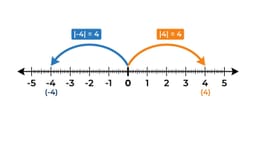
The absolute value of a number is defined as its distance from zero on the number line. Because distance is always non-negative, the absolute value of any number is always positive or zero. We denote absolute value by placing vertical bars around the number, such as |x|.
|5| = 5 (since 5 is 5 units away from 0)
|-5| = 5 (since -5 is also 5 units away from 0)
|0| = 0
Real-World Applications of Absolute Value
Absolute value is not just an abstract rule; it has vital real-world applications where direction does not matter, but magnitude does:
Distance and Navigation: Imagine a rescue helicopter flying above a hospital. Whether the helicopter is 300 meters north (+300) or 300 meters south (-300) of the hospital, its absolute distance to the hospital is the same: 300 meters. The direction is irrelevant to calculating fuel requirements for that distance.
Quality Control in Manufacturing: Consider a coffee factory where packaging machines are calibrated to fill bags with exactly 100 grams of coffee. No machine is perfect; they will make small errors. Let's look at two machines:
Machine A packages a bag with 105 grams (+5 grams deviation).
Machine B packages a bag with 98 grams (-2 grams deviation).
To determine which machine is performing with less error, we look at the absolute value of their deviations. The absolute deviation of Machine A is |+5| = 5 grams. The absolute deviation of Machine B is |-2| = 2 grams. Even though Machine B underfilled the bag (a negative error), its absolute error is smaller than Machine A's overfill. Therefore, Machine B is operating with greater precision.
Estimation Errors: If a teacher asks a class to estimate the weight of an object, some students will guess too high (positive error) and others will guess too low (negative error). By taking the absolute value of each student's error, we can calculate the average deviation to see how accurate the class was as a whole.
Key Takeaways
Understanding the properties of integers is a milestone in mathematical literacy. Here is a summary of the most important concepts to remember:
Integers (Z) extend natural numbers by including negative whole numbers and zero, allowing us to represent opposite directions and values below a reference point.
Integers possess fundamental algebraic properties, including closure (under addition, subtraction, and multiplication), commutativity, associativity, and distributivity.
The integer 0 is the additive identity, and 1 is the multiplicative identity. Every integer has an additive inverse (its opposite).
The number line is a powerful visual tool for ordering integers and representing their values.
When whole integers are insufficient (such as solving 2x = 1), we extend our system to rational numbers (Q), which represent fractions and fill the infinitely dense spaces between integers on the number line.
The absolute value represents a number's distance from zero on the number line, disregarding its sign. It is a critical tool for measuring magnitude, distance, and error margins in real-world applications.