Have you ever tried to split a single pizza equally among three friends? Or perhaps you have looked at a price tag of $1.50 and wondered how that amount relates to a whole dollar? In the world of mathematics, we use a specific class of numbers to describe these everyday situations: rational numbers. Far from being just abstract symbols on a blackboard, rational numbers are the mathematical language of sharing, measuring, and comparing parts of a whole.
In this comprehensive guide, we will explore what rational numbers are, how they behave, and how we can represent them as fractions and decimals. We will also discover the fascinating patterns hidden within their decimal forms and solve one of mathematics' most famous mind-bending debates: is 0.999... truly equal to 1?
The Core Definition of a Rational Number
To understand rational numbers, let us start with the word itself. "Rational" does not mean these numbers are logical or sensible (though they are!). Instead, it comes from the word ratio. A ratio is a comparison of two quantities, often written as a fraction.
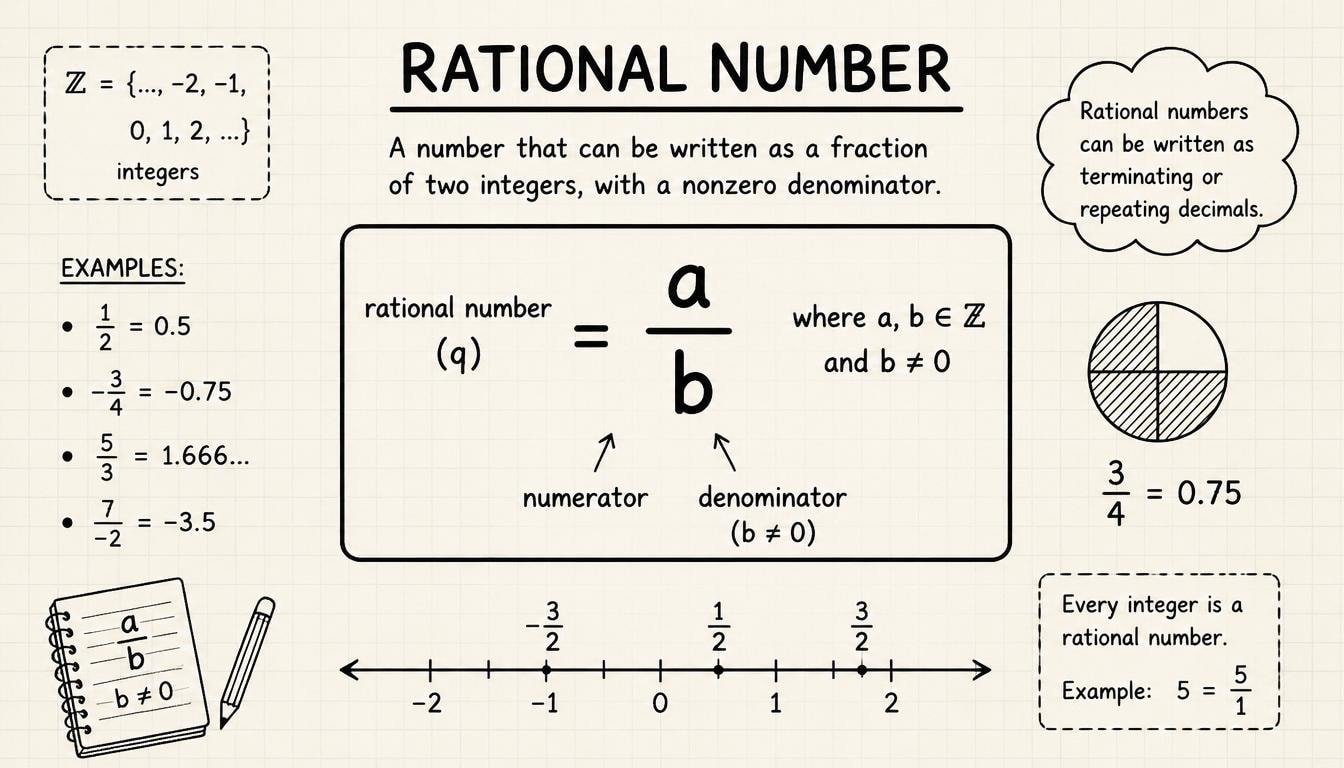
Mathematical Definition: A rational number is any number that can be expressed as the quotient or fraction p/q of two integers, a numerator p and a non-zero denominator q.
This definition has three crucial components:
The Numerator (p): This must be an integer (a whole number, negative number, or zero).
The Denominator (q): This must also be an integer, but with one strict rule: it cannot be zero. Division by zero is undefined in mathematics.
The Fraction Bar: This represents the operation of division.
Because of this definition, many numbers you already know are actually rational numbers:
Fractions: 3/4, -1/2, and 22/7 are clearly rational.
Integers: The number 5 is rational because it can be written as 5/1. Negative numbers like -8 are rational because they can be written as -8/1.
Zero: Zero is rational because it can be written as 0/1, 0/2, or 0/100.
From Fractions to Decimals: The Division Connection
Every rational number written as a fraction has an equivalent decimal representation. To find this decimal, we simply perform the division indicated by the fraction: we divide the numerator (the top number) by the denominator (the bottom number).
Let's look at two different examples of this division process:
Example 1: The Division Stops (Terminating Decimals)
Consider the rational number 3/4. To convert this to a decimal, we divide 3 by 4:
3 ÷ 4 = 0.75
Because the division ends with a remainder of zero, we call 0.75 a terminating decimal. It has a finite number of digits after the decimal point.
Example 2: The Division Never Ends (Repeating Decimals)
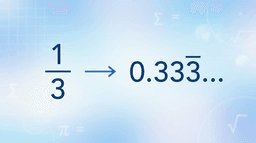
Now, let us try the rational number 1/3. We divide 1 by 3:
1 ÷ 3 = 0.3333...
No matter how long we continue this long division, we will always get a remainder of 1, and the digit 3 will repeat infinitely. We write this as 0.3 with a bar over the 3 (or as 0.333...) to show that it is a repeating (or periodic) decimal.
Terminating vs. Repeating: The Secret of the Denominator
Why do some rational numbers stop nicely, while others repeat forever? The secret lies entirely in the prime factors of the denominator when the fraction is in its simplest form.
Because our standard number system is base-10 (decimal), the factors of our base are 2 and 5. Therefore:
Terminating Decimals: If the denominator of a simplified fraction contains only the prime factors 2, 5, or both, the decimal will terminate. For example, 1/8 terminates because 8 = 2 × 2 × 2. Similarly, 3/20 terminates because 20 = 2 × 2 × 5.
Repeating Decimals: If the simplified denominator contains any prime factor other than 2 or 5 (such as 3, 7, 11, etc.), the decimal will repeat infinitely. For example, 1/6 repeats because 6 = 2 × 3 (the presence of 3 causes the repetition).
This leads us to a powerful mathematical rule: Every rational number can be represented as either a terminating decimal or a repeating decimal. There are no exceptions!
Converting Decimals Back to Fractions
Just as we can convert any fraction into a decimal, we can also convert any terminating or repeating decimal back into a fraction. This proves that these decimals are indeed rational numbers.
1. Converting Terminating Decimals
Terminating decimals are straightforward to convert. We place the digits over the appropriate power of 10 and simplify:
0.35 = 35/100 = 7/20
0.125 = 125/1000 = 1/8
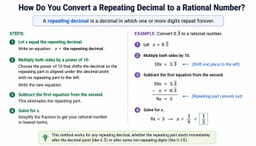
2. Converting Repeating Decimals (The Algebraic Trick)
To convert a repeating decimal like 0.666... back to a fraction, we use a simple algebraic method:
Let x equal the repeating decimal:
x = 0.666...Multiply both sides by 10 (since one digit repeats):
10x = 6.666...Subtract the first equation from the second equation:
10x - x = 6.666... - 0.666...
9x = 6Solve for x by dividing both sides by 9:
x = 6/9Simplify the fraction:
x = 2/3
The Great Debate: Does 0.999... Equal 1?
One of the most famous and counterintuitive concepts in mathematics is the idea that the infinite repeating decimal 0.999... is exactly equal to the whole number 1. Many students find this hard to believe at first, feeling that 0.999... must be just slightly less than 1. However, we can easily prove their equality using the same rational number principles we just learned.
Proof 1: The Fraction Argument
We know that the rational number 1/3 is equal to 0.333... If we multiply both sides of this equation by 3, look at what happens:
1/3 = 0.333...
3 × (1/3) = 3 × 0.333...
1 = 0.999...
Proof 2: The Algebraic Argument
Let us apply our algebraic conversion method to 0.999...:
Let x = 0.999...
Multiply by 10: 10x = 9.999...
Subtract the first equation: 10x - x = 9.999... - 0.999...
This simplifies to: 9x = 9
Divide by 9: x = 1
Since x equals both 0.999... and 1, we must conclude that 0.999... = 1. This beautiful result highlights the unique, continuous nature of rational numbers and their decimal representations.
Key Takeaways
Understanding rational numbers is a fundamental step in mastering algebra and real-world mathematics. Here are the core concepts to remember:
A rational number is any number that can be written as a fraction p/q, where p and q are integers and q is not zero.
Every rational number has a decimal representation that either terminates (stops) or repeats (goes on forever in a repeating pattern).
The prime factors of the simplified denominator determine whether a fraction will terminate (only 2s and 5s) or repeat (any other prime factors).
We can convert any terminating or repeating decimal back into a fraction, proving its status as a rational number.
Mathematical proofs show us that 0.999... is exactly equal to 1, demonstrating the elegant connections within the rational number system.