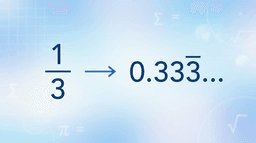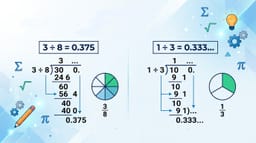
Have you ever wondered how a simple fraction can sometimes turn into an infinitely long string of numbers when written as a decimal? For instance, when you divide 1 by 3, you do not get a clean, finite number. Instead, you get 0.3333... where the 3s stretch out into infinity. This is known as a repeating decimal (or a recurring decimal).
But how do we go backward? If someone hands you a repeating decimal like 0.7777... or 0.121212..., how do you convert it back into its original fractional form—a rational number? In this comprehensive guide, we will explore the mathematical relationship between fractions and decimals, unpack the division process, and master the step-by-step algebraic methods to convert any repeating decimal into a rational number.
Understanding Rational Numbers and Decimals
Before we dive into the conversion process, we must establish what these numbers actually represent. A rational number is defined as any number that can be expressed as the quotient or fraction of two integers, written in the form p/q, where p and q are integers and q is not equal to zero.
When we convert a rational number into a decimal using long division, only one of two things can happen to the decimal representation:
It terminates: The division eventually ends with a remainder of zero. Examples include 1/2 = 0.5, 3/4 = 0.75, and 1/8 = 0.125.
It repeats: The division never ends, and a specific sequence of digits repeats infinitely. Examples include 1/3 = 0.3333... and 5/11 = 0.454545...
Why Do Some Decimals Terminate and Others Repeat?
The behavior of a rational number's decimal expansion is determined entirely by the prime factors of its denominator when the fraction is in its simplest form. Since our standard number system is base-10, and the prime factors of 10 are 2 and 5, any fraction whose denominator has only 2 and/or 5 as prime factors will result in a terminating decimal.
If the simplified denominator contains any prime factor other than 2 or 5 (such as 3, 7, 11, or 13), the decimal representation will inevitably repeat infinitely. Because there are only a finite number of possible remainders during long division, the remainders must eventually repeat, creating a periodic loop of digits.
The Algebraic Method: Step-by-Step Conversion
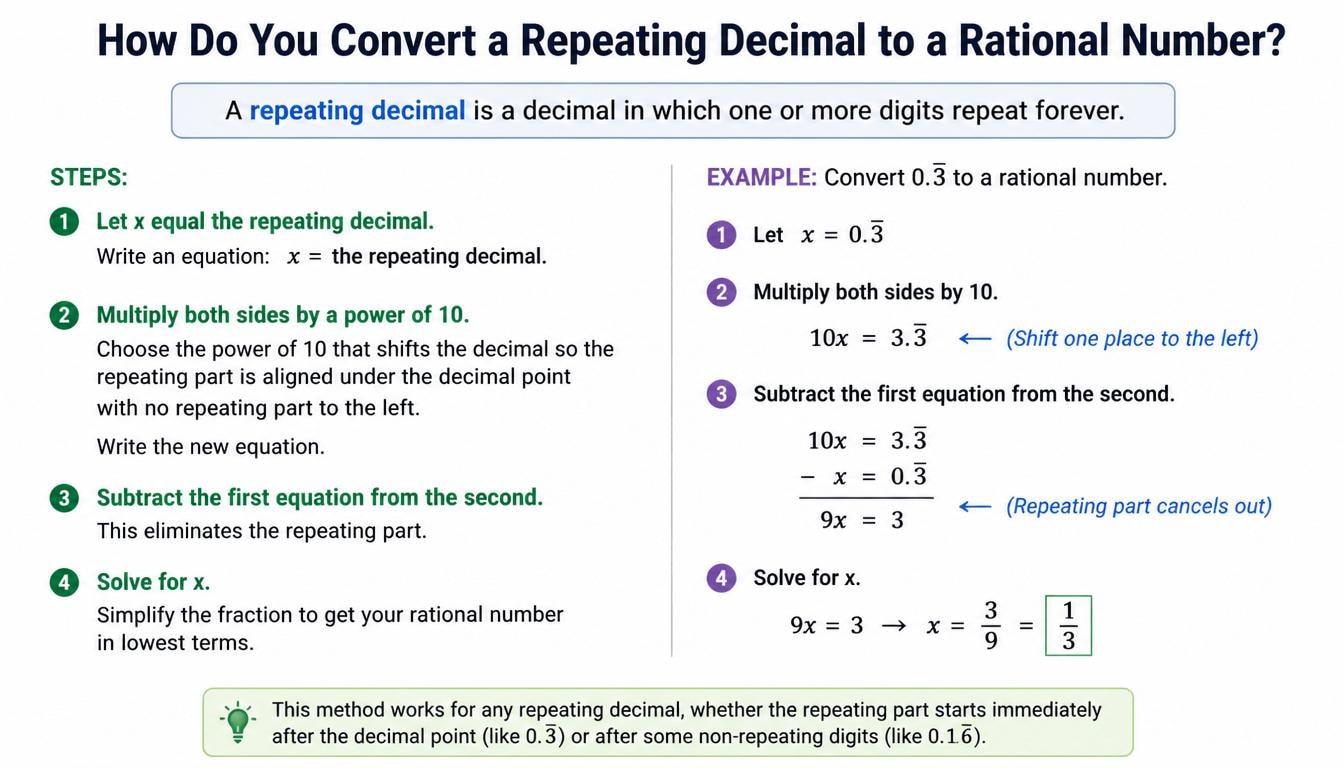
The most reliable and scientifically sound way to convert any repeating decimal into a rational number is through algebra. This method works by setting up an equation, multiplying it to shift the decimal point, and subtracting the equations to eliminate the infinite repeating tail.
Case 1: Pure Repeating Decimals (Single Repeating Digit)
Let's start with a simple example: convert 0.7777... into a fraction.
Step 1: Assign a variable, let's say x, to the repeating decimal.
x = 0.7777... (Equation 1)
Step 2: Count the number of repeating digits. In this case, only one digit (7) repeats. Multiply both sides of the equation by 10 raised to the power of the number of repeating digits (101 = 10).
10x = 7.7777... (Equation 2)
Step 3: Subtract Equation 1 from Equation 2. Notice how the infinite decimal parts perfectly align and cancel each other out.
10x - x = 7.7777... - 0.7777...
9x = 7
Step 4: Solve for x by dividing both sides by 9.
x = 7/9
Thus, the repeating decimal 0.7777... is exactly equal to the rational number 7/9.
Case 2: Pure Repeating Decimals (Multiple Repeating Digits)
Now let's convert a decimal with a multi-digit repeating pattern, such as 0.454545... (often written with a bar over the repeating digits as 0.[45]).
Step 1: Let x equal the decimal.
x = 0.454545... (Equation 1)
Step 2: Since two digits (4 and 5) repeat, multiply both sides of the equation by 102, which is 100.
100x = 45.454545... (Equation 2)
Step 3: Subtract Equation 1 from Equation 2.
100x - x = 45.454545... - 0.454545...
99x = 45
Step 4: Solve for x and simplify the resulting fraction.
x = 45/99
We can simplify 45/99 by dividing both the numerator and the denominator by their greatest common divisor, which is 9:
x = 5/11
Therefore, 0.454545... is equal to 5/11.
Case 3: Mixed Repeating Decimals (Non-Repeating and Repeating Digits)
Sometimes, a decimal has non-repeating digits immediately after the decimal point before the repeating pattern begins. Let's convert 0.124444... (where only the 4 repeats).
Step 1: Let x equal the decimal.
x = 0.124444... (Equation 1)
Step 2: First, isolate the repeating part by moving the decimal point to the right of the non-repeating digits. Since there are two non-repeating digits (1 and 2), multiply by 102 = 100.
100x = 12.4444... (Equation 2)
Step 3: Now, multiply Equation 2 by 10 to shift one period of the repeating pattern (since only one digit repeats).
1000x = 124.4444... (Equation 3)
Step 4: Subtract Equation 2 from Equation 3 to eliminate the repeating decimal tail.
1000x - 100x = 124.4444... - 12.4444...
900x = 112
Step 5: Solve for x and simplify.
x = 112/900
Dividing the numerator and denominator by 4 yields:
x = 28/225
Thus, the mixed repeating decimal 0.124444... is equal to 28/225.
The Mind-Bending Case: Does 0.9999... Equal 1?
One of the most fascinating and debated topics in introductory real analysis is whether the repeating decimal 0.9999... is strictly equal to 1. Let's apply our algebraic conversion method to find out.
Let x = 0.9999...
Multiply both sides by 10:
10x = 9.9999...
Subtract the first equation from the second:
10x - x = 9.9999... - 0.9999...
9x = 9
Divide both sides by 9:
x = 1
This proof shows that 0.9999... is mathematically and precisely equal to 1. While this may seem counterintuitive at first glance, it is a fundamental truth of real numbers. Another way to look at it is through basic arithmetic:
We know that 1/3 = 0.3333...
If we multiply both sides of this equation by 3, we get:
3 * (1/3) = 3 * (0.3333...)
1 = 0.9999...
Because the real number system does not contain infinitely small non-zero quantities (infinitesimals), there is no space or number between 0.9999... and 1. Therefore, they are simply two different ways to write the exact same real number.
The Shortcut Rule for Quick Conversions
Once you understand the algebraic principles, you can use a quick mental shortcut to convert repeating decimals directly to fractions:
The Numerator: Subtract the non-repeating part of the number from the entire number (ignoring the decimal point).
The Denominator: Write down as many 9s as there are repeating digits, followed by as many 0s as there are non-repeating digits after the decimal point.
Let's test this shortcut on our previous example, 0.124444...:
The entire number after the decimal is 124. The non-repeating part is 12. So, the numerator is 124 - 12 = 112.
There is 1 repeating digit (4), so we write one 9. There are 2 non-repeating digits after the decimal (1 and 2), so we write two 0s. The denominator is 900.
This gives us 112/900, which simplifies to 28/225. It works perfectly!
Key Takeaways
Every rational number (p/q) can be represented as either a terminating or repeating decimal.
Decimals repeat when the simplified denominator contains prime factors other than 2 or 5.
The algebraic method of multiplying by powers of 10 allows us to align and eliminate the infinite repeating loop.
0.9999... is not just "close" to 1; it is mathematically identical to 1.
Mastering these conversions bridges the gap between discrete fractions and continuous decimal values, deepening your understanding of the real number system.