Numbers are the foundation of how we measure, evaluate, and understand the universe around us. While we often begin our mathematical journeys with whole numbers, real-world measurements—like the price of an item, the precise length of a wooden plank, or the dosage of a medicine—rarely fit into neat, whole packages. This is where fractions and decimals come into play.
Among the various ways to represent parts of a whole, decimal notation is undoubtedly the most widely used in modern science, commerce, and daily life. But what exactly is decimal notation? How does it connect to division and rational numbers? Why do some fractions convert into clean, finite decimals while others repeat infinitely? In this comprehensive guide, we will explore the scientific and mathematical mechanics of decimal notation, step-by-step.
1. Defining Decimal Notation
Decimal notation is a method of representing real numbers using the base-10 positional numeral system. The word "decimal" originates from the Latin word decimus, meaning tenth. In this system, the value of each digit depends entirely on its position relative to the decimal point.
To understand this, let us look at how place value works on both sides of the decimal point:
To the left of the decimal point: Each position represents a power of 10 multiplied by a whole number (Ones, Tens, Hundreds, Thousands, etc.). As you move left, each position is 10 times larger than the one to its right.
To the right of the decimal point: Each position represents a fraction with a denominator that is a power of 10 (Tenths, Hundredths, Thousandths, Ten-Thousandths, etc.). As you move right, each position is 10 times smaller than the one to its left.
For example, the number 345.678 can be broken down into its positional components as follows:
345.678 = (3 * 100) + (4 * 10) + (5 * 1) + (6 * 0.1) + (7 * 0.01) + (8 * 0.001)
2. The Connection Between Rational Numbers and Decimals
A rational number is defined as any number that can be expressed as the quotient or fraction p/q of two integers, where the numerator (p) and the non-zero denominator (q) are integers. Every single rational number has a decimal representation. We find this representation by performing a fundamental mathematical operation: division.
To convert any fraction p/q into its decimal form, we simply divide the numerator p by the denominator q. This simple process reveals a fascinating mathematical truth: when we divide the numerator by the denominator, the resulting decimal notation will always fall into one of two categories:
Terminating Decimals: Decimals that come to an end (have a finite number of digits).
Repeating (Recurring) Decimals: Decimals that loop a specific digit or sequence of digits infinitely.
3. Terminating Decimals: Why Do They Stop?
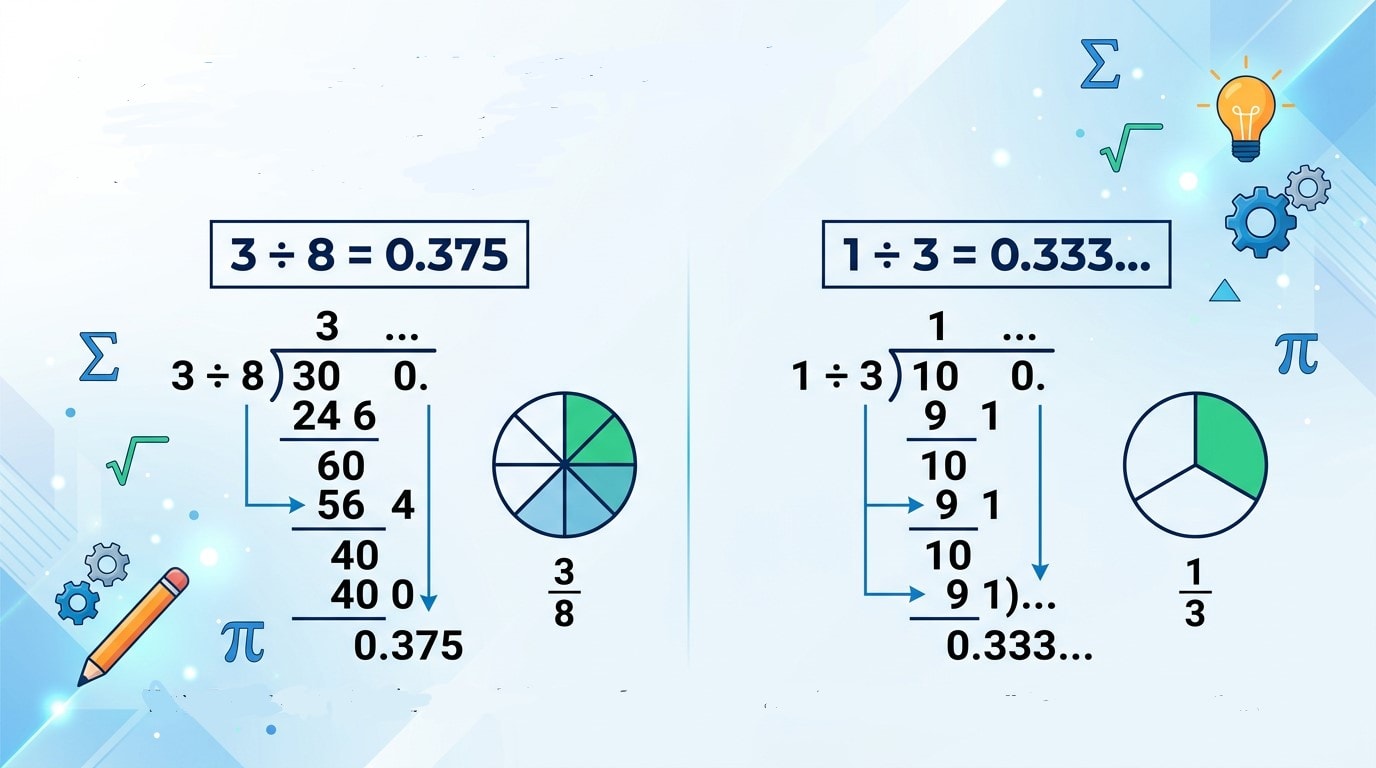
Let us look at a simple conversion. Suppose we want to find the decimal notation of the rational number 3/8. To do this, we perform long division: 3 divided by 8.
Since 8 does not go into 3, we place a decimal point and add zeros:
3.0 divided by 8 is 0.3 with a remainder of 6.
60 divided by 8 is 7 with a remainder of 4.
40 divided by 8 is exactly 5 with a remainder of 0.
Thus, 3/8 = 0.375. Because the remainder eventually becomes zero, the division process stops. This is a terminating decimal.
The Scientific Secret of the Denominator
Why do some fractions terminate while others do not? The answer lies in the prime factorization of the denominator when the fraction is in its simplest form.
Because our number system is base-10, and the prime factors of 10 are 2 and 5, a rational number p/q (in its lowest terms) will result in a terminating decimal if and only if the prime factorization of its denominator q contains no prime factors other than 2 or 5.
For 3/8, the denominator is 8. The prime factorization of 8 is 2 * 2 * 2. Since it only contains 2s, it terminates (0.375).
For 7/20, the denominator is 20. The prime factorization of 20 is 2 * 2 * 5. Since it only contains 2s and 5s, it terminates (0.35).
4. Repeating Decimals: The Infinite Loop
What happens when the denominator contains prime factors other than 2 or 5? Let us convert the rational number 1/3 into decimal notation by dividing 1 by 3.
1.0 divided by 3 is 0.3 with a remainder of 1.
10 divided by 3 is 3 with a remainder of 1.
10 divided by 3 is 3 with a remainder of 1.
Because we keep getting the same remainder (1), this process will continue forever. The digit 3 repeats infinitely. We write this as 0.3333... or use a bar over the repeating digit: 0.3̄ (or 0.3 with a dot above it).
Another example is 5/11. When we divide 5 by 11, we get:
5/11 = 0.454545... = 0.45̄
Here, the two-digit sequence "45" repeats infinitely. Because the set of possible remainders when dividing by any integer q is finite (specifically, there are at most q-1 non-zero remainders), the division process must eventually cycle back to a remainder it has seen before. This mathematical law guarantees that every rational number that does not terminate must repeat.
5. Converting Decimals Back to Fractions
Mathematics is a two-way street. Just as we can convert any fraction into a decimal, we can also convert any terminating or repeating decimal back into a rational fraction.
Case A: Converting Terminating Decimals
This is straightforward. Write the digits of the decimal as the numerator, and use the appropriate power of 10 as the denominator based on the place value of the last digit. Then, simplify.
Let's convert 0.125:
The last digit (5) is in the thousandths place, so we write: 125/1000.
We simplify by dividing both the numerator and denominator by their greatest common divisor, which is 125.
125 / 125 = 1, and 1000 / 125 = 8. Thus, 0.125 = 1/8.
Case B: Converting Repeating Decimals
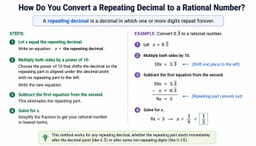
Converting repeating decimals requires a clever algebraic technique. Let's convert the repeating decimal 0.7777... (or 0.7̄) back into a fraction.
Step 1: Let a variable, x, equal the repeating decimal:
x = 0.7777...
Step 2: Multiply both sides of the equation by a power of 10 equal to the number of digits in the repeating pattern. Since only one digit (7) repeats, we multiply by 10:
10x = 7.7777...
Step 3: Subtract the original equation (Step 1) from the new equation (Step 2):
10x - x = 7.7777... - 0.7777...
9x = 7
Step 4: Solve for x by dividing both sides by 9:
x = 7/9
Thus, the decimal 0.7777... is exactly equal to the rational fraction 7/9.
6. The Mathematical Wonder: Does 0.9999... Equal 1?
One of the most fascinating and widely debated topics in introductory real analysis is whether the repeating decimal 0.9999... (0.9̄) is equal to 1. To many, it feels intuitive that 0.9999... must be slightly less than 1. However, mathematically, they are strictly and absolutely equal.
We can prove this using the exact same algebraic conversion method we just learned:
Let x = 0.9999...
Multiply both sides by 10: 10x = 9.9999...
Subtract the first equation from the second: 10x - x = 9.9999... - 0.9999...
This simplifies to: 9x = 9
Divide by 9: x = 1
Since x equals both 0.9999... and 1, we must conclude that 0.9999... = 1. Another simple way to visualize this is through basic arithmetic: if 1/3 is equal to 0.3333..., then multiplying both sides by 3 gives us 3/3 (which is 1) equal to 0.9999...
7. Key Takeaways
Understanding decimal notation is crucial for navigating both algebra and real-world science. Here are the core concepts to remember:
Decimal notation is a positional base-10 system where digits to the right of the decimal point represent fractional parts of tenths, hundredths, thousandths, etc.
Every rational number can be written as a decimal by dividing its numerator by its denominator.
A decimal will terminate if the prime factors of its simplified denominator consist only of 2s and/or 5s. Otherwise, it will repeat infinitely.
All terminating and repeating decimals represent rational numbers and can be converted back into fractional form using algebraic techniques.