A rational number is defined as any number that can be expressed in the form of a/b, where a and b are integers, and b is not equal to zero. This group of numbers includes integers, terminating decimals, repeating decimals, and proper or improper fractions. Understanding how to perform the four basic arithmetic operations—addition, subtraction, multiplication, and division—with rational numbers is a foundational milestone in mathematics. Whether you are dividing a recipe, calculating financial interest, or studying advanced algebra, these operations form the bedrock of quantitative reasoning.
In this comprehensive guide, we will break down each of these four operations step-by-step, explore the underlying mathematical principles, and look at practical examples that make these concepts easy to master.
1. Adding Rational Numbers
To add rational numbers, we must categorize our approach based on whether the denominators (the bottom numbers of the fractions) are the same or different.
Case A: Adding with Like Denominators
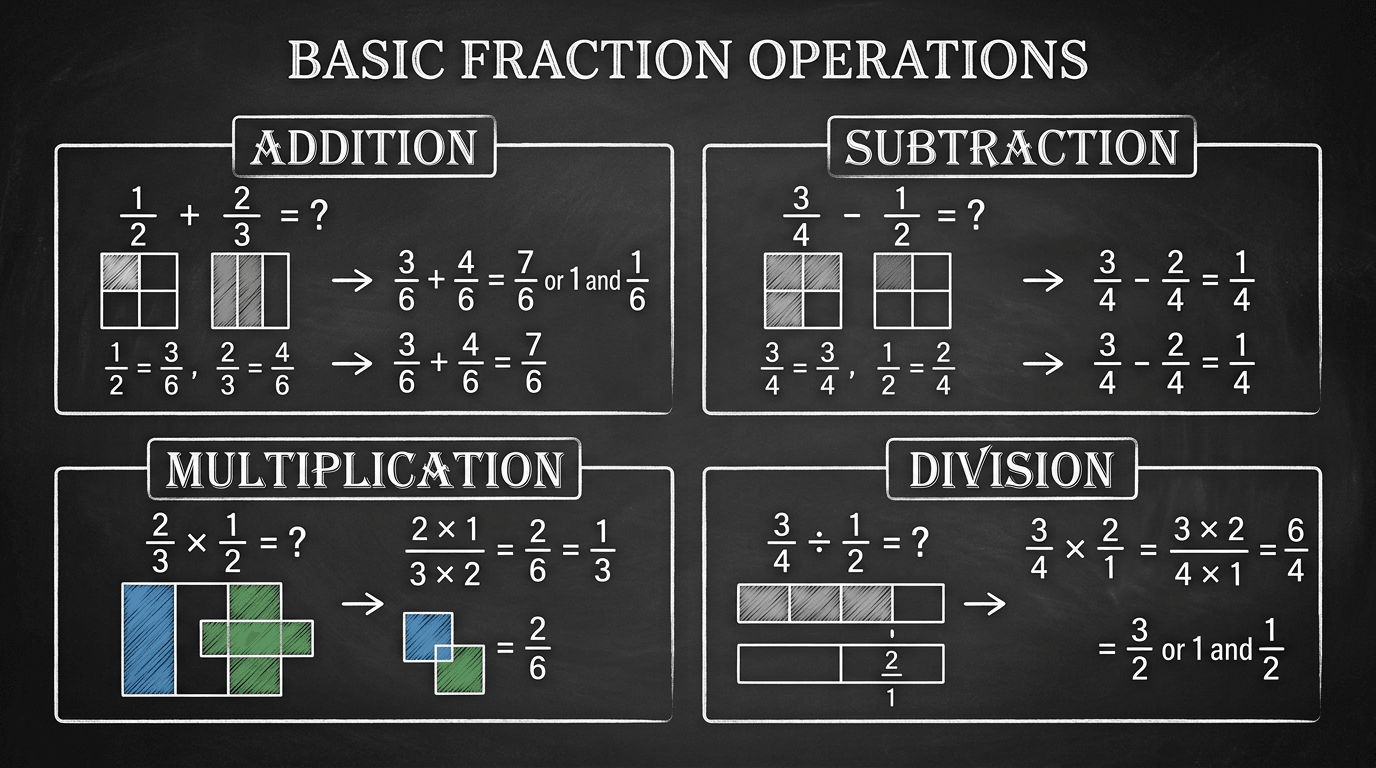
When the denominators of the rational numbers are identical, the process is straightforward. You simply add the numerators (the top numbers) together and keep the denominator the same.
Mathematical Rule:
a/c + b/c = (a + b) / c (where c is not 0)
Let's look at a simple example:
Calculate: 2/7 + 3/7
Step 1: Keep the common denominator, which is 7.
Step 2: Add the numerators: 2 + 3 = 5.
Step 3: Write the final fraction: 5/7.
Case B: Adding with Unlike Denominators
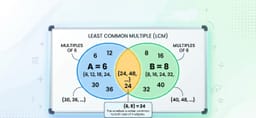
When the denominators are different, you cannot add the numerators directly. First, you must find a common ground by determining the Least Common Denominator (LCD), which is the Least Common Multiple (LCM) of the denominators.
Calculate: 1/4 + 2/3
Find the LCD: The multiples of 4 are 4, 8, 12, 16... and the multiples of 3 are 3, 6, 9, 12, 15... The least common multiple is 12.
Convert the fractions: Multiply both the numerator and denominator of each fraction by the factor needed to make the denominator 12.
- For 1/4: Multiply top and bottom by 3 to get 3/12.
- For 2/3: Multiply top and bottom by 4 to get 8/12.Add the converted fractions: 3/12 + 8/12 = (3 + 8) / 12 = 11/12.
Dealing with Negative Rational Numbers
When adding negative rational numbers, apply the standard rules of integer addition. For example, if you have -1/2 + 3/4:
Find the LCD, which is 4.
Convert -1/2 to -2/4.
Perform the addition: -2/4 + 3/4 = (-2 + 3) / 4 = 1/4.
2. Subtracting Rational Numbers
Subtraction of rational numbers follows the exact same principles as addition, utilizing the concept of the additive inverse. Subtracting a number is mathematically equivalent to adding its opposite.
Mathematical Rule:
a/c - b/c = (a - b) / c
a/b - c/d = (ad - bc) / bd
Step-by-Step Example of Subtraction
Calculate: 5/6 - 1/4
Find the LCD: The LCM of 6 and 4 is 12.
Convert the fractions:
- For 5/6: Multiply top and bottom by 2 to get 10/12.
- For 1/4: Multiply top and bottom by 3 to get 3/12.Subtract the numerators: 10/12 - 3/12 = (10 - 3) / 12 = 7/12.
The Double Negative Rule
If you are subtracting a negative rational number, the two negative signs cancel each other out to become addition. For instance:
3/5 - (-1/5) = 3/5 + 1/5 = 4/5.
3. Multiplying Rational Numbers
Unlike addition and subtraction, multiplication of rational numbers does not require finding a common denominator. This makes multiplication the most direct operation to perform.
Mathematical Rule:
(a/b) * (c/d) = (a * c) / (b * d) (where b and d are not 0)
To multiply two rational numbers, simply multiply the numerators together to find the new numerator, and multiply the denominators together to find the new denominator.
Example of Multiplication
Calculate: 3/5 * 2/7
Step 1: Multiply the numerators: 3 * 2 = 6.
Step 2: Multiply the denominators: 5 * 7 = 35.
Step 3: Combine them into the final fraction: 6/35.
Simplifying Before Multiplying (Cross-Simplification)
To avoid dealing with large numbers, you can simplify fractions diagonally before performing the multiplication. Consider this example:
Calculate: 4/9 * 3/8
Look at the diagonals: 4 and 8 share a common factor of 4. Simplify them to 1 and 2.
Look at the other diagonal: 3 and 9 share a common factor of 3. Simplify them to 1 and 3.
Now multiply the simplified terms: (1/3) * (1/2) = (1 * 1) / (3 * 2) = 1/6.
4. Dividing Rational Numbers
Division of rational numbers relies on the concept of the reciprocal (or multiplicative inverse). The reciprocal of a fraction is obtained by swapping its numerator and denominator. For example, the reciprocal of 3/4 is 4/3.
To divide by a rational number, you multiply by its reciprocal. This is often remembered by students through the simple mnemonic: Keep, Change, Flip (KCF).
Mathematical Rule:
(a/b) / (c/d) = (a/b) * (d/c) = (a * d) / (b * c) (where b, c, and d are not 0)
Step-by-Step Example of Division
Calculate: 2/3 divided by 5/7
Keep the first fraction exactly as it is: 2/3.
Change the division sign to a multiplication sign: *.
Flip the second fraction to its reciprocal: 5/7 becomes 7/5.
Multiply the fractions: (2/3) * (7/5) = (2 * 7) / (3 * 5) = 14/15.
Summary of Key Sign Rules for Operations
When working with positive and negative rational numbers, always keep the fundamental laws of signs in mind:
Multiplication and Division:
- Multiplying/dividing two numbers with the same sign results in a positive number.
- Multiplying/dividing two numbers with different signs results in a negative number.Addition and Subtraction:
- Think of negative numbers as debt and positive numbers as assets on a visual number line to help track your position relative to zero.
Conclusion
Performing the four operations with rational numbers is a systematic process. By mastering the concepts of common denominators for addition and subtraction, direct multiplication for products, and reciprocal multiplication for division, you can confidently solve any rational number problem. Regular practice with these foundational steps will ensure that these operations become second nature in your mathematical journey.