Have you ever divided 1 by 3 on a calculator and wondered why the screen filled up with an endless string of threes? Or perhaps you noticed that dividing 5 by 11 yields a repeating pattern of "45" over and over again. These are not glitches in our calculators or mathematical anomalies; they are fundamental mathematical objects known as repeating decimals (or recurring decimals).
In this comprehensive guide, we will explore the nature of repeating decimals. We will dive deep into why they occur, how they relate to fractions, how to convert them back and forth, and the fascinating mathematical proofs that explain their behavior—including the famous debate over whether 0.999... is truly equal to 1.
1. The Origin of Decimals: The Division Connection
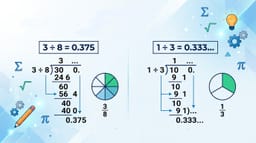
To understand repeating decimals, we must first look at the relationship between fractions, division, and decimals. Every rational number—which is simply any number that can be written as a fraction of two integers, p/q (where q is not zero)—can be converted into a decimal representation. This conversion is achieved through the simple process of long division, where we divide the numerator (the top number) by the denominator (the bottom number).
When we perform this division, one of two things will always happen to the decimal representation:
It terminates: The division process eventually results in a remainder of zero. For example, 3/4 becomes exactly 0.75.
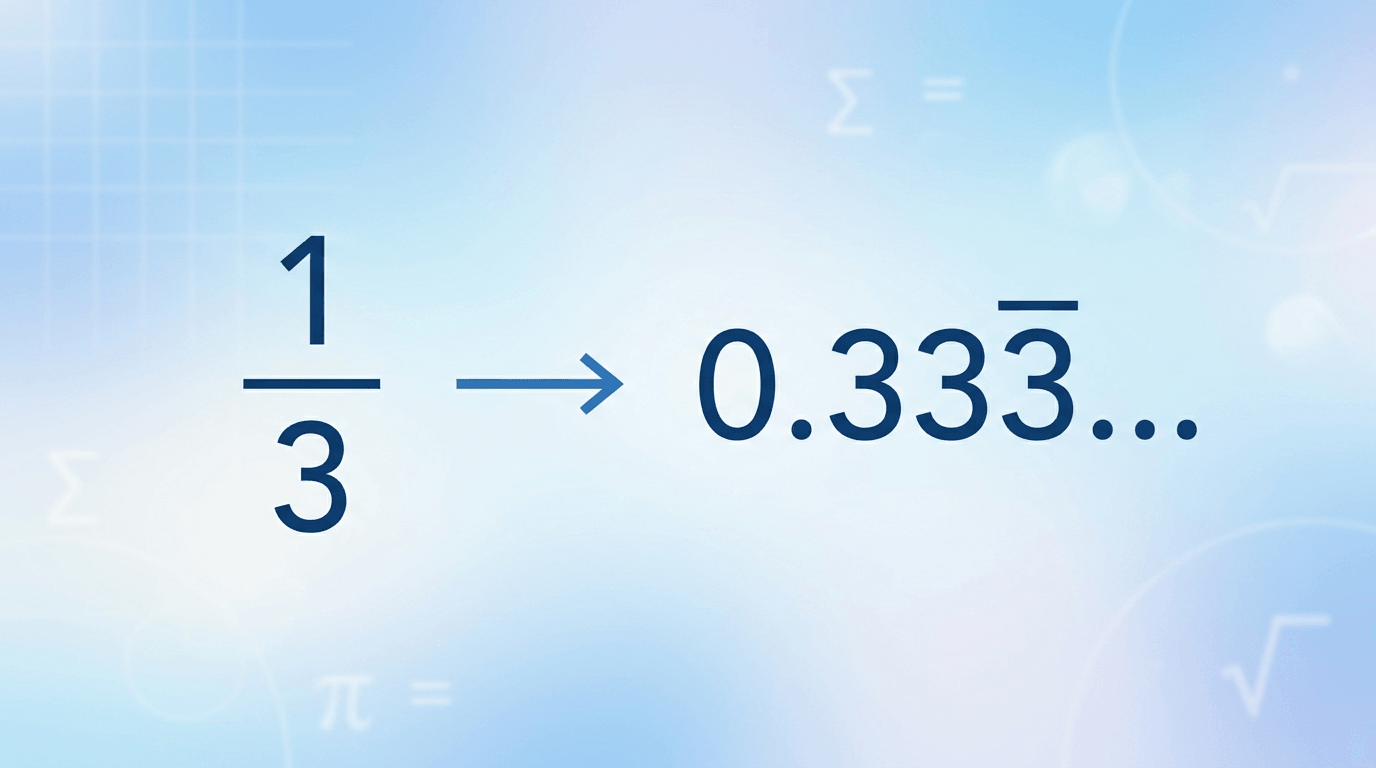
It repeats: The division process never ends because a sequence of remainders begins to cycle, causing a digit or a block of digits to repeat infinitely. For example, 1/3 becomes 0.3333...
Key Concept: Every single rational number has a decimal expansion that either terminates or repeats. There are absolutely no exceptions to this rule in the real number system.
2. Why Do Some Decimals Repeat While Others Stop?
Why does 1/8 give us a clean, terminating decimal (0.125), while 1/7 turns into an endless loop (0.142857142857...)? The secret lies entirely within the prime factorization of the denominator.
We operate in a base-10 (decimal) number system. The number 10 is composed of two prime factors: 2 and 5. Because of this, any fraction that can be simplified to have a denominator containing only the prime factors 2, 5, or both, will always result in a terminating decimal. This is because we can easily scale the denominator to a power of 10 (like 10, 100, 1000, etc.).
Let's look at some examples:
1/5: The denominator is 5. Since 5 is a prime factor of 10, it terminates: 0.2.
3/8: The denominator is 8, which is 2 × 2 × 2. Since its only prime factor is 2, it terminates: 0.375.
7/20: The denominator is 20, which is 2 × 2 × 5. Since its prime factors are only 2 and 5, it terminates: 0.35.
Conversely, if the simplified denominator contains any prime factor other than 2 or 5 (such as 3, 7, 11, 13, etc.), the decimal representation will inevitably repeat forever. For example, 1/3 contains the factor 3, 1/11 contains the factor 11, and 1/6 contains the factors 2 and 3 (the presence of 3 guarantees it will repeat).
3. The Mathematical Proof: The Pigeonhole Principle
How can we be absolutely certain that a fraction's decimal representation will *always* repeat if it doesn't terminate? Why couldn't it just produce a completely random, non-repeating sequence of infinite digits?
The answer comes from a beautiful and simple mathematical concept called the Pigeonhole Principle. The principle states that if you have n items to put into m containers, and n > m, at least one container must contain more than one item.
When we divide an integer p by another integer q, we perform long division step-by-step. At each step of the division, we calculate a remainder. Let's look at the possible remainders when dividing by q:
The remainder can be 0. If this happens, the division stops, and we have a terminating decimal.
If the remainder is not 0, the only possible remainders are the integers from 1 up to q - 1. This means there are exactly q - 1 possible non-zero remainders.
Since there are only a finite number of possible remainders (at most q - 1), as we continue our long division past the decimal point, we must eventually encounter a remainder that we have already seen before. The moment a remainder repeats, the entire sequence of division steps, quotients, and subsequent remainders must repeat in the exact same cycle. This guarantees that the decimal digits will repeat infinitely in a periodic loop.
4. Classifying Repeating Decimals
Repeating decimals can be classified into two primary categories based on where the repeating pattern (called the period) begins:
Pure Repeating Decimals
In a pure repeating decimal, the repeating pattern begins immediately after the decimal point. There are no non-repeating digits between the decimal point and the repeating loop.
1/3 = 0.3333... (The digit 3 repeats immediately)
5/11 = 0.454545... (The block "45" repeats immediately)
2/7 = 0.285714285714... (The block "285714" repeats immediately)
Mixed Repeating Decimals
In a mixed repeating decimal, there are one or more non-repeating digits immediately after the decimal point, followed by the repeating pattern.
1/6 = 0.16666... (The digit 1 does not repeat, but the 6 repeats infinitely)
7/12 = 0.583333... (The digits 5 and 8 do not repeat, but the 3 repeats infinitely)
11/90 = 0.12222... (The digit 1 does not repeat, but the 2 repeats infinitely)
5. Notation for Repeating Decimals
Writing out infinite digits is physically impossible, so mathematicians have developed shorthand notations to represent repeating decimals clearly and precisely:
The Ellipsis (...): Three dots placed at the end of the number indicate that the established pattern continues infinitely (e.g., 0.1666...).
The Vinculum (Bar Notation): A horizontal line is drawn directly over the repeating block of digits. This is the most common and precise notation used in schools and scientific texts. For example, for 0.454545..., we write 0.45 with a bar over "45".
Dot Notation: In some countries, dots are placed over the first and last digits of the repeating cycle (e.g., 0.3 with a dot over the 3, or 0.142857 with a dot over the 1 and the 7).
6. Converting Repeating Decimals to Fractions
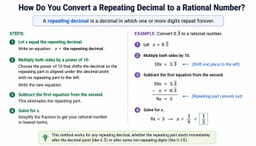
Since every repeating decimal represents a rational number, we can convert any repeating decimal back into its original fraction form using a simple algebraic method. Let's walk through two examples step-by-step.
Example 1: Converting a Pure Repeating Decimal (0.777...)
Let's convert 0.777... (or 0.7 with a bar) into a fraction:
Let x equal the repeating decimal:
x = 0.7777... (Equation 1)Multiply both sides of the equation by 10 (since the repeating cycle is only 1 digit long):
10x = 7.7777... (Equation 2)Subtract Equation 1 from Equation 2 to eliminate the infinite decimal part:
10x - x = (7.7777...) - (0.7777...)
9x = 7Solve for x by dividing both sides by 9:
x = 7/9
Thus, the repeating decimal 0.777... is exactly equal to the fraction 7/9.
Example 2: Converting a Mixed Repeating Decimal (0.1242424...)
Let's convert a slightly more complex decimal where the repeating pattern ("24") starts after a non-repeating digit ("1"):
Let x equal the decimal:
x = 0.1242424... (Equation 1)Multiply both sides by 10 to shift the decimal point to the start of the repeating cycle:
10x = 1.242424... (Equation 2)Multiply Equation 2 by 100 (since the repeating cycle "24" is 2 digits long):
1000x = 124.242424... (Equation 3)Subtract Equation 2 from Equation 3:
1000x - 10x = (124.242424...) - (1.242424...)
990x = 123Solve for x:
x = 123/990Simplify the fraction by dividing the numerator and denominator by their greatest common divisor (3):
x = 41/330
Thus, 0.1242424... is exactly equal to 41/330.
7. The Great Debate: Does 0.999... Equal 1?
One of the most famous and mind-bending discussions in mathematics centers around the repeating decimal 0.99999... (with the 9 repeating infinitely). Many people intuitively feel that 0.999... must be slightly less than 1. However, mathematically, 0.999... is exactly, unconditionally equal to 1.
Let's look at three distinct proofs that verify this fact:
Proof 1: The Fraction Argument
We know with absolute certainty that 1/3 is equal to 0.333... If we multiply both sides of this equation by 3, we get:
3 × (1/3) = 3 × 0.333...
3/3 = 0.999...
1 = 0.999...
Proof 2: The Algebraic Proof
Using the exact same algebraic conversion technique we learned earlier:
Let x = 0.9999...
Multiply both sides by 10:
10x = 9.9999...Subtract the first equation from the second:
10x - x = (9.9999...) - (0.9999...)
9x = 9Divide by 9:
x = 1
Proof 3: The Limit and Real Numbers Argument
In the real number system, there are no "infinitely small" non-zero numbers. If two real numbers are distinct, there must be another number that lies strictly between them. Ask yourself: is there any number you can place between 0.999... and 1? The answer is no. Because there is no space between them, they are representationally the same point on the number line. They are simply two different ways to write the exact same real number.
8. Key Takeaways
Understanding repeating decimals is a crucial milestone in mathematics. Here are the core concepts to remember:
Rational Nature: Every repeating decimal is a rational number, meaning it can always be written as a simple fraction of two integers.
The Role of Denominators: Decimals only terminate if the simplified fraction's denominator consists strictly of the prime factors 2 and/or 5. Any other prime factor forces the decimal to repeat.
The Pigeonhole Principle: This mathematical rule guarantees that dividing two integers will eventually result in a repeating sequence of remainders, making the decimal repeat.
0.999... is 1: Despite being counterintuitive, 0.999... is mathematically, logically, and rigorously equal to 1.
The next time you perform a division and see a repeating pattern on your screen, you'll know that you aren't just looking at random numbers—you are witnessing the perfect, structured, and beautiful laws of arithmetic in action!