Have you ever looked at a mathematical expression containing a square root and felt a bit overwhelmed? Radical expressions can look intimidating at first glance, but they are actually highly structured and logical. Just like simplifying a fraction like 4/8 to 1/2 makes it easier to understand and work with, simplifying a radical expression makes calculations smoother and reveals the true nature of the numbers involved.
In here, we will break down the process of simplifying radical expressions from the ground up. Whether you are a student encountering square roots for the first time or looking to master the technical nuances of variables and prime factorization, this article will cover everything you need to know. We will explore the physical meaning of roots, the math properties that make simplification possible, and step-by-step methods to tackle any radical problem with confidence.
1. Understanding the Basics: What is a Radical Expression?
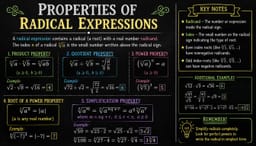
Before we dive into the simplification process, let's define our terms. A radical expression is any mathematical expression that contains a radical symbol (√). The most common radical is the square root, but radicals can also include cube roots, fourth roots, and beyond.
A standard radical expression consists of three main parts:
The Radical Symbol (√): The symbol indicating that we are taking a root.
The Radicand: The number or expression inside/underneath the radical symbol. For example, in √25, the number 25 is the radicand.
The Index: The small number written outside the radical (e.g., the 3 in 3√x) that indicates which root is being taken. If no index is written, it is understood to be a square root (index of 2).
The Geometric Connection: Area and Side Length
To truly understand what a square root is, we can look at a physical and geometric example. Imagine you have a square-shaped plot of land. If you know the length of one side of the square, you can easily find its area by squaring that length (multiplying it by itself). For instance, a square with a side length of 5 meters has an area of 5 × 5 = 25 square meters.
But what if you are given the area first? If you know the area of a square is 36 square meters, how do you find the length of one side? This is where the square root comes in. The square root is the inverse operation of squaring. It asks the question: "What positive number, when multiplied by itself, equals this area?"
In your own words: A square root of a number is simply the side length of a square that has that number as its area. Because a physical side length cannot be negative, the principal square root of a positive number is always positive.
2. Perfect Squares and Their Roots
The easiest radical expressions to simplify are those where the radicand is a perfect square. A perfect square is an integer that can be expressed as the square of another integer. Let's look at a simple table showing the relationship between side lengths (integers) and areas (perfect squares):
Side Length (x) Perfect Square Area (x2) Square Root (√x2) 1 1 √1 = 1 2 4 √4 = 2 3 9 √9 = 3 4 16 √16 = 4 5 25 √25 = 5
When you encounter a radical expression like √49, you can immediately simplify it to 7 because 7 × 7 = 49. There is no radical symbol left in the final answer because 49 is a perfect square.
3. The Core Rule of Simplification: The Product Property
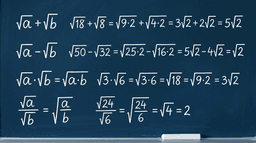
What happens when the radicand is not a perfect square? For example, how do we simplify √50? To do this, we rely on a fundamental algebraic property of radicals called the Product Property of Radicals.
The Product Property states that for any non-negative real numbers a and b:
√(a × b) = √a × √b
This rule allows us to split a single radical into the product of two separate radicals, or combine two separate radicals into one. Our main goal when simplifying a square root is to look for factors of the radicand that are perfect squares, split them off using this property, and then take their square roots.
4. Step-by-Step Methods to Simplify Radicals
There are two primary methods used to simplify radical expressions. Both methods yield the exact same result, so you can choose the one that best fits your learning style or the complexity of the number you are working with.
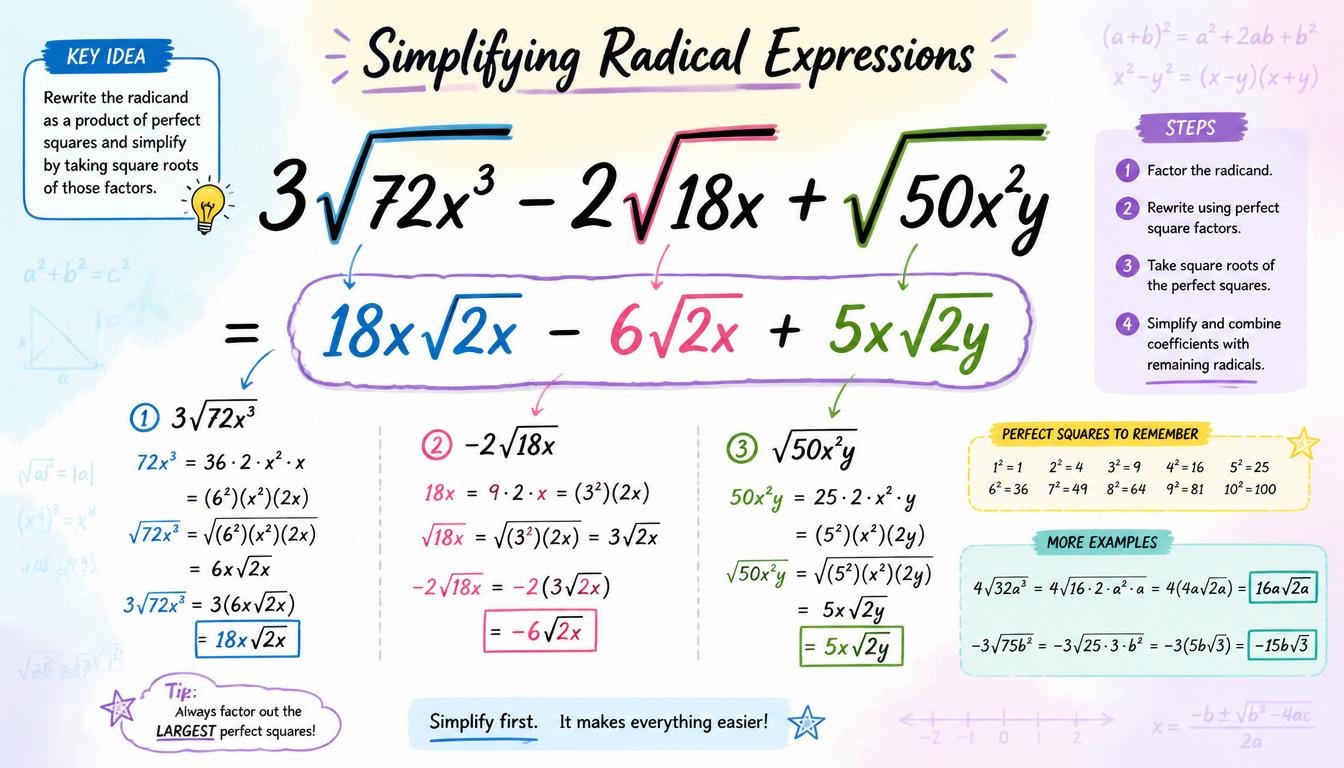
Method 1: Finding the Greatest Perfect Square Factor
This is the fastest method if you are comfortable with multiplication facts and perfect squares. Here are the steps:
Find the largest perfect square (such as 4, 9, 16, 25, 36, 49, 64, etc.) that divides evenly into the radicand.
Rewrite the radicand as a product of this perfect square and the remaining factor.
Use the Product Property to split the radical.
Take the square root of the perfect square, placing the resulting integer outside the radical symbol. Keep the other factor inside.
Example 1: Simplify √50
Step 1: Identify the factors of 50. The factors are 1, 2, 5, 10, 25, and 50. The largest perfect square in this list is 25.
Step 2: Rewrite 50 as 25 × 2. So, we have √(25 × 2).
Step 3: Split the radical: √25 × √2.
Step 4: Take the square root of 25, which is 5. The simplified expression is 5√2.
Example 2: Simplify √72
Let's say we identify 9 as a perfect square factor of 72 (since 9 × 8 = 72). We write: √72 = √9 × √8 = 3√8.
But wait! Can √8 be simplified further? Yes, because 8 has a perfect square factor of 4 (4 × 2 = 8).
So, we simplify further: 3√8 = 3 × √4 × √2 = 3 × 2 × √2 = 6√2.
Note: We could have done this in one step if we had found the *greatest* perfect square factor of 72, which is 36 (36 × 2 = 72). Then, √72 = √36 × √2 = 6√2. Always look for the largest perfect square to save steps!
Method 2: Prime Factorization
If you are dealing with a large number and cannot easily identify its perfect square factors, the prime factorization method is highly reliable.
Find the prime factorization of the radicand (break it down completely into prime numbers).
Group the identical prime factors into pairs (since we are dealing with square roots).
For every pair of identical numbers, pull one representative number out of the radical.
Multiply all the numbers that were pulled out together. Multiply any remaining unpaired numbers together and leave them inside the radical.
Example: Simplify √108
Step 1: Break 108 down into its prime factors.
108 = 2 × 54 = 2 × 2 × 27 = 2 × 2 × 3 × 9 = 2 × 2 × 3 × 3 × 3.Step 2: Group the prime factors into pairs: (2 × 2) × (3 × 3) × 3.
Step 3: For the pair of 2s, pull a 2 outside. For the pair of 3s, pull a 3 outside. The single 3 remains inside.
Step 4: Multiply the outside numbers: 2 × 3 = 6. The simplified expression is 6√3.
5. Simplifying Radical Expressions with Variables
Simplifying variables inside a radical follows the exact same logic. We look for perfect squares. For any variable x, a perfect square is any even power (like x2, x4, x6) because we can divide the exponent by 2 to find the square root.
Even Powers
To take the square root of a variable with an even exponent, simply divide the exponent by 2:
√x2 = x
√x6 = x3
√x100 = x50
Odd Powers
If the exponent is odd, split the variable into a product of the largest even power and x1. Then, simplify the even power and leave the single variable inside the radical.
Example: Simplify √x7
Step 1: Rewrite x7 as x6 × x1.
Step 2: Split the radical: √x6 × √x.
Step 3: Take the square root of the even power: x3√x.
6. Estimating Non-Perfect Squares (Irrational Numbers)
Some numbers cannot be simplified into clean integers or mixed radical forms. For instance, √2, √3, and √5 cannot be factored further. These are irrational numbers—numbers that cannot be written as a simple fraction, and whose decimal representations go on forever without repeating.
How do we understand these values without a calculator? We can estimate their values by placing them between known perfect squares on a number line.
The Number Line Estimation Strategy
Let's say we want to find the approximate value of √20.
Identify the perfect squares immediately below and above 20.
The perfect square below 20 is 16 (since 42 = 16).
The perfect square above 20 is 25 (since 52 = 25).Set up an inequality: 16 < 20 < 25.
Take the square root of all parts: √16 < √20 < √25, which means 4 < √20 < 5.
Since 20 is almost halfway between 16 and 25, we can estimate that √20 is approximately 4.5. (Using a calculator, the actual value is approximately 4.47).
Conclusion and Key Takeaways
Simplifying radical expressions is a foundational algebraic skill that bridges the gap between basic arithmetic and advanced mathematical analysis. By breaking down radicands into their perfect square components, we can make complex calculations manageable and precise.
Here are the key takeaways to remember:
The square root of a number represents the side length of a square with that given area.
The Product Property of Radicals (√ab = √a × √b) is your primary tool for breaking down expressions.
Always look for the largest perfect square factor to simplify expressions quickly.
For variables, divide even exponents by 2, and split odd exponents to create an even power.
If a number is not a perfect square, you can estimate its value by finding the closest perfect squares below and above it on a number line.
With these strategies in your math toolkit, you can tackle any radical expression with ease and precision!