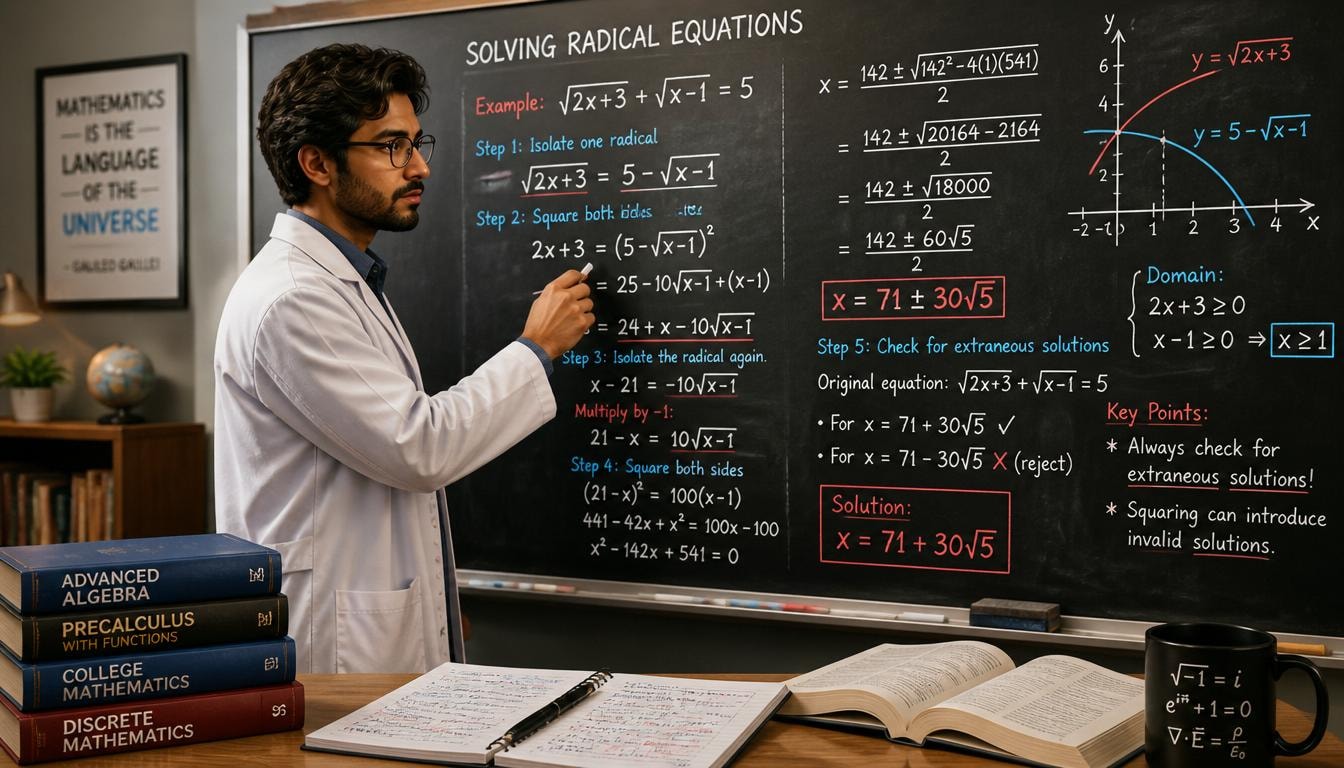
Radical equations can initially seem intimidating. The presence of the radical symbol (√) often makes an algebraic expression look far more complex than it actually is. However, solving radical equations relies on a fundamental principle of algebra: performing inverse operations to isolate the variable. By understanding how to systematically undo radical operations, you can solve even the most intricate equations with confidence.
Now, we will break down the entire process of solving radical equations. We will explore the mathematical foundations of radicals, outline a foolproof step-by-step method for solving them, examine the critical concept of extraneous solutions, tackle advanced equations with multiple radicals, and look at how these equations are applied in real-world science and physics.
1. Understanding the Anatomy of a Radical
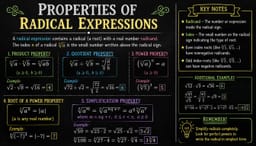
Before diving into the algebraic steps, we must understand the components of a radical expression. A radical expression is written as:
n√x
In this expression, three key terms define what we are working with:
The Radical Symbol (√): The symbol indicating that a root is being taken.
The Radicand (x): The expression or number inside/underneath the radical symbol.
The Index (n): The small number outside the radical that indicates which root is being taken (e.g., 2 for a square root, 3 for a cube root). If no index is written, it is implicitly understood to be a square root (index of 2).
The fundamental rule of solving radical equations is that raising a radical to a power equal to its index eliminates the radical. For example, squaring a square root cancels the root: (√x)2 = x. Similarly, cubing a cube root cancels the root: (3√x)3 = x. This inverse relationship is the key to unlocking every radical equation.
2. The Step-by-Step Method to Solve Simple Radical Equations
To solve an equation containing a single radical, you should follow this structured four-step process:
Isolate the radical expression: Rearrange the equation so that the radical term stands completely alone on one side of the equal sign.
Raise both sides to the power of the index: If it is a square root, square both sides. If it is a cube root, cube both sides. This eliminates the radical symbol.
Solve the remaining equation: Once the radical is gone, solve the resulting linear, quadratic, or polynomial equation using standard algebraic techniques.
Check for extraneous solutions: Substitute your solutions back into the original equation to verify that they are true. This is not an optional step—it is mathematically mandatory.
Example 1: Solving a Basic Square Root Equation
Let's apply these steps to solve the following equation:
√(2x + 3) - 5 = 0
Step 1: Isolate the radical. We need to get √(2x + 3) by itself. We do this by adding 5 to both sides of the equation:
√(2x + 3) = 5
Step 2: Raise both sides to the power of the index. Since this is a square root (index of 2), we square both sides of the equation:
(√(2x + 3))2 = 52
2x + 3 = 25
Step 3: Solve the remaining equation. Now we have a simple linear equation. Subtract 3 from both sides:
2x = 22
Divide by 2:
x = 11
Step 4: Check your solution. Substitute x = 11 back into our original equation:
√(2(11) + 3) - 5 = 0
√(22 + 3) - 5 = 0
√(25) - 5 = 0
5 - 5 = 0 (This is true, so x = 11 is the correct solution!)
3. The Danger of Extraneous Solutions
Why is checking your answer mandatory when solving radical equations? The answer lies in a mathematical phenomenon known as extraneous solutions. An extraneous solution is a root obtained through algebraic manipulation that does not satisfy the original equation.
Extraneous solutions are introduced when we raise both sides of an equation to an even power (such as squaring both sides). Squaring can mask sign differences because both positive and negative numbers yield positive results when squared. For example, consider the statement:
x = -2
If we square both sides of this statement, we get:
x2 = 4
If we solve x2 = 4 by taking the square root, we get x = 2 and x = -2. We have artificially introduced a new solution (x = 2) that was not part of our original statement. When dealing with principal square roots (which are always non-negative by definition), this discrepancy frequently creates false solutions.
Example 2: An Equation with an Extraneous Solution
Let's solve the following equation to see how an extraneous solution appears:
√(x + 2) = x
Step 1: Isolate the radical. The radical is already isolated on the left side.
Step 2: Square both sides.
(√(x + 2))2 = x2
x + 2 = x2
Step 3: Solve the quadratic equation. Rearrange the terms to set the quadratic equation to zero:
x2 - x - 2 = 0
We can factor this quadratic equation:
(x - 2)(x + 1) = 0
This gives us two potential solutions: x = 2 and x = -1.
Step 4: Check the solutions in the original equation.
Let's test x = 2:
√(2 + 2) = 2
√(4) = 2
2 = 2 (This is true, so x = 2 is a valid solution.)
Now let's test x = -1:
√(-1 + 2) = -1
√(1) = -1
1 = -1 (This is false! The principal square root of 1 is positive 1, not negative 1.)
Therefore, x = -1 is an extraneous solution. The only actual, valid solution to the equation is x = 2.
4. Solving Equations with Multiple Radicals
When an equation contains more than one radical, you cannot eliminate all of them in a single step. Instead, you must apply the isolation and squaring process multiple times. Let's look at how to navigate this process systematically.
Example 3: Equation with Two Radicals
Consider the equation:
√(2x + 5) - √(x + 2) = 1
Step 1: Isolate one of the radicals. Let's isolate √(2x + 5) by adding √(x + 2) to both sides:
√(2x + 5) = 1 + √(x + 2)
Step 2: Square both sides. Be very careful here. The right side is a binomial (1 + √(x + 2)), so we must expand it using the FOIL method or the binomial expansion rule (a + b)2 = a2 + 2ab + b2:
(√(2x + 5))2 = (1 + √(x + 2))2
2x + 5 = 1 + 2√(x + 2) + (x + 2)
Simplify the right side:
2x + 5 = x + 3 + 2√(x + 2)
Step 3: Isolate the remaining radical term. Move all non-radical terms to the left side of the equation:
2x + 5 - x - 3 = 2√(x + 2)
x + 2 = 2√(x + 2)
Step 4: Square both sides again. This will eliminate the final radical:
(x + 2)2 = (2√(x + 2))2
x2 + 4x + 4 = 4(x + 2)
x2 + 4x + 4 = 4x + 8
Step 5: Solve the resulting equation. Subtract 4x and 4 from both sides:
x2 = 4
Taking the square root of both sides gives:
x = 2 or x = -2
Step 6: Check both solutions in the original equation.
Test x = 2:
√(2(2) + 5) - √(2 + 2) = √(9) - √(4) = 3 - 2 = 1 (True!)
Test x = -2:
√(2(-2) + 5) - &radic(-2 + 2) = √(1) - √(0) = 1 - 0 = 1 (True!)
In this rare case, both solutions are valid. The solution set is { -2, 2 }.
5. Real-World and Scientific Applications
Radical equations are not just abstract mathematical exercises; they describe critical physical laws in our universe. Here are two prominent examples of radical equations in science:
A. Pendulum Motion (Physics)
The time (T) it takes for a simple pendulum to complete one full swing back and forth is modeled by the following radical equation:
T = 2π√(L / g)
Where L is the length of the pendulum and g is the acceleration due to gravity (approximately 9.8 m/s2). If engineers want to design a clock pendulum with a period of exactly 2 seconds, they must solve this radical equation for L.
B. Escape Velocity (Astrophysics)
To calculate the velocity (v) required for a spacecraft to break free from a planet's gravitational pull, scientists use the escape velocity formula:
v = √(2GM / R)
Where G is the gravitational constant, M is the mass of the planet, and R is the radius of the planet. Solving this equation allows astronomers to determine the physical dimensions of celestial bodies based on observed velocities.
6. Key Takeaways and Summary
Solving radical equations is a straightforward process when approached systematically. Keep these core principles in mind to avoid common mistakes:
Isolate before you power: Never square or cube both sides of an equation until you have isolated a radical term. Doing so prematurely makes the algebra incredibly difficult.
Match the power to the index: Square to remove square roots, cube to remove cube roots, and raise to the n-th power to remove n-th roots.
Always expand binomials properly: Remember that (a + b)2 is not equal to a2 + b2. You must use the distributive property.
The "Check Step" is mandatory: Because squaring both sides can introduce extraneous solutions, you must always plug your final answers back into the original equation to verify them.