Understanding how to manipulate these expressions is essential for solving complex equations and simplifying mathematical models. While radicals can initially look intimidating, the rules governing their addition, subtraction, multiplication, and division are closely related to the basic algebraic principles you already know, such as combining like terms and the distributive property.
In this comprehensive guide, we will break down the step-by-step methods for performing the four basic arithmetic operations on radical expressions. We will explore the mathematical theories behind these operations, walk through detailed examples, and learn how to handle advanced scenarios like rationalizing denominators.
Understanding the Anatomy of a Radical
Before we perform operations on radicals, it is crucial to understand their components. A standard radical expression is written as:
n√x
Where:
√ is the radical symbol.
x is the radicand (the number or expression inside the radical).
n is the index (which represents the root, such as 2 for a square root, 3 for a cube root, etc.). If no index is written, it is understood to be a square root (index of 2).
The Essential Prerequisite: Simplifying Radicals
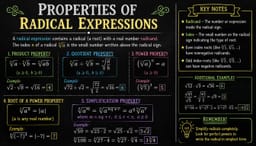
To perform arithmetic operations efficiently, you must first know how to simplify radicals. A radical is in its simplest form when the radicand contains no factors that can be written as perfect powers of the index. This is based on the Product Property of Radicals:
n√(a · b) = n√a · n√b
For example, to simplify √18:
Find the largest perfect square factor of 18, which is 9.
Write 18 as 9 · 2.
Apply the product property: √18 = √9 · √2.
Simplify the perfect square: 3√2.
How to Add and Subtract Radical Expressions
Adding and subtracting radical expressions is highly analogous to combining like terms in polynomial algebra. Just as you can only add 3x and 5x to get 8x, you can only add or subtract like radicals.
What Are Like Radicals?
Like radicals are radical expressions that have the same index and the same radicand. For example:
3√5 and 7√5 are like radicals (index 2, radicand 5).
23√7 and -53√7 are like radicals (index 3, radicand 7).
3√5 and 3√2 are not like radicals (different radicands).
√5 and 3√5 are not like radicals (different indexes).
The Rule for Addition and Subtraction
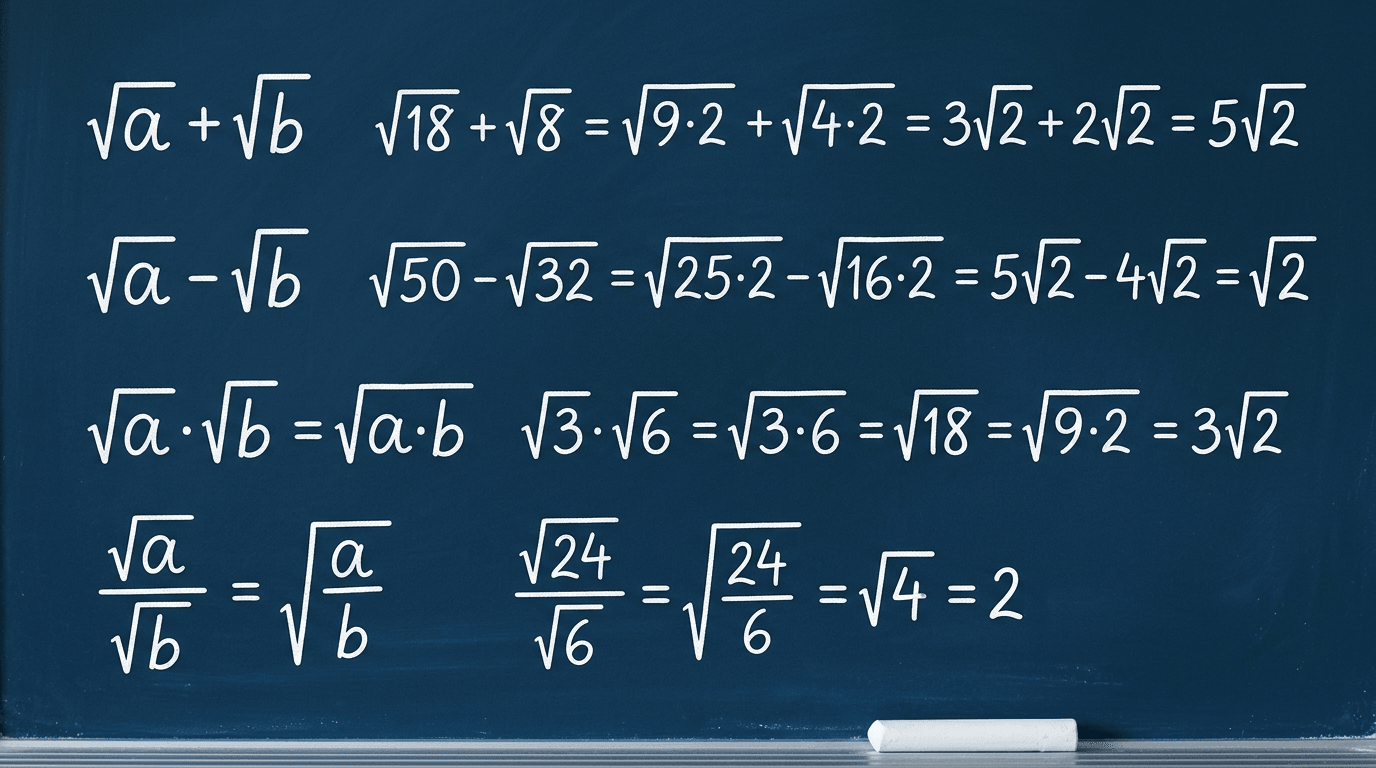
When adding or subtracting like radicals, you add or subtract their coefficients (the numbers outside the radical) and keep the common radical part unchanged:
an√x + bn√x = (a + b)n√x
Step-by-Step Example (Simplification Required)
Often, radicals do not look like "like radicals" at first glance. You must simplify them first to see if they can be combined.
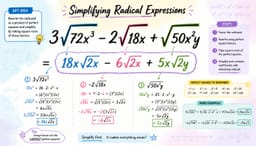
Problem: Simplify 5√12 + √27 - 2√3
Simplify each term:
5√12 = 5 · √(4 · 3) = 5 · 2√3 = 10√3
√27 = √(9 · 3) = 3√3
2√3 is already simplified.
Rewrite the expression: 10√3 + 3√3 - 2√3
Combine the coefficients: (10 + 3 - 2)√3 = 11√3
How to Multiply Radical Expressions
Unlike addition and subtraction, multiplication does not require the radicands to be identical. However, the indexes must be the same. Multiplication relies directly on the Product Property of Radicals.
Multiplying Monomial Radicals
To multiply single-term radical expressions, multiply the coefficients together and the radicands together:
(an√x) · (bn√y) = (a · b)n√(x · y)
Example: Multiply 3√6 · 5√2
Multiply the coefficients: 3 · 5 = 15
Multiply the radicands: √6 · √2 = √12
Combine them: 15√12
Simplify the result: 15√(4 · 3) = 15 · 2√3 = 30√3
Multiplying Binomial Radicals (FOIL Method)
When multiplying expressions containing two terms, use the distributive property or the FOIL (First, Outer, Inner, Last) method.
Example: Multiply (2 + √3)(4 - √3)
First: 2 · 4 = 8
Outer: 2 · (-√3) = -2√3
Inner: √3 · 4 = 4√3
Last: √3 · (-√3) = -√9 = -3
Combine like terms: 8 - 2√3 + 4√3 - 3 = (8 - 3) + (-2 + 4)√3 = 5 + 2√3
How to Divide Radical Expressions
Division of radicals utilizes the Quotient Property of Radicals, which states that the root of a quotient is equal to the quotient of the roots:
n√(x / y) = n√x / n√y (where y ≠ 0)
Simplifying Quotients Directly
If the radicands can be divided directly to yield a whole number or a simpler fraction, do that first.
Example: Simplify √72 / √8
Apply the quotient property to combine them under one radical: √(72 / 8)
Divide the numbers: √9
Simplify: 3
Rationalizing the Denominator
In mathematics, it is standard convention not to leave a radical in the denominator of a simplified fraction. The process of eliminating a radical from the denominator is called rationalizing the denominator.
Case 1: Monomial Denominator (Square Root)
If the denominator is a simple square root, multiply both the numerator and the denominator by that same square root.
Example: Simplify 5 / √3
Multiply numerator and denominator by √3: (5 · √3) / (√3 · √3)
Simplify the denominator: √3 · √3 = √9 = 3
Result: 5√3 / 3
Case 2: Binomial Denominator (Using Conjugates)
If the denominator contains a binomial with one or more square roots (such as a + √b), you must multiply the numerator and denominator by the conjugate of the denominator. The conjugate of (a + √b) is (a - √b).
This technique relies on the difference of squares identity: (x - y)(x + y) = x2 - y2, which effectively eliminates the radical terms.
Example: Simplify 3 / (5 - √2)
Identify the conjugate of the denominator (5 - √2), which is (5 + √2).
Multiply numerator and denominator by the conjugate:
[3 · (5 + √2)] / [(5 - √2) · (5 + √2)]Expand the numerator: 15 + 3√2
Expand the denominator using the difference of squares: 52 - (√2)2 = 25 - 2 = 23
Combine the results: (15 + 3√2) / 23
Key Summary of Rules
To master operations with radical expressions, keep these core rules in mind:
Addition/Subtraction: Only combine like radicals (same index, same radicand) by adding/subtracting their coefficients.
Multiplication: Multiply coefficients with coefficients, and radicands with radicands (indexes must match).
Division: Divide coefficients with coefficients, and radicands with radicands.
Rationalization: Always ensure no radical terms remain in the denominator of your final answer.