In mathematics, we often look for ways to reverse operations. We know that addition is undone by subtraction, and multiplication is undone by division. But what happens when we scale numbers into the third dimension? When we multiply a number by itself three times, we "cube" it. The mathematical tool used to reverse this process is called the cube root.
Understanding cube roots is a fundamental milestone in algebra, geometry, and physics. Whether you are calculating the side length of a physical container, analyzing three-dimensional space, or solving complex algebraic equations, the cube root is an indispensable concept. In this comprehensive guide, we will explore what a cube root is, examine its physical and geometric foundations, look at its unique mathematical properties, and learn how to calculate and estimate it.
The Geometric Foundation: Thinking in Three Dimensions
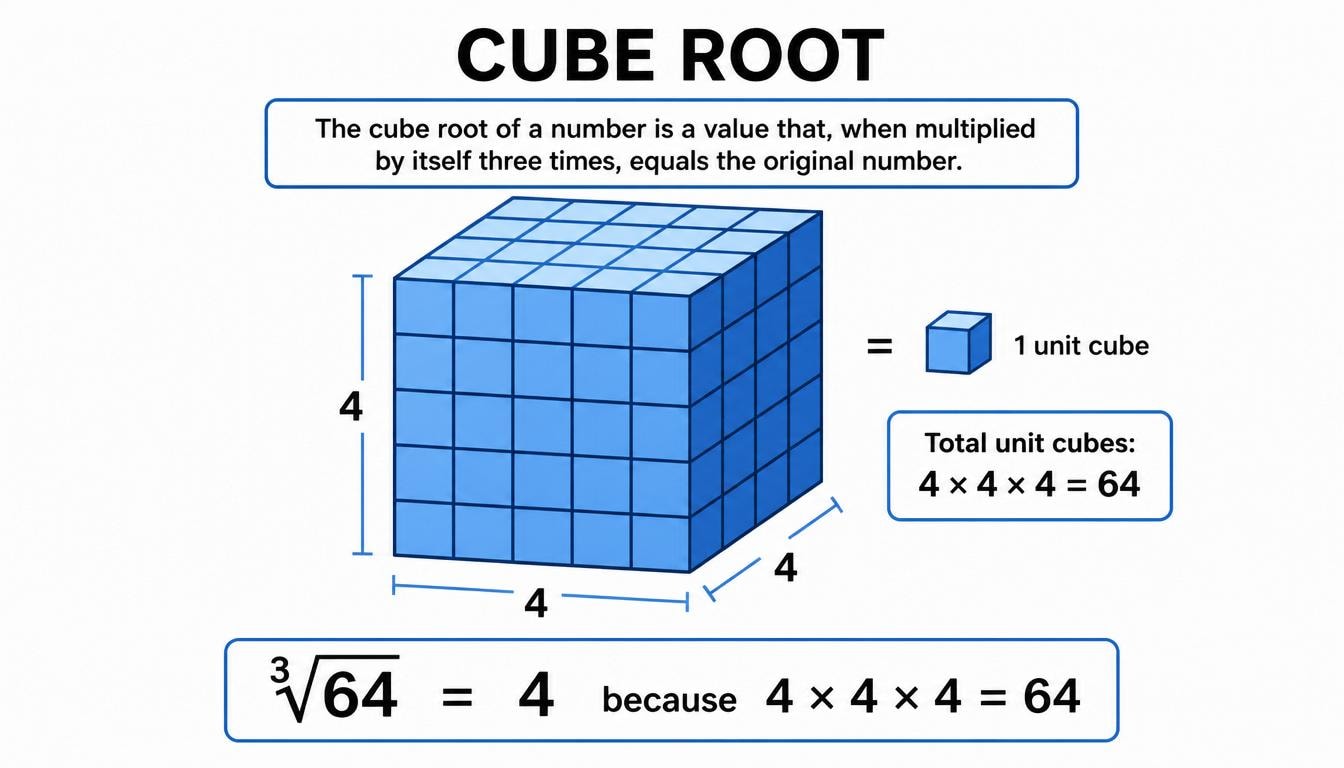
To truly grasp the concept of a cube root, it helps to start with physical geometry. Imagine you have a set of small, identical wooden blocks, each measuring 1 unit on all sides (a 1x1x1 unit cube).
If you want to build a larger, perfect solid cube using these blocks, you cannot just add blocks randomly. You must build equal dimensions of length, width, and height:
To make a cube with a side length of 2 units, you need 2 × 2 × 2 = 8 blocks.
To make a cube with a side length of 3 units, you need 3 × 3 × 3 = 27 blocks.
To make a cube with a side length of 4 units, you need 4 × 4 × 4 = 64 blocks.
The Geometric Definition: If you are given the total volume of a perfect physical cube, the cube root is the measurement of just one of its edge lengths.
If someone hands you a box containing exactly 125 cubic units of volume and tells you it is a perfect cube, finding the cube root of 125 means finding the length of one side. Since 5 × 5 × 5 = 125, the side length—and therefore the cube root—is 5.
The Mathematical Definition of a Cube Root
In algebra, the cube root of a number x is a number y such that when y is multiplied by itself three times, it equals x. We write this relationship as:
y³ = x which means ³√x = y
The symbol used for the cube root is the radical symbol (√) with a small number 3 (called the index) nestled in the upper left: ³√. This index is crucial because it distinguishes the cube root from the standard square root, which has an implied index of 2.
Key Properties of Cube Roots
Cube roots have unique properties that make them distinct from square roots. Understanding these properties is essential for solving algebraic equations correctly.
1. Cube Roots of Negative Numbers Exist
One of the most important differences between square roots and cube roots involves negative numbers. In the real number system, you cannot take the square root of a negative number because multiplying any real number (positive or negative) by itself always results in a positive number (e.g., -2 × -2 = 4).
However, this is not true for cube roots. When you multiply a negative number by itself three times, the result remains negative:
(-2) × (-2) × (-2) = -8
Because of this, the cube root of -8 is exactly -2. We write this as ³√(-8) = -2. Every real number—whether positive, negative, or zero—has exactly one real cube root.
2. Single Real Solution
Unlike square roots, which have both a positive and a negative root (for example, the square roots of 9 are both 3 and -3), every real number has only one unique real-number cube root. The sign of the cube root always matches the sign of the original number:
The cube root of a positive number is always positive.
The cube root of a negative number is always negative.
The cube root of zero is always zero (³√0 = 0).
Perfect Cubes
A perfect cube is an integer whose cube root is also an integer. Memorizing the first few perfect cubes can greatly speed up your mathematical calculations. Here is a table of the most common perfect cubes and their corresponding cube roots:
Integer (y) The Cube (y³ = x) The Cube Root (³√x = y) 1 1 ³√1 = 1 2 8 ³√8 = 2 3 27 ³√27 = 3 4 64 ³√64 = 4 5 125 ³√125 = 5 6 216 ³√216 = 6 7 343 ³√343 = 7 8 512 ³√512 = 8 9 729 ³√729 = 9 10 1000 ³√1000 = 10
How to Calculate Cube Roots
If you are dealing with a non-perfect cube, finding the exact cube root can be more challenging because the answer will be an irrational number (a decimal that goes on forever without repeating). Here are the primary methods used to find or estimate cube roots:
Method 1: Prime Factorization (For Perfect Cubes)
For larger numbers that you suspect are perfect cubes, prime factorization is an excellent, systematic approach. Here is how to do it step-by-step:
Find the prime factors of the target number.
Group the identical prime factors into sets of three.
Take one number from each group and multiply them together.
Example: Find ³√216
Find the prime factorization of 216: 216 = 2 × 2 × 2 × 3 × 3 × 3
Group them into triplets: (2 × 2 × 2) × (3 × 3 × 3)
Take one representative from each triplet: 2 × 3
Multiply them: 2 × 3 = 6
Therefore, ³√216 = 6.
Method 2: Estimation (For Non-Perfect Cubes)
When a number is not a perfect cube, you can estimate its value by placing it between two known perfect cubes.
Example: Estimate ³√30
Identify the perfect cubes closest to 30. Looking at our list, we see that 27 (which is 3³) and 64 (which is 4³) sandwich our number: 27 < 30 < 64.
This tells us that the cube root of 30 must lie between 3 and 4: 3 < ³√30 < 4.
Because 30 is much closer to 27 than it is to 64, we can estimate that the cube root is only slightly larger than 3. A reasonable guess would be around 3.1.
If we check this guess: 3.1 × 3.1 × 3.1 = 29.791, which is incredibly close to 30!
Real-World Applications of Cube Roots
While cube roots might seem like abstract algebra, they are frequently used in science, technology, engineering, and daily life:
Packaging and Shipping: If a company needs to design a cube-shaped box that can hold a specific volume of liquid or packing material, they use the cube root of the volume to determine the exact dimensions of the cardboard needed to manufacture the box.
Astronomy and Astrophysics: Kepler's Third Law of Planetary Motion states that the square of a planet's orbital period is proportional to the cube of its semi-major axis. Calculating these distances requires the use of cube roots.
Material Science and Chemistry: When studying the crystal structures of metals or salts, scientists use cube roots to calculate the distance between atoms based on the density and total volume of the unit cell.
Summary of Key Takeaways
To wrap up, here are the most important things to remember about cube roots:
The cube root of a number is the value that, when multiplied by itself three times, yields the original number.
Geometrically, the cube root of a volume represents the side length of a perfect cube.
Unlike square roots, you can take the cube root of negative numbers.
Every real number has exactly one real cube root, which shares the same sign as the original number.
For non-perfect cubes, you can easily estimate the value by finding the nearest surrounding perfect cubes.