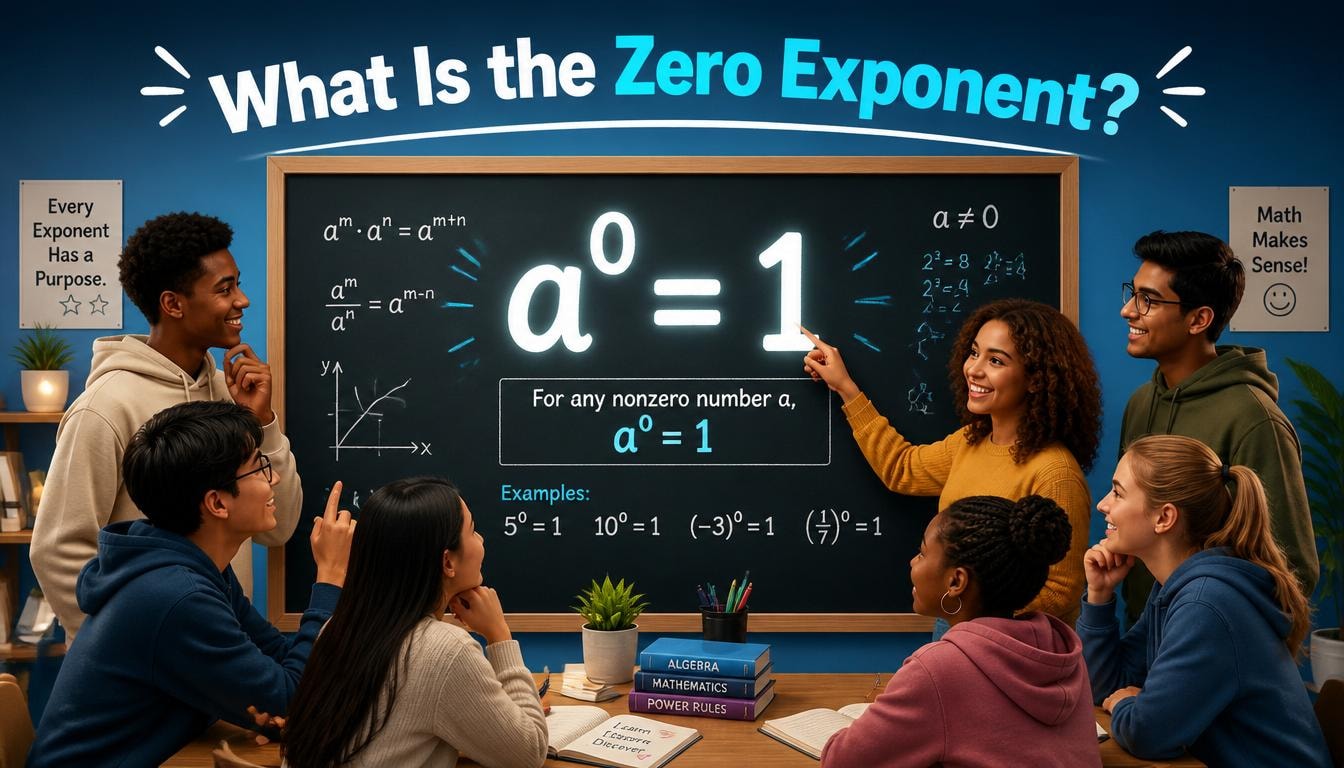
In mathematics, some rules feel immediately intuitive. For instance, when we learn that multiplication is repeated addition, it makes perfect sense that 3 × 4 means adding three four times. When we are introduced to exponents, we are often told that exponentiation is simply "repeated multiplication." Under this definition, 23 means multiplying 2 by itself three times: 2 × 2 × 2 = 8. This explanation works beautifully for positive integer exponents.
However, this intuitive definition quickly breaks down when we encounter a strange mathematical phenomenon: the zero exponent. If an exponent tells us how many times to multiply a number by itself, how can we multiply a number by itself "zero times"? And why, when we do so, is the result almost always 1?
In this comprehensive guide, we will demystify the zero exponent rule. We will explore why any non-zero number raised to the power of zero equals one (x0 = 1) through logical patterns, algebraic proofs, and the concept of the multiplicative identity. We will also tackle the ultimate mathematical paradox: what happens when we raise zero to the power of zero?
The Intuitive Trap of "Repeated Multiplication"
To understand the zero exponent, we first have to recognize the limits of our initial understanding of exponents. If you ask a student to explain xn, they will likely say, "It means multiplying x by itself n times." Let's test this definition with different exponents:
53: Multiply 5 by itself 3 times → 5 × 5 × 5 = 125. (Makes sense!)
51: Multiply 5 by itself 1 time → 5. (A bit strange, but still manageable.)
50: Multiply 5 by itself 0 times → ???
If we strictly follow the "repeated multiplication" definition, a zero exponent should mean we have "no fives at all," which might lead us to assume the answer is 0. However, this assumption is incorrect. Mathematics is a system built on consistency and logical progression. To find the true meaning of the zero exponent, we must look at the patterns that govern exponents.
Method 1: The Inductive Approach (Finding the Pattern)
One of the most powerful ways to understand the zero exponent is to look at a decreasing pattern of powers. Let's construct a table using base 2 and observe what happens as we decrease the exponent by 1 at each step.
Powers of 2:
24 = 16
23 = 8
22 = 4
21 = 2
20 = ?
Look closely at the results on the right side of the equations: 16, 8, 4, 2. What mathematical operation occurs as we move down from one row to the next?
Each step down is equivalent to dividing the previous value by the base (2):
To get from 16 to 8, we divide by 2 (16 / 2 = 8).
To get from 8 to 4, we divide by 2 (8 / 2 = 4).
To get from 4 to 2, we divide by 2 (4 / 2 = 2).
To maintain the logical consistency of this mathematical pattern, we must apply the exact same rule to find the value of 20. We take the value of 21 (which is 2) and divide it by the base (2):
20 = 2 / 2 = 1
This pattern is not unique to base 2. Let's try it with base 10:
Powers of 10:
103 = 1000
102 = 100 (divided by 10)
101 = 10 (divided by 10)
100 = 1 (10 divided by 10 = 1)
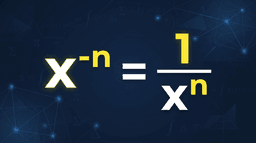
By extending this pattern, we can even discover the meaning of negative exponents. If we decrease the exponent further, we continue dividing by the base:
100 = 1
10-1 = 1 / 10 = 0.1
10-2 = 0.1 / 10 = 0.01
This inductive reasoning demonstrates that defining x0 as 1 is not an arbitrary rule; it is a logical necessity required to keep the laws of arithmetic consistent.
Method 2: The Deductive Approach (The Quotient Rule of Exponents)
While patterns are highly convincing, mathematicians prefer formal algebraic proofs. We can prove that any non-zero number raised to the power of zero is 1 by using the Quotient Rule of Exponents.
The Quotient Rule states that when you divide two exponential terms with the same base, you subtract the exponent in the denominator from the exponent in the numerator:
xa / xb = xa - b (where x ≠ 0)
Let us apply this rule to a specific case where the exponent in the numerator is equal to the exponent in the denominator (a = b). For example, let's look at the expression:
x3 / x3
We can evaluate this expression in two different ways:
Using the Quotient Rule:
x3 / x3 = x3 - 3 = x0Using basic arithmetic:
We know that any non-zero number divided by itself is equal to 1. For example, 5/5 = 1, and 100/100 = 1. Therefore:
x3 / x3 = 1
Because both methods are mathematically valid, their results must be equal to each other. Therefore, we can set them equal:
x0 = 1
This elegant algebraic proof shows that the zero exponent is a natural consequence of the rules of division and exponents working together.
Method 3: The Concept of the Multiplicative Identity
To resolve the conceptual conflict of "multiplying a number zero times," we can introduce a fundamental concept in arithmetic: the multiplicative identity.
In arithmetic, the number 1 is the multiplicative identity because multiplying any number by 1 does not change its value (1 × y = y). When we perform multiplication, we always have an implicit starting point of 1.
We can rewrite our understanding of positive exponents by starting each expression with the multiplicative identity:
x3 = 1 × x × x × x (Start with 1, multiply by x three times)
x2 = 1 × x × x (Start with 1, multiply by x twice)
x1 = 1 × x (Start with 1, multiply by x once)
x0 = 1 (Start with 1, multiply by x zero times)
When viewed through the lens of the multiplicative identity, the zero exponent makes perfect sense. Raising a number to the power of zero simply means we do not apply any multiplication to our starting identity element, leaving us with a clean, unaltered 1.
The Ultimate Paradox: What Is Zero to the Power of Zero (00)?
Now that we have established that x0 = 1, we must address the major exception to this rule. What happens when the base itself is zero? What is 00?
This question is a classic mathematical battleground because it pits two fundamental mathematical principles against each other:
The Zero Exponent Rule: Any number raised to the power of 0 is 1. Under this rule, 00 should equal 1.
The Zero Base Rule: Zero raised to any positive power is 0 (e.g., 02 = 0 × 0 = 0). Under this rule, 00 should equal 0.
So, which rule wins? The answer depends on the context of the mathematics being used:
1. In Algebra and Calculus: It is Indeterminate / Undefined
In general arithmetic and calculus, 00 is considered undefined or an indeterminate form. To understand why, we can look at our division proof from earlier: x0 = xn / xn. If we substitute x = 0, we get:
00 = 0n / 0n = 0 / 0
Division by zero is undefined in mathematics. Furthermore, in calculus, if you analyze the limit of the function f(x, y) = xy as both x and y approach 0, the limit can equal many different values depending on the path taken. Therefore, to prevent logical contradictions, mathematicians leave 00 undefined in these contexts.
2. In Discrete Mathematics and Combinatorics: It Is Defined as 1
In branches of mathematics like combinatorics, set theory, and algebra involving power series (such as the Binomial Theorem), it is highly convenient to define 00 = 1. Without this definition, many elegant formulas would require cumbersome extra terms to handle special cases involving zero. For example, the polynomial expansion formula:
∑ an xn
would fail at x = 0 for the first term (n = 0) if 00 were not evaluated as 1.
Common Misconceptions to Avoid
When working with zero exponents, students frequently make a few common errors. Keep these in mind to ensure accuracy:
1. Confusing x0 with 0
The most common mistake is assuming that any expression involving a zero exponent must equal zero. Always remember: x0 = 1 (for x ≠ 0). Do not let the presence of the number zero trick you into thinking the final value is zero.
2. The Placement of Negative Signs
Pay close attention to parentheses when negative numbers are raised to the power of zero. The order of operations (PEMDAS/BODMAS) dictates that exponents are evaluated before multiplication (including negation):
(-5)0 = 1: Here, the entire negative number -5 is raised to the power of zero.
-50 = -1: Here, only the 5 is raised to the power of zero, which equals 1. The negative sign is applied afterward, resulting in -1.
Key Takeaways
The Rule: Any non-zero number raised to the power of zero is equal to 1 (x0 = 1).
The Logic: This rule is supported by the decreasing patterns of exponents, the quotient rule of division (xn/xn), and the concept of the multiplicative identity.
The Exception: 00 is a special case. It is generally considered undefined or indeterminate in calculus, but is often defined as 1 in algebra and combinatorics for convenience.
Order of Operations: Be careful with negative signs; (-x)0 evaluates to 1, while -x0 evaluates to -1.
Understanding the zero exponent is a major milestone in a student's mathematical journey. It marks the transition from viewing math as a set of rigid, physical instructions ("multiply this many times") to viewing it as a beautiful, interconnected system of logical structures and patterns.