Exponential expressions are one of the most powerful tools in mathematics. They allow us to represent incredibly large numbers, like the distance between galaxies, or microscopic quantities, such as the size of a single bacterium, in a highly compact form. Whether you are analyzing biological cell division, calculating compound interest, measuring the seismic intensity of an earthquake, or determining the storage capacity of a computer's solid-state drive, you will inevitably encounter exponents.
However, working with exponents requires a solid understanding of their unique algebraic rules. Unlike simple arithmetic, you cannot always add, subtract, multiply, or divide exponential expressions in a straightforward manner. In this comprehensive guide, we will break down the fundamental properties of exponents, explore how to perform the four basic arithmetic operations on them, and examine the logical proofs behind these rules using step-by-step examples.
1. The Anatomy of an Exponential Expression
Before diving into arithmetic operations, let us define what an exponential expression is. An exponential expression consists of two primary components:
The Base (a): The number or variable that is being repeatedly multiplied by itself.
The Exponent or Power (n): The number of times the base is used as a factor.
Written algebraically, it looks like this:
an
For example, in the expression 34, the base is 3 and the exponent is 4. This means 3 is multiplied by itself 4 times: 3 × 3 × 3 × 3 = 81.
Expanding to Rational Bases and Integer Exponents
While we often begin learning exponents with positive integers, the base can be any rational number (such as fractions or decimals), and the exponent can be any integer (positive, negative, or zero).
Let's look at how we define zero and negative exponents by observing a natural mathematical pattern. Consider the powers of 3:
33 = 27
32 = 9 (divided by 3)
31 = 3 (divided by 3)
If we continue this pattern of dividing by the base (3) to decrease the exponent by 1, we get:
30 = 3 ÷ 3 = 1
3-1 = 1 ÷ 3 = 1/3
3-2 = (1/3) ÷ 3 = 1/9 = 1/32
This pattern helps us establish two fundamental rules of exponents:
The Zero Exponent Rule: Any non-zero base raised to the power of 0 is equal to 1. (a0 = 1, where a ≠ 0).
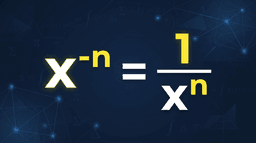
The Negative Exponent Rule: A negative exponent represents the reciprocal of the base raised to the positive power. (a-n = 1/an, where a ≠ 0).
2. How to Multiply Exponential Expressions
Multiplication of exponential expressions depends entirely on whether the bases or the exponents are the same. Let's look at the two primary rules.
Rule A: Multiplying Expressions with the Same Base
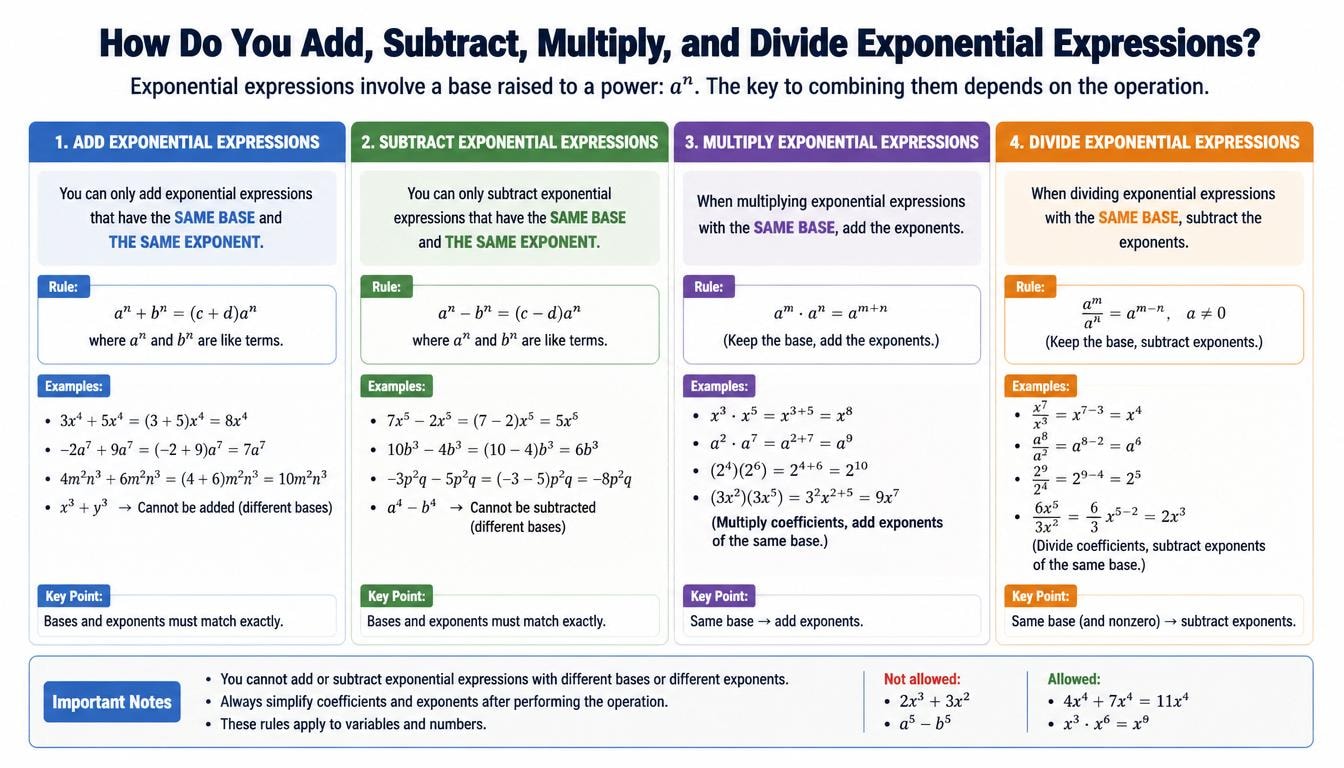
When multiplying exponential expressions that have the exact same base, you keep the base unchanged and add the exponents. This is known as the Product of Powers Rule.
am × an = am + n
Why does this work? Let's prove this rule by expanding the terms. Suppose we want to multiply 23 by 24:
Expand 23: (2 × 2 × 2)
Expand 24: (2 × 2 × 2 × 2)
Multiply them together: (2 × 2 × 2) × (2 × 2 × 2 × 2) = 2 × 2 × 2 × 2 × 2 × 2 × 2
Count the factors: there are 7 factors of 2 in total. Therefore, 23 × 24 = 23 + 4 = 27 = 128.
Example with a Rational Base and Negative Exponents:
Let's multiply (1/2)-3 × (1/2)5:
(1/2)-3 + 5 = (1/2)2 = 1/4
Rule B: Multiplying Expressions with Different Bases but the Same Exponent
If the bases are different but the exponents are the same, you multiply the bases together and keep the common exponent. This is the Power of a Product Rule.
an × bn = (a × b)n
Example: Simplify 23 × 53.
Using the rule: (2 × 5)3 = 103 = 1000.
Verification by expansion: 23 = 8 and 53 = 125. Since 8 × 125 = 1000, the rule is verified.
3. How to Divide Exponential Expressions
Just as multiplication is connected to addition, division of exponential expressions is naturally connected to subtraction.
Rule A: Dividing Expressions with the Same Base
When dividing exponential expressions with the same base, you keep the base and subtract the exponent of the denominator from the exponent of the numerator. This is the Quotient of Powers Rule.
am ÷ an = am - n (where a ≠ 0)
Why does this work? Let's expand 55 ÷ 52:
Write it as a fraction: (5 × 5 × 5 × 5 × 5) / (5 × 5)
We can cancel out two factors of 5 from both the numerator and the denominator:
(&sout;5 × &sout;5 × 5 × 5 × 5) / (&sout;5 × &sout;5) = 5 × 5 × 5 = 53
This matches our rule: 55 - 2 = 53 = 125.
Example with Negative Exponents:
Simplify 43 ÷ 4-2:
Apply the subtraction rule: 43 - (-2) = 43 + 2 = 45 = 1024.
Rule B: Dividing Expressions with Different Bases but the Same Exponent
When the bases are different but the exponents are identical, you divide the bases first and keep the exponent. This is the Power of a Quotient Rule.
an ÷ bn = (a / b)n (where b ≠ 0)
Example: Simplify 124 ÷ 44.
Using the rule: (12 ÷ 4)4 = 34 = 81.
4. How to Add and Subtract Exponential Expressions
Adding and subtracting exponential expressions is where many students make mistakes. Crucial Warning: There is no direct property of exponents for addition or subtraction. That is:
am + an ≠ am + n (This is a common mathematical error!)
To add or subtract exponential expressions, you must evaluate them individually or use algebraic factoring techniques.
Method 1: Direct Evaluation (For Concrete Numbers)
If the expressions consist of small, manageable numbers, simply evaluate each exponential term first, then perform the addition or subtraction.
Example: Calculate 33 + 24.
Step 1: Evaluate 33 = 27.
Step 2: Evaluate 24 = 16.
Step 3: Add the values: 27 + 16 = 43.
Method 2: Factoring Out the Greatest Common Factor (For Large or Algebraic Terms)
If the bases are the same but the exponents are large or contain variables, you can simplify the expression by factoring out the lowest power of the base.
Example 1: Simplify 512 - 510.
Calculating 512 directly is impractical without a calculator. Instead, identify the greatest common factor, which is the term with the smaller exponent: 510.
Rewrite 512 as 510 × 52 using our multiplication rule.
Now rewrite the subtraction: (510 × 52) - (510 × 1)
Factor out 510: 510(52 - 1)
Simplify the expression inside the parentheses: 510(25 - 1) = 510(24) = 24 × 510.
Example 2: Simplify 3x+2 + 3x.
Factor out the lowest power, which is 3x:
3x(32 + 1) = 3x(9 + 1) = 10 × 3x.
5. The Power of a Power Rule
What happens when you raise an exponential expression to another power? For instance, what is (am)n?
In this case, you keep the base and multiply the exponents together.
(am)n = am × n
Why does this work? Let's evaluate (42)3:
The exponent 3 outside the parentheses means we repeat the inside expression 3 times as a factor:
(42) × (42) × (42)
Using our rule for multiplying expressions with the same base, we add the exponents: 42 + 2 + 2 = 46.
This is exactly the same as multiplying the exponents: 42 × 3 = 46 = 4096.
6. Real-World Applications of Exponential Operations
Understanding how to manipulate and calculate exponential expressions is not just an academic exercise. It is a vital skill across many scientific disciplines:
Seismology (Earthquake Intensity): The Richter scale is logarithmic, meaning each whole number increase on the scale represents a 10-fold increase in measured amplitude. If one earthquake measures 7.0 and another measures 5.0, the difference in ground motion is calculated using division of exponents: 107 ÷ 105 = 107 - 5 = 102 = 100 times stronger.
Biology (Cell Division & Bacterial Growth): Under ideal conditions, certain bacteria double every hour. If you start with 1 bacterium, the population after t hours is 2t. To find how many times larger a colony is at 10 hours compared to 6 hours, we divide: 210 ÷ 26 = 24 = 16 times larger.
Computer Science (Data Storage): Digital storage scales exponentially. A Kilobyte is 210 bytes, and a Megabyte is 220 bytes. To find out how many Kilobytes are in a Megabyte, we divide: 220 ÷ 210 = 220 - 10 = 210 = 1024 Kilobytes.
7. Summary Checklist of Exponent Rules
To ensure you never get confused, keep this quick-reference summary of exponent rules handy:
Operation / Rule Algebraic Formula Concrete Example Product of Powers (Same Base) am × an = am+n 32 × 34 = 36 = 729 Product of Powers (Different Base) an × bn = (ab)n 23 × 53 = 103 = 1000 Quotient of Powers (Same Base) am ÷ an = am-n 65 ÷ 63 = 62 = 36 Power of a Power (am)n = am×n (23)2 = 26 = 64 Negative Exponent a-n = 1 / an 5-2 = 1/25 = 0.04 Zero Exponent a0 = 1 9990 = 1
By mastering these rules and practicing the structural derivations shown above, you will be able to tackle any algebraic equation involving exponents with ease and precision!