Exponential equations might look intimidating at first glance. With variables hanging high up in the exponents, they seem to defy the standard rules of basic algebra. However, solving these equations is not only highly systematic but also deeply connected to the natural world. From tracking the rapid spread of a biological virus to calculating the decay of radioactive waste, or even estimating the magnitude of an earthquake on the Richter scale, exponential equations are the mathematical language of growth and decay.
In this comprehensive guide, we will break down exactly how to solve exponential equations. We will explore the fundamental properties of exponents, examine different solving strategies depending on the nature of the equation, walk through step-by-step examples, and analyze real-world applications that bring these concepts to life.
1. Anatomy of an Exponential Expression
Before we dive into solving equations, we must understand the building blocks. An exponential expression is written in the form bx, where:
b is the base (a positive real number, where b ≠ 1).
x is the exponent (or power), which can be any real number, including positive and negative integers, zero, or rational numbers.
The Zero and Negative Exponent Rules
To solve advanced equations, you must be comfortable with exponents that are zero or negative. We can discover these rules by looking at a decreasing division pattern. Consider the powers of 3:
33 = 27
32 = 9 (divided by 3)
31 = 3 (divided by 3)
If we continue this logical division pattern, we naturally find the values for zero and negative exponents:
30 = 1 (since 3 ÷ 3 = 1)
3-1 = 1/3 (since 1 ÷ 3 = 1/3)
3-2 = 1/9 (since 1/3 ÷ 3 = 1/9)
The Rules:
1. Zero Exponent Rule: b0 = 1 (for any non-zero base b).
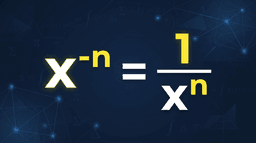
2. Negative Exponent Rule: b-n = 1 / bn.
The Pitfalls of Negative Bases and Parentheses
A common point of confusion for students is how negative signs interact with exponents. It is vital to distinguish between the following expressions:
(-a)n: The negative sign is inside the parentheses, meaning the entire negative number is multiplied repeatedly. For example, (-3)2 = (-3) × (-3) = 9.
-an: The negative sign is outside. The exponent is applied first, and then the result is negated. For example, -32 = -(3 × 3) = -9.
2. Fundamental Laws of Exponents
To manipulate and solve exponential equations, you must have these algebraic laws memorized and ready to apply:
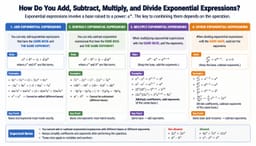
Product of Powers Rule: bx × by = bx+y
Quotient of Powers Rule: bx / by = bx-y
Power of a Power Rule: (bx)y = bx × y
Power of a Product Rule: (a × b)x = ax × bx
Power of a Quotient Rule: (a / b)x = ax / bx
3. Step-by-Step Methods to Solve Exponential Equations
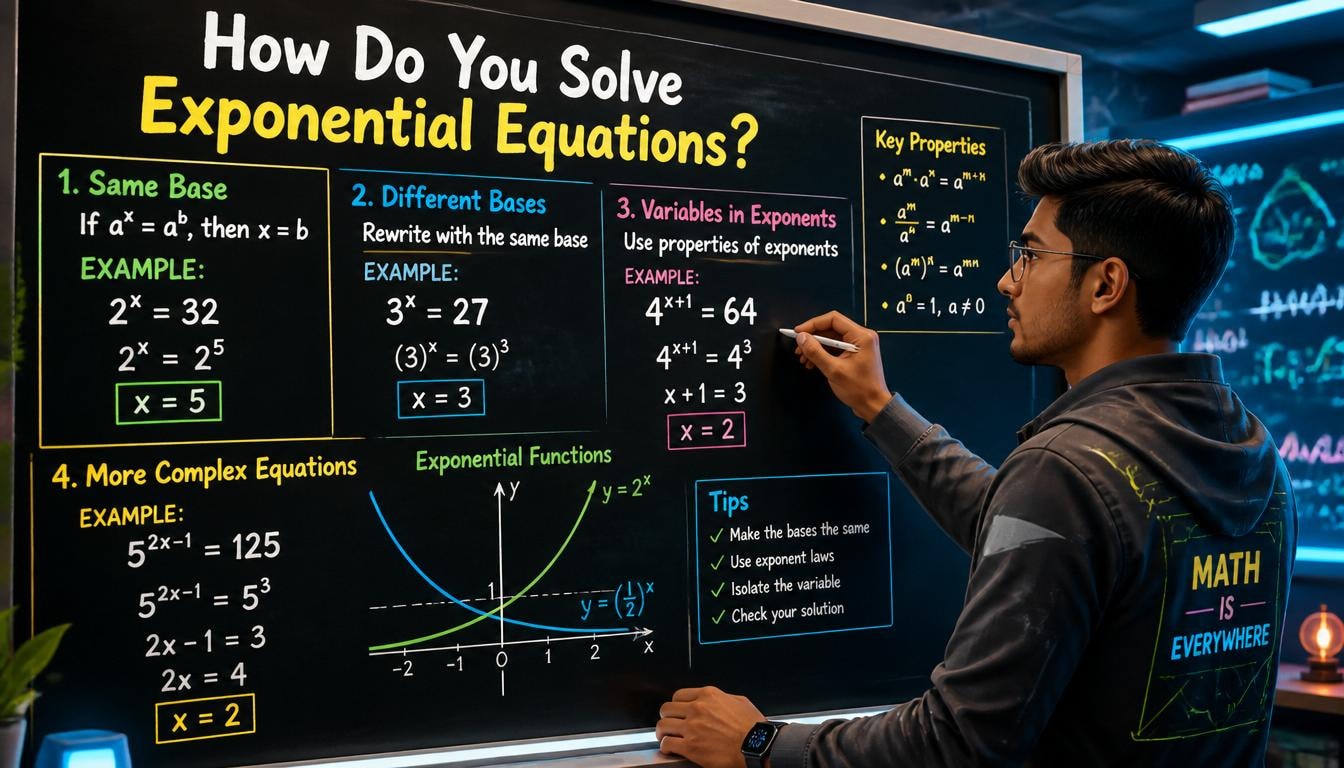
Depending on the complexity of the equation, we generally use one of three primary methods to solve for the unknown variable.
Method A: Equating the Bases (The Property of Equality)
This is the most straightforward method and is used when both sides of the equation can be written with the same base. The core mathematical principle here is:
If bx = by, then x = y (where b > 0 and b ≠ 1).
Example 1 (Integer Base): Solve 2x+3 = 16.
Step 1: Express both sides using the same base. We know that 16 can be written as a power of 2, specifically 24.
2x+3 = 24
Step 2: Equate the exponents. Since the bases are now identical, we set their exponents equal to each other:
x + 3 = 4
Step 3: Solve the resulting linear equation.
x = 1
Example 2 (Rational/Fractional Base): Solve (2/3)x-1 = 27/8.
Step 1: Analyze the bases. The left side has a base of 2/3. The right side is 27/8. We can recognize that 27 = 33 and 8 = 23, so 27/8 = (3/2)3.
Step 2: Use negative exponents to align the bases. To convert (3/2)3 to a base of 2/3, we take its reciprocal and negate the exponent:
(3/2)3 = (2/3)-3
Now substitute this back into our original equation:
(2/3)x-1 = (2/3)-3
Step 3: Equate the exponents and solve.
x - 1 = -3
x = -2
Method B: Solving by Factoring and Simplification
Sometimes, exponential equations contain multiple terms with the same base, separated by addition or subtraction. In these cases, we can factor out the greatest common exponential factor.
Example: Solve 3x+2 - 3x = 24.
Step 1: Rewrite terms using the Product Rule. We can rewrite 3x+2 as 3x × 32.
(3x × 32) - 3x = 24
Step 2: Factor out the common term, 3x.
3x × (32 - 1) = 24
3x × (9 - 1) = 24
3x × 8 = 24
Step 3: Isolate the exponential term. Divide both sides by 8:
3x = 3
Since 3 is 31, we find:
x = 1
Method C: Using Logarithms (For Unequal Bases)
What happens when you cannot write both sides of the equation with the same base? For example, how do you solve 5x = 12? Since 12 cannot be easily written as an integer power of 5, we must use logarithms.
The fundamental property of logarithms that helps us is the Power Property: log(ax) = x × log(a). This allows us to bring the variable down from the exponent.
Example: Solve 5x = 12.
Step 1: Take the common logarithm (log) or natural logarithm (ln) of both sides.
log(5x) = log(12)
Step 2: Apply the power property to bring the x out front.
x × log(5) = log(12)
Step 3: Isolate x by dividing.
x = log(12) / log(5)
Using a calculator to find the approximate value:
x ≈ 1.079 / 0.699 ≈ 1.544
4. Real-World Applications of Exponential Equations
Biology (Cell Division & Bacteria Growth): Under ideal conditions, a single bacterium can divide every 20 minutes. If a colony starts with 100 bacteria, the population N after t hours can be modeled by N(t) = 100 × 23t. Solving for t allows scientists to predict when a bacterial population will reach a dangerous threshold.
Physics (Radioactive Decay): Unstable atomic nuclei lose energy by emitting radiation. The rate of decay is measured in half-lives. The remaining mass M of a substance with half-life h after time t is given by M(t) = M0 × (1/2)t/h. Environmental scientists solve these equations to determine how long nuclear waste will remain hazardous.
Earth Sciences (Earthquake Magnitude): The Richter scale is logarithmic, meaning each whole number increase on the scale represents a ten-fold increase in measured amplitude. Solving the underlying exponential relations helps seismologists calculate the energy released during seismic events.
Computer Science (Data Storage): Computational data is measured in powers of 2. For example, 1 Kilobyte (KB) is 210 bytes, and 1 Megabyte (MB) is 220 bytes. Understanding these relations is essential for software engineering and database optimization.
5. Analyzing a Crucial Misconception: "Does a larger exponent always mean a larger value?"
It is easy to assume that if you increase the exponent, the overall value of the expression must increase. However, this is a dangerous assumption that depends entirely on the base.
When the base is greater than 1 (b > 1): Yes, as the exponent increases, the value increases. For example, 21 < 22 < 23 (2 < 4 < 8).
When the base is between 0 and 1 (0 < b < 1): No, as the exponent increases, the value actually decreases. For example, consider a base of 1/2: (1/2)1 = 0.5, (1/2)2 = 0.25, and (1/2)3 = 0.125. Here, 0.5 > 0.25 > 0.125.
When the base is negative: The values alternate between positive and negative numbers. For example, (-2)1 = -2, (-2)2 = 4, (-2)3 = -8. The value oscillates, meaning there is no simple "larger exponent equals larger value" rule.
Conclusion: Mastering the Exponential Landscape
Solving exponential equations requires a solid grasp of exponent properties, a clear strategy for manipulating bases, and an understanding of when to employ logarithms. By breaking the equation down to its base components and systematically applying algebraic laws, even the most complex exponential problems become highly manageable.
Whether you are calculating interest rates, tracking bacterial colonies, or solving textbook problems, these mathematical principles remain consistent, powerful, and universally applicable.