Have you ever looked at a mathematical expression and noticed a tiny, elevated number with a minus sign next to it? If you have, you encountered a negative exponent. At first glance, the idea of a negative exponent can seem counterintuitive. After all, if a positive exponent tells us how many times to multiply a base by itself, how can we multiply a number by itself a negative number of times? Does it mean the final answer is negative?
The short answer is no. Negative exponents do not make numbers negative. Instead, they represent a very specific and elegant mathematical operation: division. In this comprehensive guide, we will demystify negative exponents, explore the logical patterns that define them, look at their formal mathematical rules, and see how they are used to solve real-world scientific problems.
1. Recapping the Basics of Exponents
Before we dive into negative exponents, let us briefly review what an exponent actually is. An exponent (or power) is a shorthand way of writing repeated multiplication. It consists of two main parts:
The Base: The number that is being multiplied.
The Exponent: The small, raised number that tells us how many times to use the base in the multiplication.
For example, in the expression 23, the number 2 is the base, and 3 is the exponent. We calculate this as:
23 = 2 × 2 × 2 = 8
This is straightforward when the exponent is a positive whole number. But what happens when the exponent becomes zero, or even goes below zero into negative territory?
2. The Logical Pattern of Exponents
To understand negative exponents, we do not need to memorize arbitrary rules. Instead, we can discover them by looking at a simple division pattern. Let us look at what happens to powers of 2 as we decrease the exponent by 1 at each step:
24 = 16
23 = 8 (which is 16 divided by 2)
22 = 4 (which is 8 divided by 2)
21 = 2 (which is 4 divided by 2)
Do you see the pattern? Every time we decrease the exponent by 1, the value of the expression is divided by the base (in this case, 2). If we continue this logical pattern, we can find the values for an exponent of zero and negative exponents:
20 = 2 divided by 2 = 1
2-1 = 1 divided by 2 = 1/2
2-2 = 1/2 divided by 2 = 1/4 (which is 1/22)
2-3 = 1/4 divided by 2 = 1/8 (which is 1/23)
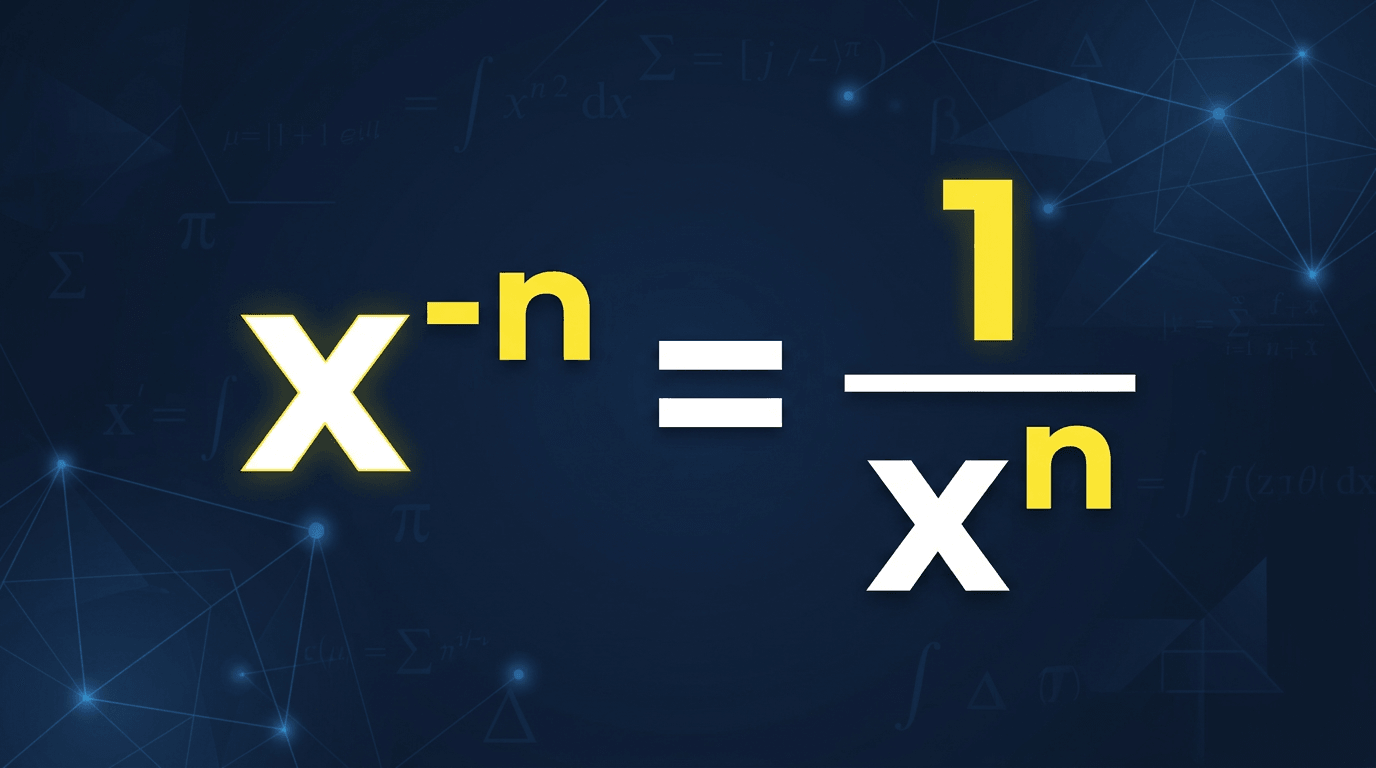
This pattern reveals the fundamental nature of negative exponents: a negative exponent indicates the reciprocal of the base raised to the positive power. Instead of multiplying, a negative exponent tells us to divide.
3. The Formal Definition of Negative Exponents
Mathematically, we define a negative exponent using a simple algebraic formula. For any non-zero real number a and any integer n:
a-n = 1 / an
Similarly, if the negative exponent is in the denominator of a fraction, it moves to the numerator as a positive exponent:
1 / a-n = an
Why Can't the Base (a) Be Zero?
The definition of a negative exponent requires that the base a cannot be equal to zero (a ≠ 0). If we try to apply the negative exponent rule to a base of zero, we get:
0-2 = 1 / 02 = 1 / 0
In mathematics, division by zero is undefined. Therefore, expressions like 0-5 or 0-1 have no mathematical meaning and are strictly undefined.
4. Scientific and Real-World Applications
Negative exponents are not just abstract mathematical puzzles; they are essential tools used by scientists, engineers, and researchers to describe the universe. When dealing with extremely small quantities, negative exponents of 10 (scientific notation) make calculations manageable.
The Scale of the Microscopic World
In physics and chemistry, measurements of atoms, molecules, and light waves are incredibly tiny. Writing these numbers with standard decimals would require a massive string of zeros, which is prone to reading and writing errors. Negative exponents solve this problem elegantly:
The Diameter of a Hydrogen Atom: Approximately 0.0000000001 meters. In scientific notation, this is written as 1 × 10⁻¹⁰ meters.
The Size of a Water Molecule: Roughly 0.00000000028 meters, which is written as 2.8 × 10⁻¹⁰ meters.
Wavelength of Red Light: Approximately 0.0000007 meters, written as 7 × 10⁻⁷ meters.
Computer Science and Data Units
In computer technology, we often measure time in fractions of a second. A nanosecond is one-billionth of a second. Instead of writing 0.000000001 seconds, computer scientists write 10-9 seconds. This makes comparing processor speeds and data transfer rates incredibly efficient.
5. Step-by-Step Solved Examples
Let us look at some practical examples to see how to apply the negative exponent rule in different mathematical contexts.
Example 1: Evaluating an Integer Base
Evaluate the expression: 3-4
Solution:
Apply the negative exponent rule: 3-4 = 1 / 34
Calculate 34: 3 × 3 × 3 × 3 = 81
Write the final fraction: 1/81
Example 2: Handling a Fractional Base
Evaluate the expression: (2/5)-3
Solution:
When a fraction is raised to a negative power, we can take the reciprocal of the fraction (flip the numerator and denominator) and change the exponent to positive:
(2/5)-3 = (5/2)3
Apply the exponent to both the numerator and denominator: 53 / 23
Calculate the powers: 53 = 125 and 23 = 8
Write the final fraction: 125/8
Example 3: Simplifying Algebraic Expressions
Simplify the expression: x5 × x-3
Solution:
According to the product rule of exponents, when multiplying expressions with the same base, we add the exponents:
x5 × x-3 = x5 + (-3) = x2
This shows how negative exponents work seamlessly with existing exponent laws, simplifying algebraic calculations.
6. Common Pitfalls to Avoid
Even advanced algebra students sometimes make mistakes when working with negative exponents. Keep these three critical rules in mind to avoid common errors:
The Negative Result Myth: A negative exponent never makes the base negative. For example, 5-2 is equal to 1/25 (a positive fraction), not -25.
The Parentheses Trap: Be careful with negative signs in the base. Note the difference between:
(-3)-2 = 1 / (-3)2 = 1 / 9
-3-2 = - (1 / 32) = -1 / 9
Don't Move the Base Alone: When simplifying terms like 3x-2, only the variable x has the negative exponent. The 3 remains in the numerator. The simplified expression is 3 / x2.
7. Summary and Key Takeaways
Negative exponents are simply a mathematical language designed to make writing and calculating division cleaner and more uniform. Here are the core concepts to remember:
A negative exponent represents division and the reciprocal of the base.
The core formula is a-n = 1 / an (where a ≠ 0).
Negative exponents do not change the sign of the base; they change its position in a fraction.
They are widely used in scientific notation to represent incredibly small physical, chemical, and technological scales.
By understanding the patterns and rules of negative exponents, you unlock a deeper appreciation for the symmetry of algebra and equip yourself with the tools needed to explore the microscopic and macroscopic wonders of our universe!