Imagine trying to calculate the number of cells in your body, tracking the rapid growth of a bacterial colony, measuring the immense energy released during an earthquake, or determining the storage capacity of your smartphone's memory card. In all of these scenarios, scientists and mathematicians rely on a highly efficient mathematical shorthand: exponents.
Exponents allow us to represent incredibly large or incredibly small numbers without writing out endless strings of zeros. But what exactly is an exponent, how does it work, and what are the fundamental rules that govern its behavior? In this comprehensive guide, we will explore the concept of exponents from the ground up, starting with simple whole numbers and moving into rational bases, negative powers, and real-world applications.
The Anatomy of an Exponent
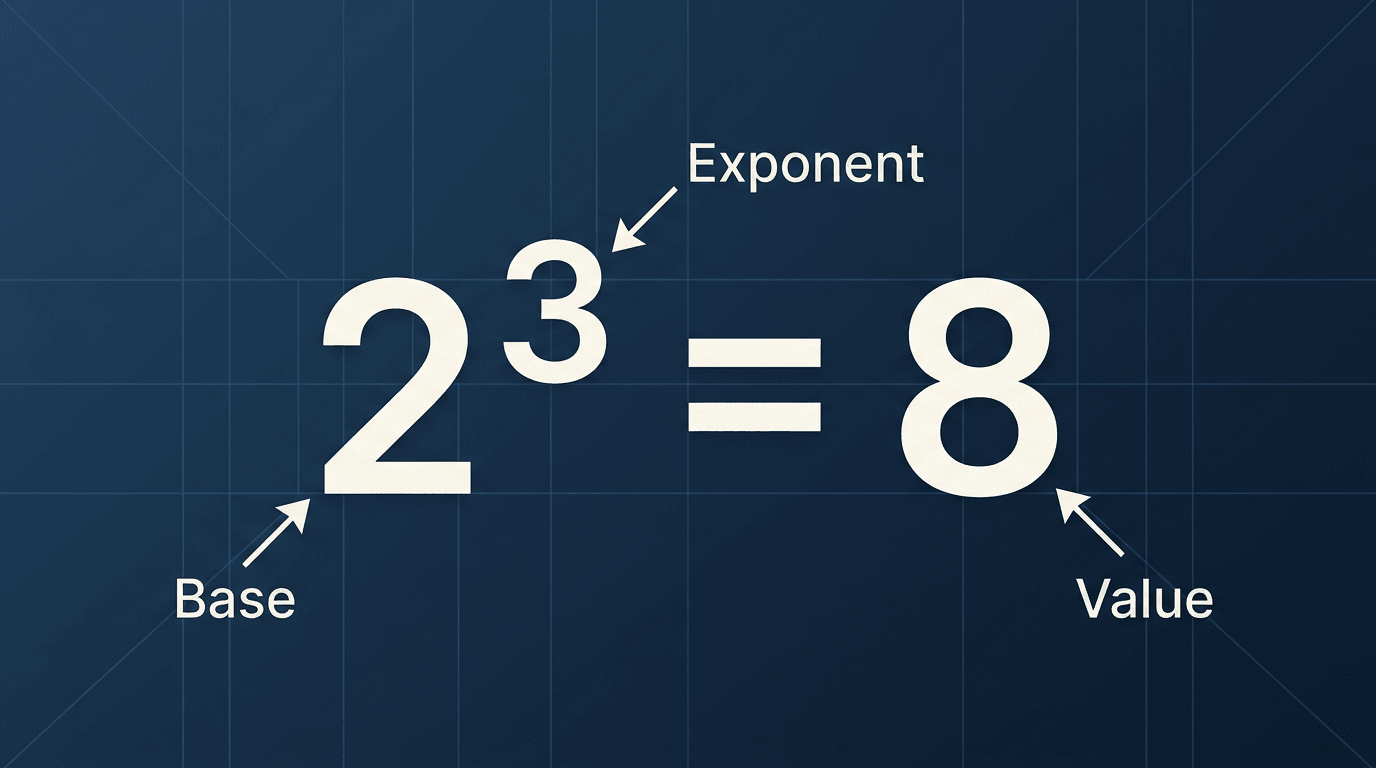
At its core, an exponent represents repeated multiplication of a number by itself. Instead of writing out 2 × 2 × 2 × 2 × 2, we can write this expression compactly as 25.
An exponential expression consists of two main parts:
The Base (a): The number that is being multiplied by itself. In the expression 25, the base is 2. The base can be a positive or negative integer, a fraction, or any rational number.
The Exponent or Power (n): The number that tells us how many times the base is used as a factor in the multiplication. In 25, the exponent is 5.
Mathematical Definition: If a is a rational number and n is a positive integer, then an is defined as:
an = a × a × a × ... × a (n times)
Expanding the Base: From Integers to Rational Numbers
While we often begin learning exponents using positive integers as bases (like 53 = 5 × 5 × 5 = 125), the base can be any rational number. This includes fractions and negative numbers.
1. Fractions as Bases
When the base is a fraction, the exponent applies to both the numerator and the denominator. For example, if we have the fraction (2/3) raised to the power of 3, we multiply the fraction by itself three times:
(2/3)3 = (2/3) × (2/3) × (2/3) = (2 × 2 × 2) / (3 × 3 × 3) = 8/27
2. Negative Numbers as Bases
When dealing with negative bases, the placement of parentheses is critical. It determines whether the negative sign is part of the base being multiplied:
(-3)4: Here, the base is -3. The negative sign is inside the parentheses, meaning we multiply -3 by itself four times: (-3) × (-3) × (-3) × (-3) = 81. Since the exponent is even, the result is positive.
-34: Here, the base is 3, and the negative sign is outside. This expression means "the negative of 34": -(3 × 3 × 3 × 3) = -81.
(-3)3: When a negative base is raised to an odd power, the result remains negative: (-3) × (-3) × (-3) = -27.
The Mystery of Zero and Negative Exponents
What happens when an exponent is zero or a negative number? To understand this, we can look at a mathematical pattern. Let us observe the powers of 3 in descending order:
33 = 27
32 = 9 (divided by 3)
31 = 3 (divided by 3)
Following this logical division pattern, what should come next?
30: If we divide the previous value (3) by the base (3), we get 3 / 3 = 1. Therefore, 30 = 1. This leads to the universal rule: any non-zero base raised to the power of 0 is always equal to 1 (a0 = 1, where a ≠ 0).
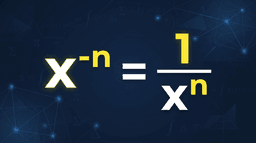
3-1: Continuing the pattern, if we divide 1 by 3, we get 1/3. Therefore, 3-1 = 1/31.
3-2: Dividing again, we get (1/3) / 3 = 1/9. Therefore, 3-2 = 1/32.
The Negative Exponent Rule: A negative exponent tells us to take the reciprocal of the base and raise it to the positive power:
a-n = 1 / an (where a ≠ 0)
Debunking a Common Misconception: "Does a Larger Exponent Always Mean a Larger Value?"
A very common assumption is that as the exponent increases, the value of the expression must always get larger. While this is true for bases greater than 1 (such as 22 < 23 < 24), it is not true for bases between 0 and 1.
Let us test this assumption using a rational base like 1/2:
(1/2)1 = 1/2 (or 0.5)
(1/2)2 = 1/4 (or 0.25)
(1/2)3 = 1/8 (or 0.125)
As you can see, as the exponent increases from 1 to 3, the actual value of the expression decreases. This demonstrates why it is crucial to test mathematical assumptions across different types of numbers (integers, fractions, positive, and negative values) before making generalizations.
The Laws of Exponents (Properties of Operations)
When working with algebraic expressions, we frequently need to multiply, divide, or raise exponential terms to other powers. To do this efficiently, we use the Laws of Exponents. Let's explore these rules with repeated multiplication to see why they work.
1. Product of Powers (Same Base)
When multiplying two exponential expressions with the same base, we keep the base and add the exponents:
am × an = am+n
Why does this work? Let's look at 33 × 32:
33 × 32 = (3 × 3 × 3) × (3 × 3) = 3 × 3 × 3 × 3 × 3 = 35 (which is 33+2).
2. Quotient of Powers (Same Base)
When dividing two exponential expressions with the same base, we subtract the exponent of the denominator from the exponent of the numerator:
am / an = am-n (where a ≠ 0)
Why does this work? Let's look at 55 / 52:
(5 × 5 × 5 × 5 × 5) / (5 × 5) = 5 × 5 × 5 = 53 (which is 55-2).
3. Power of a Power
When raising an exponential expression to another power, we multiply the exponents:
(am)n = am × n
Why does this work? Let's look at (23)2:
(23)2 = 23 × 23 = (2 × 2 × 2) × (2 × 2 × 2) = 26 (which is 23×2).
4. Power of a Product
When raising a product of different bases to a power, the exponent applies to each base individually:
(a × b)n = an × bn
Decimals and Powers of Ten
Exponents are also used to expand and analyze our base-10 number system. We can decompose decimal numbers using positive and negative powers of 10. This process is called decimal expansion or decomposition.
Let's look at the decimal number 345.128. We can break it down using place value and write it using powers of 10:
3 is in the hundreds place: 3 × 100 = 3 × 10²
4 is in the tens place: 4 × 10 = 4 × 101
5 is in the ones place: 5 × 1 = 5 × 100
1 is in the tenths place: 1 × 0.1 = 1 × 10⁻¹
2 is in the hundredths place: 2 × 0.01 = 2 × 10⁻²
8 is in the thousandths place: 8 × 0.001 = 8 × 10⁻³
Putting it all together, the expanded form of the number is:
345.128 = (3 × 10²) + (4 × 101) + (5 × 100) + (1 × 10⁻¹) + (2 × 10⁻²) + (8 × 10⁻³)
Real-World Applications of Exponents
Exponents are not just abstract mathematical symbols; they describe how the physical universe behaves. Here are some key scientific and real-world areas where exponents are essential:
1. Biology: Cellular Division and Bacterial Growth
Many organisms reproduce by dividing in two. If a single bacterium divides every hour, the population grows exponentially. Starting with 1 cell (20), after 1 hour there are 2 cells (21), after 2 hours there are 4 cells (22), after 3 hours there are 8 cells (23), and so on. After 24 hours, the population reaches 224, which is over 16 million bacteria!
2. Earth Science: Measuring Earthquakes
The severity of natural disasters like earthquakes is measured using the Richter scale, which is logarithmic and based on powers of 10. A magnitude 6 earthquake is not just one unit stronger than a magnitude 5 earthquake; its ground motion amplitude is actually 101 times (10 times) larger. A magnitude 7 earthquake is 102 times (100 times) larger than a magnitude 5 earthquake. This logarithmic scale helps scientists measure and compare the massive energy outputs of seismic events.
3. Technology: Data Storage and Memory
Computer systems run on binary code (base 2). Therefore, data storage sizes like kilobytes (KB), megabytes (MB), and gigabytes (GB) are structured around powers of 2. For instance, 1 kilobyte of data is equal to 210 bytes (which is 1,024 bytes).
Key Takeaways
An exponent indicates how many times a base is multiplied by itself.
The base can be any rational number, including fractions and negative values.
Any non-zero base raised to the power of 0 is equal to 1 (a0 = 1).
A negative exponent indicates the reciprocal of the base raised to a positive power (a-n = 1 / an).
If the base is between 0 and 1, the value of the expression decreases as the exponent increases.
Exponents provide a critical shortcut for performing operations on massive scale values in science, computing, and geography.