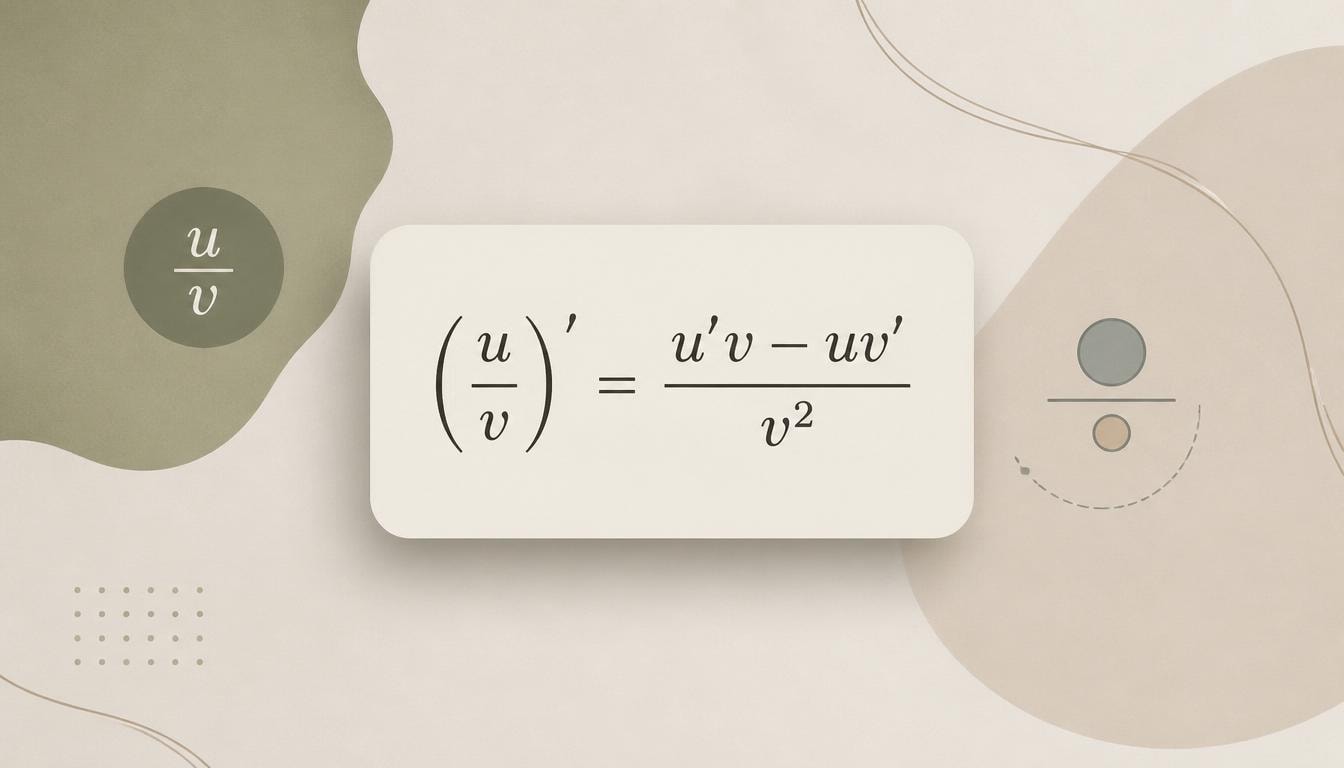
While finding the derivative of a simple polynomial or a basic trigonometric function is relatively straightforward, real-world scenarios often present us with more complex mathematical relationships. One of the most common complex structures is a fraction, where one function is divided by another. To find the derivative of such a division, mathematicians use a powerful tool known as the Quotient Rule.
In this comprehensive guide, we will explore what the quotient rule is, why it is necessary, how it is derived from first principles, and how to apply it step-by-step to various mathematical problems. We will also examine its scientific applications and the common mistakes students make when using it.
Understanding the Quotient Rule
The quotient rule is a formal rule used in calculus to find the derivative of a function that is the ratio of two other differentiable functions. If you have a function h(x) that is defined as:
h(x) = f(x) / g(x)
where both f(x) and g(x) are differentiable functions and g(x) is not equal to zero, then the derivative of h(x), denoted as h'(x), is given by the formula:
h'(x) = [ f'(x)g(x) - f(x)g'(x) ] / [g(x)]²
In verbal terms, the derivative of a quotient is equal to the derivative of the numerator times the denominator, minus the numerator times the derivative of the denominator, all divided by the square of the denominator.
The Famous Mnemonic: "Low d-High..."
Because the numerator of the quotient rule contains a subtraction, the order of the terms is extremely important. To help students remember the correct order, calculus teachers have used a classic mnemonic device for generations:
"Low d-high minus high d-low, draw the line and square below."
Let us break down this mnemonic to see how it maps directly to the mathematical formula:
Low: The denominator function, g(x)
d-High: The derivative of the numerator function, f'(x)
Minus: The subtraction sign ( - )
High: The numerator function, f(x)
d-Low: The derivative of the denominator function, g'(x)
Square below: The denominator function squared, [g(x)]²
By keeping this simple rhyme in mind, you can ensure that you never swap the terms in the numerator, which is one of the most common errors made during calculus exams.
Rigorous Mathematical Derivations
To truly appreciate the quotient rule, it is helpful to understand where it comes from. There are two primary ways to prove the quotient rule: using the limit definition of a derivative, and using the product and chain rules.
Method 1: Derivation via the Limit Definition
The limit definition of a derivative states that for any function F(x), the derivative is:
F'(x) = lim (h -> 0) [ F(x + h) - F(x) ] / h
Let us apply this to our quotient function, F(x) = f(x) / g(x). Substituting this into the limit definition gives:
F'(x) = lim (h -> 0) [ (f(x + h) / g(x + h)) - (f(x) / g(x)) ] / h
To simplify the numerator of this fraction, we find a common denominator, which is g(x + h) * g(x):
F'(x) = lim (h -> 0) [ (f(x + h)g(x) - f(x)g(x + h)) / (g(x + h)g(x)) ] / h
We can rewrite this by bringing the h into the denominator of the main expression:
F'(x) = lim (h -> 0) [ f(x + h)g(x) - f(x)g(x + h) ] / [ h * g(x + h)g(x) ]
Now, we use a classic algebraic trick. We add and subtract the term f(x)g(x) in the numerator. This does not change the value of the expression, but it allows us to group terms for factoring:
F'(x) = lim (h -> 0) [ f(x + h)g(x) - f(x)g(x) + f(x)g(x) - f(x)g(x + h) ] / [ h * g(x + h)g(x) ]
Now, we group the terms in the numerator into two separate fractions:
F'(x) = lim (h -> 0) [ g(x) * (f(x + h) - f(x)) - f(x) * (g(x + h) - g(x)) ] / [ h * g(x + h)g(x) ]
We can separate the limit of the product into products of limits. As h approaches 0, the term g(x + h) in the denominator simply becomes g(x). This gives us:
F'(x) = { g(x) * [ lim (h -> 0) (f(x + h) - f(x))/h ] - f(x) * [ lim (h -> 0) (g(x + h) - g(x))/h ] } / [ g(x) * g(x) ]
Recognizing the limit definitions of f'(x) and g'(x) within this expression, we get:
F'(x) = [ f'(x)g(x) - f(x)g'(x) ] / [g(x)]²
This completes our first proof, demonstrating that the quotient rule is a direct consequence of the fundamental definition of a derivative.
Method 2: Derivation via Product and Chain Rules
An alternative and much faster way to prove the quotient rule is to rewrite the quotient as a product and apply the product and chain rules. We can write:
h(x) = f(x) * [g(x)]⁻¹
According to the product rule, the derivative of a product of two functions u(x) * v(x) is u'(x)v(x) + u(x)v'(x). Let u(x) = f(x) and v(x) = [g(x)]⁻¹.
First, we find the derivative of v(x) using the chain rule:
v'(x) = -1 * [g(x)]⁻² * g'(x) = -g'(x) / [g(x)]²
Now, we apply the product rule:
h'(x) = f'(x) * [g(x)]⁻¹ + f(x) * ( -g'(x) / [g(x)]² )
To combine these terms, we rewrite the first term with a common denominator of [g(x)]²:
h'(x) = [ f'(x)g(x) / [g(x)]² ] - [ f(x)g'(x) / [g(x)]² ]
Combining the numerators yields the familiar quotient rule formula:
h'(x) = [ f'(x)g(x) - f(x)g'(x) ] / [g(x)]²
Step-by-Step Guide to Applying the Quotient Rule
When faced with a quotient rule problem, following a structured sequence of steps will prevent algebraic mistakes:
Identify the parts: Clearly label your numerator function as f(x) and your denominator function as g(x).
Differentiate separately: Calculate the derivatives f'(x) and g'(x) independently before putting them into the main formula.
Assemble the formula: Substitute your functions and their derivatives into the quotient rule formula.
Simplify the numerator: Expand the terms in the numerator, combine like terms, and factor if possible. Do not expand the denominator unless absolutely necessary, as keeping it as a square is usually preferred.
Worked Examples
Example 1: A Basic Rational Function
Let us find the derivative of the function:
y = (x² + 3) / (2x - 1)
Step 1: Identify the parts.
Numerator, f(x) = x² + 3
Denominator, g(x) = 2x - 1
Step 2: Differentiate separately.
f'(x) = 2x
g'(x) = 2
Step 3: Assemble the formula.
y' = [ (2x)(2x - 1) - (x² + 3)(2) ] / (2x - 1)²
Step 4: Simplify.
Expand the numerator:
y' = [ (4x² - 2x) - (2x² + 6) ] / (2x - 1)²
y' = [ 4x² - 2x - 2x² - 6 ] / (2x - 1)²
Combine like terms:
y' = (2x² - 2x - 6) / (2x - 1)²
Example 2: Proving the Derivative of Tangent
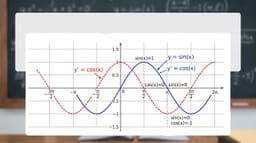
The quotient rule can be used to derive the derivatives of other trigonometric functions. Let us find the derivative of y = tan(x) using the identity tan(x) = sin(x) / cos(x).
Step 1: Identify the parts.
f(x) = sin(x)
g(x) = cos(x)
Step 2: Differentiate separately.
f'(x) = cos(x)
g'(x) = -sin(x)
Step 3: Assemble the formula.
y' = [ (cos(x))(cos(x)) - (sin(x))(-sin(x)) ] / (cos(x))²
Step 4: Simplify.
y' = [ cos²(x) + sin²(x) ] / cos²(x)
Using the fundamental Pythagorean trigonometric identity, sin²(x) + cos²(x) = 1, we get:
y' = 1 / cos²(x)
Since 1 / cos(x) = sec(x), we conclude:
y' = sec²(x)
Common Pitfalls and How to Avoid Them
Even experienced calculus students can make mistakes when applying the quotient rule. Keep an eye out for these frequent errors:
Reversing the Subtraction: Writing fg' - f'g instead of f'g - fg'. Because subtraction is not commutative, this mistake will result in an answer that has the opposite sign of the correct derivative. Always start with the derivative of the top function.
Forgetting to Square the Denominator: It is common to focus so much on the complex algebra of the numerator that you completely forget to write or square the denominator. Always write down the squared denominator first to secure it.
Illegal Algebraic Cancellation: Students often try to cancel a term from the denominator with a term in only one part of the numerator. Remember that you can only cancel a factor if it is common to all terms in the numerator.
Scientific and Physical Applications
Fluid Dynamics and Thermodynamics
In physics, many properties are defined as ratios. For example, density is mass divided by volume (Density = Mass / Volume). If both mass and volume are changing over time (for example, in a heating gas chamber where gas is escaping), the rate of change of density over time must be calculated using the quotient rule.
Pharmacokinetics in Medicine
In medicine, when a patient takes a drug, the concentration of the drug in the bloodstream over time t is often modeled by a rational function, such as:
C(t) = at / (t² + b)
To determine when the drug reaches its maximum concentration in the body, medical researchers must find the derivative of this function and set it equal to zero. This optimization process relies directly on the quotient rule to find C'(t).
Summary of Key Takeaways
The quotient rule is used to differentiate functions that are structured as a fraction: f(x) / g(x).
The formula is h'(x) = [ f'(x)g(x) - f(x)g'(x) ] / [g(x)]².
Use the mnemonic "Low d-high minus high d-low, square below" to remember the order of terms.
Always differentiate the numerator and denominator separately before assembling the final formula to avoid algebraic confusion.