Imagine you are driving a car down a long, open highway. You look down at your speedometer, and the needle points exactly to 60 miles per hour. At that precise split second, you are traveling at that specific speed. But think about this deeply: speed is defined as distance divided by time. How can you have a speed at a single, frozen instant in time, where the elapsed time is zero and the distance traveled is also zero? If you try to calculate speed at an instantaneous moment using traditional arithmetic, you get zero divided by zero—a mathematical impossibility.
This paradox baffled the greatest minds of antiquity. For centuries, philosophers and mathematicians struggled to reconcile the continuous flow of the physical universe with the static nature of classical mathematics. The breakthrough came in the late 17th century when Sir Isaac Newton and Gottfried Wilhelm Leibniz independently developed a revolutionary mathematical tool designed specifically to measure instantaneous change. That tool is the derivative.
In this comprehensive guide, we will explore the derivative from the ground up. We will unpack its physical meaning, construct its formal mathematical definition using limits, visualize it geometrically, learn the fundamental rules of differentiation, and look at how it is applied to solve complex problems in physics, economics, and beyond.
1. The Core Concept: Average vs. Instantaneous Rate of Change
To truly understand what a derivative is, we must first distinguish between two fundamental types of change: average change and instantaneous change.
Average Rate of Change
Suppose you go on a road trip. You leave your house at 12:00 PM and arrive at a destination 120 miles away at 2:00 PM. Your total travel time is 2 hours. To find your average speed, you simply divide the total distance by the total time:
Average Speed = Total Distance / Total Time = 120 miles / 2 hours = 60 miles per hour
While this number is useful, it tells us very little about the journey itself. It does not tell us if you were stuck in traffic at 12:30 PM going 5 miles per hour, or if you were cruising smoothly on the highway at 1:15 PM going 75 miles per hour. The average rate of change smooths over all the real-world fluctuations.
Instantaneous Rate of Change
Now, imagine shrinking the time interval. Instead of measuring your average speed over 2 hours, you measure it over 10 minutes. Then, over 10 seconds. Then, over a millisecond. As the interval of time shrinks closer and closer to zero, the average speed over that tiny interval becomes an incredibly accurate approximation of your actual speed at that exact moment.
The derivative is the exact value that this average rate of change approaches as the time interval shrinks to zero. It is the mathematically precise definition of the instantaneous rate of change.
2. The Geometric Interpretation: Secants to Tangents
To visualize this concept, let us translate it onto a coordinate graph. Suppose we have a function y = f(x) representing a curve.
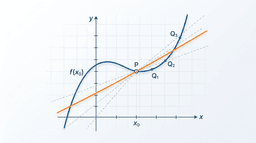
If we choose two distinct points on this curve, point A at coordinates (x, f(x)) and point B at coordinates (x + h, f(x + h)), where h represents a horizontal distance between the two points, we can draw a straight line through both points. This line is called a secant line.
The slope of this secant line represents the average rate of change of the function between those two points. Recall that the slope formula is rise over run:
Slope of Secant = [f(x + h) - f(x)] / [(x + h) - x] = [f(x + h) - f(x)] / h
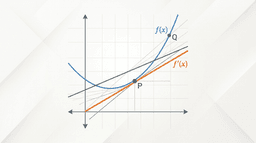
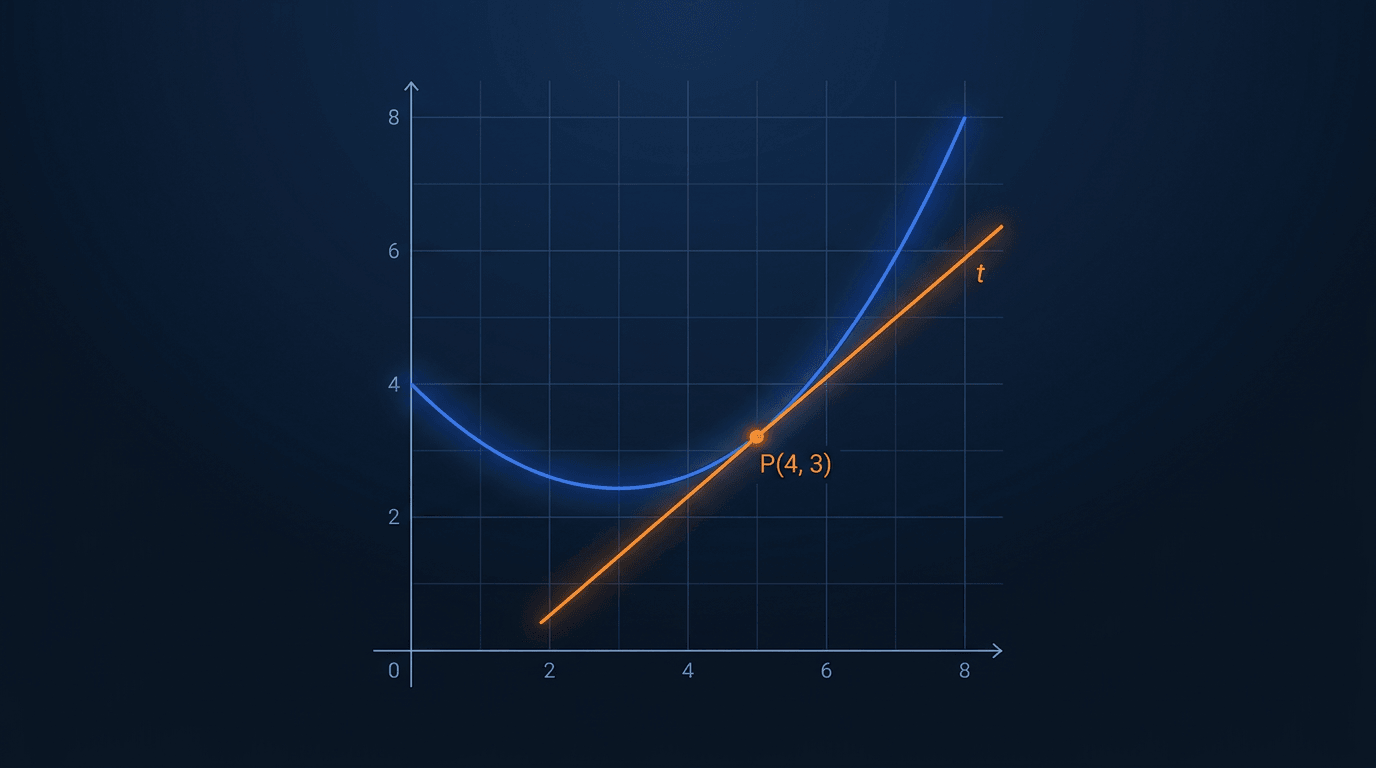
Now, imagine that we begin to slide point B along the curve closer and closer to point A. This means we are making the interval h smaller and smaller. As h approaches zero, the secant line pivots. When h finally reaches the limit of zero, point B merges with point A. The secant line is no longer passing through two separate points; it now grazes the curve at exactly one single point. This line is called the tangent line.
The derivative of a function at a specific point is the slope of the tangent line to the curve at that point. It tells us the direction and steepness of the curve at that exact location.
3. The Formal Definition: The Limit Representation
Using the geometric intuition we just developed, we can write the formal, rigorous definition of the derivative. In calculus, we use the concept of a limit to describe what happens to a expression as a variable gets infinitely close to a certain value without actually reaching it.
The derivative of a function f(x) with respect to x, denoted as f'(x) (read as "f prime of x") or df/dx (Leibniz's notation), is defined as:
f'(x) = limh → 0 [f(x + h) - f(x)] / h
Let us break down this beautiful equation step-by-step:
f(x + h) - f(x): This is the change in the output value (the "rise").
h: This is the change in the input value (the "run").
[f(x + h) - f(x)] / h: This is the difference quotient, representing the slope of the secant line.
limh → 0: This is the instruction to observe what value the difference quotient approaches as the step size h shrinks infinitely close to zero.
If this limit exists, we say that the function f(x) is differentiable at x. If the limit does not exist (for example, at a sharp corner, a cusp, or a vertical break in the graph), then the derivative does not exist at that point.
4. Proving the Rules of Differentiation via Limits
While using the limit definition is the foundational way to find a derivative, doing this manually for every function is highly tedious. Fortunately, mathematicians have proved general rules that allow us to find derivatives quickly. Let us look at how we can prove these rules using our limit definition.
A. The Sum and Difference Rules
Suppose we have two differentiable functions, u(x) and v(x). We want to find the derivative of their sum, f(x) = u(x) + v(x). Let's use the limit definition:
f'(x) = limh → 0 [(u(x+h) + v(x+h)) - (u(x) + v(x))] / h
By rearranging the terms in the numerator, we can separate the functions:
f'(x) = limh → 0 [(u(x+h) - u(x)) + (v(x+h) - v(x))] / h
Using the limit laws (the limit of a sum is the sum of the limits), we get:
f'(x) = limh → 0 [u(x+h) - u(x)]/h + limh → 0 [v(x+h) - v(x)]/h
This simplifies perfectly to the sum of their individual derivatives:
(u + v)' = u' + v'
The exact same logic applies to subtraction, giving us the difference rule: (u - v)' = u' - v'.
B. The Product Rule
What happens when we want to find the derivative of two functions multiplied together, f(x) = u(x) * v(x)? Let's apply the limit definition:
f'(x) = limh → 0 [u(x+h)v(x+h) - u(x)v(x)] / h
To solve this, we use a classic mathematical trick: adding and subtracting the same term in the numerator. We will add and subtract u(x+h)v(x):
f'(x) = limh → 0 [u(x+h)v(x+h) - u(x+h)v(x) + u(x+h)v(x) - u(x)v(x)] / h
Now, we group the terms and factor them:
f'(x) = limh → 0 [u(x+h)(v(x+h) - v(x)) + v(x)(u(x+h) - u(x))] / h
Distributing the limit across the terms:
f'(x) = (limh → 0 u(x+h)) * (limh → 0 [v(x+h) - v(x)]/h) + v(x) * (limh → 0 [u(x+h) - u(x)]/h)
As h goes to 0, u(x+h) simply becomes u(x). The other limits are the definitions of the derivatives of v and u. Thus, we get the Product Rule:
(u * v)' = u * v' + v * u'
C. The Quotient Rule
For the division of two functions, f(x) = u(x) / v(x) (where v(x) ≠ 0), we can prove the rule using a similar algebraic manipulation with limits:
(u / v)' = [u' * v - u * v'] / v2
D. The Chain Rule (Composite Functions)
Often, functions are nested inside one another, like f(x) = u(v(x)). To find the rate of change of a composite function, we use the Chain Rule. It states that you take the derivative of the outer function evaluated at the inner function, and multiply it by the derivative of the inner function:
(u(v(x)))' = u'(v(x)) * v'(x)
5. Physical Interpretation: Motion in the Real World
To appreciate the utility of these rules, let us look at how physics relies heavily on the derivative to model the physical universe. One of the best ways to understand derivatives is through the lens of kinematics (the study of motion).
Position, Velocity, and Acceleration
Let's say an object is moving along a straight line, and its position at any time t is given by a function s(t).
Position: s(t) - Tells us where the object is located at time t.
Velocity: v(t) = s'(t) - The first derivative of position with respect to time tells us how fast the position is changing. It is the instantaneous velocity.
Acceleration: a(t) = v'(t) = s''(t) - The derivative of velocity (which is the second derivative of position) tells us how fast the velocity is changing. This is acceleration.
For example, if a falling object's position is given by the formula s(t) = 4.9t2 (under the influence of Earth's gravity, ignoring air resistance), we can find its velocity at any second by taking the derivative:
Using the power rule, the derivative of s(t) is:
v(t) = s'(t) = 9.8t
This means that at exactly 3 seconds, the object's instantaneous velocity is 9.8 * 3 = 29.4 meters per second. By taking the derivative once more, we get the acceleration:
a(t) = v'(t) = 9.8 m/s2
This constant acceleration is the acceleration due to gravity on Earth!
6. Evaluating the Usefulness of Mathematical Proofs
In your study of mathematics, you might ask: "Why do we need to learn and evaluate the proofs of these rules if we can just memorize the formulas?"
This is an important question. Evaluating the proofs of derivatives provides several vital benefits:
Conceptual Security: Memorized formulas can be forgotten or misremembered under stress. Knowing the proof allows you to reconstruct the rule from first principles.
Understanding Boundaries: Proofs show us the conditions under which a rule is valid (for instance, why the quotient rule requires the denominator to be non-zero).
Logical Development: Working through proofs trains your brain to think systematically, a critical skill in scientific research, engineering, and software development.
7. Key Takeaways
The derivative is not just an abstract formula to be solved on homework sheets. It is a profound concept that serves as the foundation of modern science. Here are the core ideas to remember:
The derivative represents the instantaneous rate of change of a function.
Geometrically, the derivative is the slope of the tangent line to a curve at a given point.
Formally, it is defined using the limit of a difference quotient as the interval approaches zero.
Through differentiation rules (sum, product, quotient, and chain rules), we can rapidly compute derivatives for complex functions.
Derivatives are essential for modeling dynamic systems in physics, biology, economics, and engineering.
By mastering the derivative, you have unlocked the door to understanding a universe in constant motion. Whether you are calculating the trajectory of a spacecraft, predicting market trends, or modeling the spread of a biological virus, the derivative is the primary tool that helps us navigate change.