Imagine you are driving a car down a straight highway. You look down at your speedometer, and it reads exactly 60 miles per hour. This seems like a simple, everyday observation. But if you stop to analyze it from a strict physical standpoint, a profound paradox emerges. Speed is defined as the distance traveled divided by the time elapsed. At one precise, instantaneous moment, how much time has passed? Zero seconds. And how much distance have you covered in that exact instant? Zero miles. If you try to calculate your speed at that exact moment using basic arithmetic, you find yourself trying to divide zero by zero.
How can we make sense of a physical reality—your car is clearly moving—when the mathematics of division seems to break down? The answer to this ancient puzzle lies in one of the most elegant and revolutionary concepts in human thought: the limit. The limit is the mathematical foundation of calculus, providing the rigorous framework needed to understand instantaneous change, motion, and infinity.
The Core Intuition: Approaching Without Touching
At its heart, a limit is not about what happens *at* a specific point, but rather what happens as you get *closer and closer* to that point. It is a study of behavior near a target.
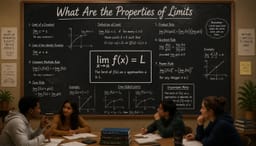
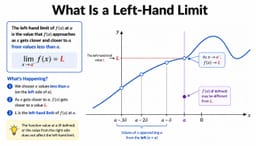
Let us define this more formally. Suppose we have a mathematical function, f(x). We want to understand how the output values of this function behave as the input variable, x, gets closer and closer to a specific number, which we will call "a". If the output values of f(x) get closer and closer to a single real number, "L", as x approaches "a" from both sides, we say that the limit of f(x) as x approaches "a" is "L".
Mathematical Notation: We write this relationship as: lim (x → a) f(x) = L. This is read as: "The limit of f of x, as x approaches a, equals L."
The most critical distinction to make here is that the limit is completely independent of the actual value of the function at "a". In fact, f(a) does not even need to exist for the limit to exist. The limit only cares about the trend of the function as we get infinitely close to "a".
The Mystery of Indeterminate Forms: The 0/0 Conundrum
To truly appreciate why limits are necessary, we must explore what happens when standard arithmetic fails us. These situations are known as indeterminate forms, with the most famous being zero divided by zero (0/0) and infinity divided by infinity.
Formulating Initial Hypotheses
When students first encounter the expression 0/0 in a limit problem, they often make several intuitive hypotheses based on their past algebraic experience:
Hypothesis 1: The result must be 0, because 0 divided by anything is 0.
Hypothesis 2: The result must be 1, because any number divided by itself is 1.
Hypothesis 3: The result must be undefined or infinity, because division by zero is strictly forbidden in mathematics.
To see which of these hypotheses (if any) holds true, we must look at how different functions behave near points where they produce this 0/0 structure. Let us examine three different mathematical patterns.
Analyzing Patterns and Generalizing
Let us evaluate three different functions as x approaches specific values, all of which yield a direct substitution of 0/0:
Case A: Consider the function f(x) = (x² - 9) / (x - 3) as x approaches 3.
If we plug in x = 3 directly, we get (3² - 9) / (3 - 3) = 0/0.
Let's look at the behavior as we get closer to 3. If x = 2.9, f(2.9) = 5.9. If x = 2.99, f(2.99) = 5.99. If x = 3.01, f(3.01) = 6.01.
Clearly, as x approaches 3, the values of f(x) are converging toward 6.
Case B: Consider the function g(x) = (x² - 4) / (x - 2) as x approaches 2.
Direct substitution gives (2² - 4) / (2 - 2) = 0/0.
If we test values close to 2: g(1.9) = 3.9, g(1.99) = 3.99, g(2.01) = 4.01.
Here, as x approaches 2, the values of g(x) converge toward 4.
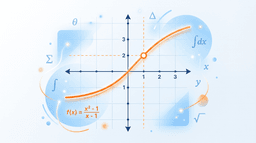
Case C: Consider the function h(x) = (x³ - 1) / (x - 1) as x approaches 1.
Direct substitution yields 0/0.
Analyzing values close to 1: h(0.9) = 2.71, h(0.99) = 2.97, h(1.01) = 3.03.
As x approaches 1, the values of h(x) converge toward 3.
By analyzing these patterns, we can reach a powerful generalization: The expression 0/0 does not have a single, fixed value. Depending on the functions involved, the limit of a 0/0 expression can be 6, 4, 3, or indeed any real number. This is why mathematicians call 0/0 an "indeterminate form"—its value cannot be determined simply by looking at the isolated parts; it depends entirely on the dynamic relationship between the numerator and the denominator as they approach zero.
Comparing Generalizations with Hypotheses
When we compare our findings with the initial student hypotheses, we discover that all three hypotheses were incorrect. The limit is not automatically 0, nor is it automatically 1, nor is it always undefined. The mistake in the initial hypotheses was treating "0" as a static, dead value. In limits, we are dealing with quantities that are actively shrinking toward zero. The final value of the limit depends on *which* part of the fraction is shrinking faster.
Proposing Mathematical Rules for Limits
From our pattern analysis, we can propose a formal mathematical methodology for resolving these indeterminate forms. Since the division by zero is caused by a shared "troublemaker" factor in both the numerator and the denominator, we can use algebra to simplify the expression before taking the limit.
The Factoring Proposition: If a rational function f(x) = P(x)/Q(x) yields the indeterminate form 0/0 as x approaches 'a', then (x - a) must be a common factor of both P(x) and Q(x). By factoring out and canceling this common term, we can find the true limit of the function.
Let us apply this proposition to Case A: f(x) = (x² - 9) / (x - 3). We can factor the numerator as a difference of squares: (x - 3)(x + 3). Thus, the function becomes f(x) = [(x - 3)(x + 3)] / (x - 3). Because we are looking at the limit where x approaches 3, x is close to 3 but *not equal to* 3. This means (x - 3) is not zero, and we are legally allowed to cancel it out. This leaves us with f(x) = x + 3. Now, as x approaches 3, x + 3 simply approaches 3 + 3 = 6. Our proposition works perfectly!
Today, students and scientists do not have to rely solely on manual calculations to verify these propositions. Modern mathematical software tools, such as GeoGebra, Desmos, and computer algebra systems (CAS), allow us to graph these functions dynamically. When you plot f(x) = (x² - 9) / (x - 3) on a graphing tool, you will see a perfectly straight line with a tiny, single-point "hole" at x = 3. The software visually confirms that as you slide your cursor along the line from either side toward x = 3, the height of the graph converges exactly to y = 6.
Real-World Application: The Physics of Instantaneous Velocity
The concept of a limit is not just an abstract playground for mathematicians; it is the fundamental tool used to describe the physical universe. The most direct application of this concept is in calculating instantaneous velocity.
If you drop an object from a high cliff, its position over time can be modeled by Galileo's law of free fall. Let's say the distance fallen after t seconds is given by the function s(t) = 5t² meters. Suppose we want to find the exact speed of the falling object at precisely t = 2 seconds.
To find the average velocity over an interval of time, we use the formula:
Average Velocity = [s(2 + Δt) - s(2)] / Δt
Here, Δt represents a small change in time. If we try to calculate the instantaneous velocity by setting Δt equal to 0, the formula yields [s(2) - s(2)] / 0 = 0/0, which is our familiar indeterminate form. Physics has presented us with a 0/0 problem!
To solve this, we apply our limit proposition. Let us write out the average velocity expression algebraically:
s(2 + Δt) = 5(2 + Δt)² = 5(4 + 4Δt + (Δt)²) = 20 + 20Δt + 5(Δt)²
s(2) = 5(2)² = 20
Now substitute these back into our velocity formula:
Average Velocity = [20 + 20Δt + 5(Δt)² - 20] / Δt = [20Δt + 5(Δt)²] / Δt
We can factor out Δt from the numerator: Δt(20 + 5Δt) / Δt. Since we are taking the limit as Δt approaches 0, Δt is not actually zero, so we can cancel the Δt terms. This leaves us with:
Instantaneous Velocity = lim (Δt → 0) (20 + 5Δt)
As the time interval Δt shrinks to absolute zero, the term 5Δt vanishes, leaving us with an exact instantaneous velocity of 20 meters per second.
Key Takeaways
The limit is about trends: A limit describes the value a function approaches as its input gets infinitely close to a target, regardless of what happens at that exact target point.
Indeterminate forms are not dead ends: Forms like 0/0 are not undefined numbers; they are mathematical invitations to look deeper using algebraic simplification or graphing tools.
Limits connect the discrete to the continuous: By allowing us to divide by quantities that approach zero without ever reaching it, limits resolve physical paradoxes of motion and change.
The foundation of modern science: Without limits, we would have no derivatives, no integrals, no classical mechanics, and no way to precisely model the dynamic, changing world around us.