Have you ever encountered a math problem where the answer seemed to vanish into a black hole of logical contradictions? In basic arithmetic, we are taught strict rules: any number divided by itself is 1, zero divided by any number is 0, and dividing by zero is strictly forbidden. But what happens when we enter the dynamic world of calculus, where numbers are not static but are actively moving, shrinking, or growing?
This is where we encounter the mysterious and fascinating concept of indeterminate forms. Expressions like 0/0 or ∞/∞ are not simply "undefined" dead ends. Instead, they are mathematical invitations to look closer. In this comprehensive guide, we will explore what indeterminate forms are, how we can make sense of them, and why they are absolutely essential for understanding how our physical universe works.
1. The Initial Guess: What Do We Expect to Happen?
Let us start with a thought experiment. Imagine we have a function defined as a fraction of two other functions, f(x) / g(x). We want to find the limit of this fraction as x approaches a specific value a. If we plug in a and find that both the numerator and the denominator approach zero, we get the expression 0/0.
If you ask someone who hasn't studied calculus what 0/0 equals, they might make a few reasonable hypotheses:
Hypothesis A: "It must be 1, because any number divided by itself is 1."
Hypothesis B: "It must be 0, because zero divided by anything is 0."
Hypothesis C: "It must be infinity or undefined, because you cannot divide by zero."
These guesses are intuitive, but they all fail to capture the true nature of limits. The term "indeterminate" means that the form alone does not give us enough information to determine the limit. To see why, we need to look at patterns across different functions.
2. Analyzing Patterns: The Battle of Rates
To understand why 0/0 is indeterminate, let us look at three different limit problems as x approaches 0. In all three cases, direct substitution yields the form 0/0:
Case 1: limit of (3x) / x as x approaches 0. If we simplify the fraction first for x ≠ 0, we get 3. The limit is 3.
Case 2: limit of x2 / x as x approaches 0. Simplifying the fraction gives us x. As x approaches 0, the limit is 0.
Case 3: limit of x / x2 as x approaches 0. Simplifying gives us 1/x. As x approaches 0 from the positive side, the limit goes to positive infinity (∞).
Look at what just happened! In all three cases, direct substitution gave us the exact same form: 0/0. Yet, the actual limits were completely different: 3, 0, and infinity. This pattern shows us that 0/0 does not have a single, fixed value. The result depends entirely on how fast the numerator is shrinking to zero compared to the denominator. It is a mathematical tug-of-war, and the rate of approach determines who wins.
3. Generalizing the Indeterminate Forms
By studying these patterns, mathematicians have categorized several types of indeterminate forms. The two primary algebraic indeterminate forms are:
0/0 (Zero over Zero)
∞/∞ (Infinity over Infinity)
There are also other forms that can be algebraically manipulated into these two primary forms, such as:
0 × ∞ (Zero times Infinity)
∞ - ∞ (Infinity minus Infinity)
1∞, 00, and ∞0 (Indeterminate powers)
Important Distinction: Indeterminate is NOT the same as undefined. An undefined expression, like 5/0, has no limit (it approaches infinity or does not exist). An indeterminate form, like 0/0, is a signal that a limit might exist, but we have to do more work to find it.
4. Comparing Our Guesses with the Truth
Now let's compare our initial hypotheses with our generalizations. We hypothesized that 0/0 might always be 1, 0, or undefined. Our pattern analysis proved these hypotheses wrong. The truth is that the limit of an indeterminate form can be any real number, or it might not exist at all.
This realization changes how we view functions. We learn that we cannot evaluate limits simply by looking at individual points. We must look at the behavior of the functions as they dynamically approach those points. This transition from static arithmetic to dynamic analysis is the very foundation of calculus.
5. Resolving Indeterminate Forms and Digital Verification
How do we actually solve these forms? Mathematicians have formulated reliable propositions to resolve indeterminacy:
Algebraic Simplification: Factoring, rationalizing denominators, or using trigonometric identities to cancel out the terms causing the zero.
L'Hôpital's Rule: A powerful theorem stating that if a limit yields 0/0 or ∞/∞, the limit of the fraction is equal to the limit of the derivatives of the numerator and denominator:
lim [f(x)/g(x)] = lim [f'(x)/g'(x)].
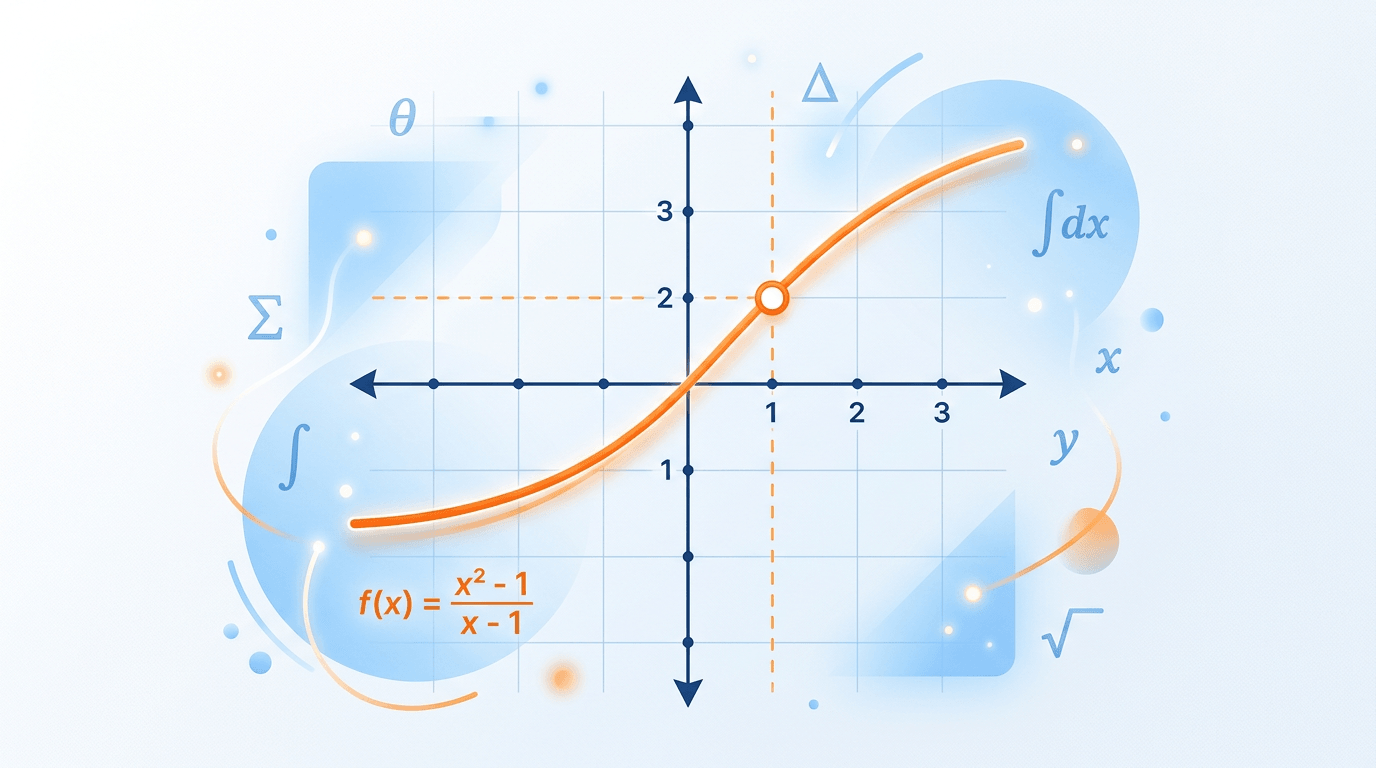
Today, we don't have to rely solely on paper-and-pencil calculations. Digital tools like Desmos, GeoGebra, and computer algebra systems allow us to visualize these limits. By graphing a function like y = sin(x)/x, we can clearly see that as x approaches 0, the graph smoothly approaches 1, even though plugging in 0 directly results in the indeterminate form 0/0. Using digital tools helps us confirm our mathematical propositions visually and numerically.
6. Real-World Applications: Instantaneous Velocity
Indeterminate forms are not just abstract puzzles; they are the key to describing the physical world. The most famous real-world application of an indeterminate form is the calculation of instantaneous velocity.
If you drive a car 100 miles in 2 hours, your average velocity is 50 mph. This is calculated as:
Average Velocity = Change in Distance (Δs) / Change in Time (Δt)
But what if you want to know your exact speed at one specific fraction of a second? If you try to calculate the speed at an exact instant, the change in time (Δt) is 0, and the distance traveled in that instant (Δs) is also 0. This gives you:
Instantaneous Velocity = 0 / 0
Without calculus and the resolution of this indeterminate form, physics would be unable to define speed at a single moment! By taking the limit as Δt approaches 0, we resolve the 0/0 form, allowing speedometers to work, GPS systems to calculate arrival times, and physicists to map the trajectories of rockets.
Conclusion: The Beauty of the Indeterminate
Indeterminate forms teach us an important lesson about mathematics: what appears to be an error or an impossibility at first glance is often just a deeper truth waiting to be uncovered. By moving past static numbers and embracing the dynamic concept of limits, we unlock the tools necessary to analyze change, motion, and the very fabric of our universe.