In our everyday lives, we intuitively understand the concept of continuity. We expect time to flow without sudden pauses, a moving car to travel along a road without instantly vanishing and reappearing elsewhere, and the temperature of a room to rise or fall gradually rather than jumping instantly from 20°C to 30°C. In the physical world, continuity represents a seamless progression.
But how do we translate this intuitive physical understanding into the rigorous language of mathematics? How can we prove mathematically that a process, a curve, or a system has no "gaps," "jumps," or "holes"? This article explores the mathematical definition of continuity, dissects its necessary and sufficient conditions, analyzes how limits interact with function values, and examines how these theoretical concepts apply to real-world scenarios like manufacturing costs and physical sciences.
The Mathematical Definition of Continuity
To understand continuity mathematically, we must focus on what happens to a function at a specific point. A function f(x) is said to be continuous at a point x = c if and only if its behavior near that point matches its behavior exactly at that point.
For this simple statement to hold true, three distinct mathematical conditions must be met simultaneously. If even one of these conditions fails, the function is considered discontinuous at that point.
The Three Pillars of Continuity
The Function Must Be Defined: The value f(c) must exist. In other words, c must be in the domain of the function. If the function is not defined at that point, there is a hole in the graph, and it cannot be continuous there.
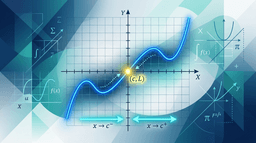
The Limit Must Exist: The limit of f(x) as x approaches c must exist. Mathematically, this means the left-hand limit and the right-hand limit must be equal:
limx → c- f(x) = limx → c+ f(x) = L.The Limit and the Value Must Be Equal: The value that the function approaches as x gets closer to c must be exactly equal to the actual value of the function at c:
limx → c f(x) = f(c).
The Core Insight: Continuity bridging the gap between "where a function is heading" (its limit) and "where the function actually is" (its value). When expectation matches reality, we have continuity.
Analyzing the Relationship Between Limits and Function Values
To fully grasp continuity, we must look at how functions can fail to be continuous. By comparing the value of a function at a point with its limit at that point, we can classify different types of behavior:
Scenario A: The Limit Exists, but the Function is Undefined.
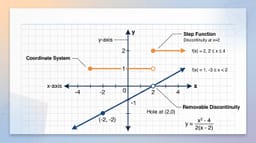
Consider the function f(x) = (x2 - 4) / (x - 2). If we try to evaluate this at x = 2, we get a division by zero (0/0), meaning f(2) is undefined. However, if we calculate the limit as x approaches 2, we can simplify the expression to x + 2, which gives us a limit of 4. Because the first pillar is broken, the function is discontinuous at x = 2. This is known as a removable discontinuity (or a "hole").Scenario B: The Limit Exists, the Function is Defined, but They Are Not Equal.
Imagine a piecewise function where f(x) = x + 1 for all x ≠ 1, but f(1) = 5. As x approaches 1, the values of the function get closer and closer to 2. Thus, the limit is 2. However, the actual value at x = 1 is 5. Since limx → 1 f(x) ≠ f(1), the graph has a point that is "displaced" above the line. This is also a removable discontinuity.Scenario C: The Limit Does Not Exist.
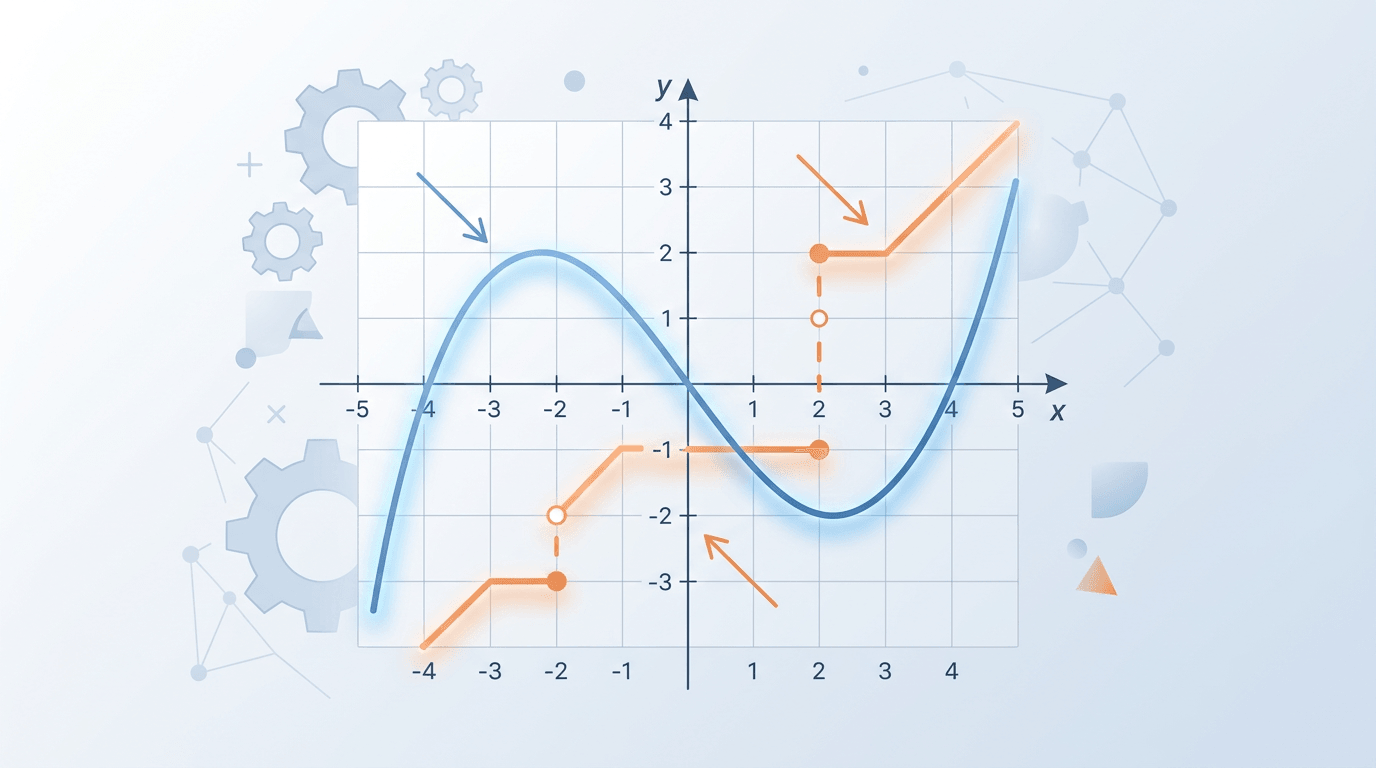
If the left-hand limit and the right-hand limit approach different values, the overall limit does not exist. For example, in a step function where f(x) = 0 for x < 0 and f(x) = 1 for x ≥ 0, the limit as x approaches 0 from the left is 0, while from the right it is 1. Even though f(0) is defined (it is 1), the function has a sudden jump discontinuity.
Continuity in Piecewise Functions: Critical Point Analysis
Piecewise functions are excellent tools for studying continuity because they are defined by different formulas on different intervals. The points where the formulas change are called critical points, and these are the primary locations where discontinuities can occur.
Let us analyze a concrete mathematical example. Consider the piecewise function:
f(x) = x2 + a (for x < 3)
f(x) = 2ax - 1 (for x ≥ 3)
Our goal is to find the value of the constant a that makes the function continuous everywhere, particularly at the critical point x = 3.
To ensure continuity at x = 3, we must satisfy our three pillars:
Find the function value: Since the second rule applies when x ≥ 3, we evaluate f(3) = 2a(3) - 1 = 6a - 1.
Find the left-hand limit: As x approaches 3 from the left (values smaller than 3), we use the first rule:
limx → 3- (x2 + a) = 32 + a = 9 + a.Find the right-hand limit: As x approaches 3 from the right, we use the second rule:
limx → 3+ (2ax - 1) = 6a - 1.
For the limit to exist, the left-hand limit must equal the right-hand limit:
9 + a = 6a - 1
Subtracting a from both sides gives: 9 = 5a - 1. Adding 1 to both sides gives: 10 = 5a, which means a = 2.
If a = 2, the limit as x approaches 3 is 11, and the function value f(3) is also 11. Thus, the function is continuous at the critical point.
Mathematical Propositions Regarding Continuity
Using these fundamental definitions, mathematicians have established several key propositions that make working with continuous functions much easier:
Algebra of Continuous Functions: If two functions f(x) and g(x) are continuous at a point c, then their sum (f + g), difference (f - g), and product (f · g) are also continuous at c. Their quotient (f / g) is also continuous at c, provided that g(c) ≠ 0.
Continuity of Polynomials: Every polynomial function is continuous everywhere (for all real numbers).
The Intermediate Value Theorem (IVT): If a function f is continuous on a closed interval [a, b], and N is any number between f(a) and f(b), then there exists at least one number c in the interval (a, b) such that f(c) = N. This theorem is physically intuitive: to cross a river, you must step on the water at some point.
Real-World Applications of Continuity
Continuity is not just an abstract mathematical concept; it is an essential framework for modeling real-world physical and economic processes.
1. Production Cost vs. Production Quantity (Economics)
In business and industrial engineering, we analyze how the cost of manufacturing a product changes based on the volume of production. In an ideal continuous model, producing a tiny fraction more of a liquid chemical costs a tiny fraction more money, resulting in a continuous cost function.
However, real-world constraints often introduce discontinuities:
Setup and Machine Costs: Suppose a factory can produce up to 1,000 plastic bottles with a single machine. To produce the 1,001st bottle, the factory must purchase or turn on a second machine. This causes an instantaneous jump in the total cost function.
Bulk Discount Pricing: A raw materials supplier might charge 8 per unit for orders of 500 units or more. This creates a step-like discontinuity in the cost function at the critical point of 500 units.
Analyzing these critical points helps businesses identify optimal production levels where costs do not spike unexpectedly.
2. Physical Movement and Mechanics
In classical physics, the position of an object over time must be a continuous function. An object cannot teleport from position A to position B without passing through all the points in between (as guaranteed by the Intermediate Value Theorem).
However, the velocity of an object can exhibit near-discontinuity. When a tennis ball hits a wall, its velocity changes direction almost instantaneously. While at a microscopic level this change is continuous due to the compression of the ball, at a macroscopic modeling level, it is often represented as a sharp, non-differentiable corner or a jump in velocity, demonstrating how scale changes our perception of continuity.
Key Takeaways
Definition: Continuity at a point requires the function to be defined, the limit to exist, and both to be equal.
Critical Points: Piecewise functions must be carefully evaluated at their boundary points by matching left-hand and right-hand limits.
Practicality: While physical processes like motion are generally continuous, economic systems (like pricing and manufacturing scales) often feature step-like discontinuities that require careful analysis.