In this comprehensive guide, we will explore the Power Rule—the elegant mathematical shortcut used to find the derivative of any power function. We will dive deep into its definition, prove why it works using the limit definition of a derivative, walk through diverse examples (including positive, negative, fractional, and real exponents), and examine how this rule is applied to solve real-world scientific and physical problems.
Understanding Power Functions
Before we can find the derivative of a power function, we must clearly define what a power function is. A power function is a function of the form:
f(x) = xn
Where x is the independent variable (the base), and n is a constant real number (the exponent). It is crucial to distinguish power functions from other types of functions, such as exponential functions:
Power Function: The base is variable, and the exponent is constant (e.g., f(x) = x3).
Exponential Function: The base is constant, and the exponent is variable (e.g., g(x) = 3x).
The exponent n in a power function can be any real number. It can be a positive integer (like 2, 3, or 10), a negative integer (like -1 or -5), a fraction (like 1/2 or 2/3), or even an irrational number (like π or √2).
The Power Rule: The Core Formula
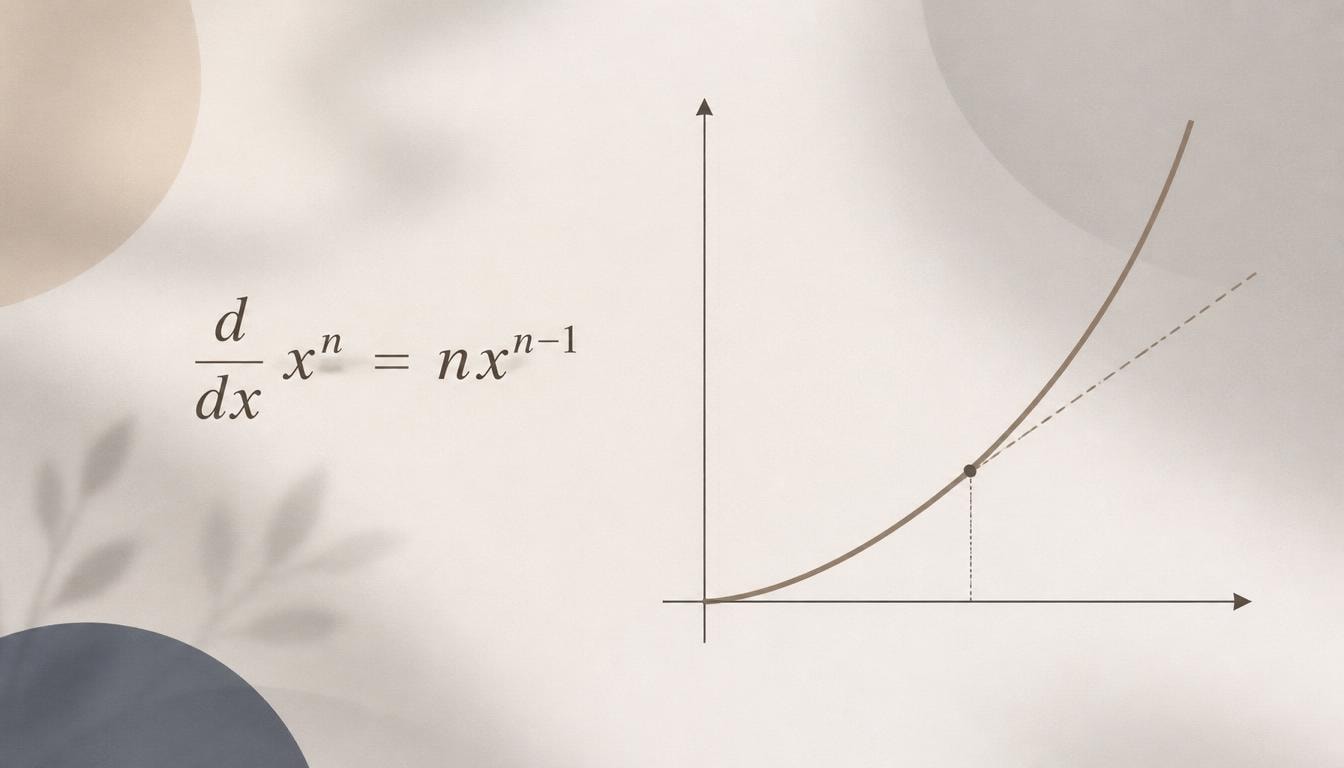
The derivative of a power function is found using a simple yet incredibly powerful formula known as the Power Rule. The Power Rule states that for any real number n:
d/dx [xn] = n · xn - 1
In plain English, to find the derivative of a power function, you take the exponent, bring it down to the front to multiply it by the variable, and then decrease the original exponent by exactly 1.
This rule transforms what could be a lengthy and tedious algebraic process into a quick, single-step operation. Let us look at why this rule holds true mathematically.
Proving the Power Rule
To truly understand the derivative of a power function, we must look at how the Power Rule is derived. We can prove this rule using the fundamental limit definition of the derivative.
The limit definition of a derivative for any function f(x) is:
f'(x) = limh → 0 [f(x + h) - f(x)] / h
Proof for Positive Integer Exponents (Using the Binomial Theorem)
Let us assume n is a positive integer. If we substitute f(x) = xn into our limit definition, we get:
f'(x) = limh → 0 [(x + h)n - xn] / h
To simplify the term (x + h)n, we can expand it using the Binomial Theorem:
(x + h)n = xn + n · xn-1 · h + [n(n-1)/2] · xn-2 · h2 + ... + hn
Now, substitute this expansion back into our limit equation:
f'(x) = limh → 0 [ (xn + n · xn-1 · h + [n(n-1)/2] · xn-2 · h2 + ... + hn) - xn ] / h
Notice that the first term, xn, and the subtracted term, -xn, cancel each other out:
f'(x) = limh → 0 [ n · xn-1 · h + [n(n-1)/2] · xn-2 · h2 + ... + hn ] / h
Next, we can factor out an h from every term in the numerator:
f'(x) = limh → 0 [ h · (n · xn-1 + [n(n-1)/2] · xn-2 · h + ... + hn-1) ] / h
We can cancel the h in the numerator with the h in the denominator:
f'(x) = limh → 0 [ n · xn-1 + [n(n-1)/2] · xn-2 · h + ... + hn-1 ]
Finally, we evaluate the limit as h approaches 0. Every term containing an h becomes 0, leaving only the first term:
f'(x) = n · xn-1
This completes the proof for positive integer exponents.
General Proof for All Real Exponents (Using Logarithmic Differentiation)
While the Binomial Theorem works beautifully for positive integers, it does not easily apply to negative, fractional, or irrational exponents. To prove the Power Rule for any real number n, we can use natural logarithms and the Chain Rule.
Let f(x) = xn for x > 0. We can rewrite xn using the natural exponential and logarithmic functions:
xn = eln(xn) = en · ln(x)
Now, we find the derivative of this expression with respect to x using the Chain Rule:
d/dx [xn] = d/dx [en · ln(x)]
Since the derivative of eu is eu · du/dx, we set u = n · ln(x). The derivative of u with respect to x is n · (1/x). Therefore:
d/dx [en · ln(x)] = en · ln(x) · [n · (1/x)]
Substitute xn back in place of en · ln(x):
d/dx [xn] = xn · (n / x)
Using the laws of exponents, we simplify xn / x to xn-1:
d/dx [xn] = n · xn-1
This elegant proof demonstrates that the Power Rule holds true for absolutely any real exponent n.
Step-by-Step Examples
To master the Power Rule, it is helpful to look at how it applies to different types of exponents. Let us walk through several examples step-by-step.
Example 1: Positive Integer Exponent
Find the derivative of f(x) = x5.
Identify the exponent: n = 5.
Apply the Power Rule: Bring the 5 to the front and subtract 1 from the exponent.
f'(x) = 5 · x5 - 1
f'(x) = 5x4
Example 2: Negative Exponent
Find the derivative of f(x) = 1 / x3.
First, rewrite the function as a power function with a negative exponent: f(x) = x-3.
Identify the exponent: n = -3.
Apply the Power Rule: f'(x) = -3 · x-3 - 1.
Simplify the exponent: -3 - 1 = -4. Thus, f'(x) = -3x-4.
Convert back to fraction form if desired: f'(x) = -3 / x4.
Example 3: Fractional Exponent (Radicals)
Find the derivative of f(x) = √x.
Rewrite the square root as a fractional exponent: f(x) = x1/2.
Identify the exponent: n = 1/2.
Apply the Power Rule: f'(x) = (1/2) · x(1/2) - 1.
Simplify the exponent: 1/2 - 1 = -1/2. Thus, f'(x) = (1/2)x-1/2.
Rewrite with positive exponents and radical notation: f'(x) = 1 / (2√x).
Example 4: Real Exponent
Find the derivative of f(x) = xπ.
Identify the exponent: n = π (which is a constant real number).
Apply the Power Rule: f'(x) = π · xπ - 1.
Since π is irrational, we leave the expression in its exact form: f'(x) = πxπ - 1.
Scientific and Physical Applications
The derivative of a power function is not just an abstract mathematical trick; it is a vital tool used across physics, chemistry, engineering, and economics to model rates of change in the physical universe.
1. Kinematics (Motion in Physics)
In physics, the position of a free-falling object under the influence of gravity (neglecting air resistance) can be modeled by a quadratic power function of time t:
s(t) = (1/2)g · t2
Where s(t) is the position, g is the constant acceleration due to gravity, and t is time. To find the instantaneous velocity v(t) of the object, we take the derivative of the position function with respect to time:
v(t) = d/dt [(1/2)g · t2]
Using the Power Rule on t2 (where n = 2):
v(t) = (1/2)g · (2 · t2-1) = g · t
By taking the derivative once more, we find the acceleration a(t), which is the derivative of velocity:
a(t) = d/dt [g · t1] = g · (1 · t0) = g
This classic physical derivation relies entirely on the derivative of simple power functions.
2. Geometric Rates of Change
Consider a spherical balloon being inflated. The volume V of a sphere is given by the power function of its radius r:
V(r) = (4/3)π · r3
If we want to know how fast the volume is changing with respect to the radius, we calculate the derivative dV/dr:
dV/dr = d/dr [(4/3)π · r3]
Applying the Power Rule to r3 (where n = 3):
dV/dr = (4/3)π · (3 · r2) = 4πr2
Interestingly, the derivative of the volume of a sphere with respect to its radius is exactly equal to the surface area of the sphere (4πr2). This geometric relationship is a direct consequence of the Power Rule.
Common Pitfalls to Avoid
While the Power Rule is straightforward, students frequently make a few common errors. Keep these tips in mind to avoid mistakes:
Do not confuse power functions with exponential functions: You cannot use the Power Rule to differentiate f(x) = 2x. The derivative of 2x is 2x · ln(2), not x · 2x-1. The Power Rule only applies when the base is the variable and the exponent is a constant.
Be careful with negative exponents: When differentiating x-2, subtracting 1 from the exponent results in -3, not -1 (since -2 - 1 = -3). A common error is writing the derivative as -2x-1.
Remember to rewrite radicals first: Always convert roots (like ³√x2) into fractional exponents (x2/3) before applying the Power Rule.
Key Takeaways
Understanding how to find the derivative of a power function is one of the most critical milestones in calculus. Here is a summary of what we covered:
A power function is defined as f(x) = xn, where the exponent n is any constant real number.
The derivative is found using the Power Rule: d/dx [xn] = n · xn - 1.
The Power Rule can be proven rigorously for all real numbers using the limit definition of the derivative and logarithmic differentiation.
The rule applies universally, whether the exponent is positive, negative, fractional, or irrational.
Power function derivatives are essential for analyzing physical systems, calculating geometric rates of change, and solving real-world scientific problems.