Introduction to Exponential and Logarithmic Derivatives
In the study of calculus, few mathematical concepts are as elegant and widely applicable as exponential and logarithmic functions. These functions serve as the primary mathematical language for describing processes of growth, decay, and scaling across physics, chemistry, biology, economics, and engineering. Whether you are modeling the cooling of a physical object, the decay of radioactive isotopes, the growth of a bacterial population, or the continuous compounding of financial assets, you will inevitably encounter these functions.
To analyze these dynamic processes quantitatively, we must understand how these functions change at any given instant. This brings us to the core question of differential calculus: What are the derivatives of exponential and logarithmic functions? In this comprehensive, scientifically grounded guide, we will explore the fundamental rules, step-by-step proofs, algebraic properties, and practical applications of these essential derivatives.
1. The Derivative of the Natural Exponential Function: ex
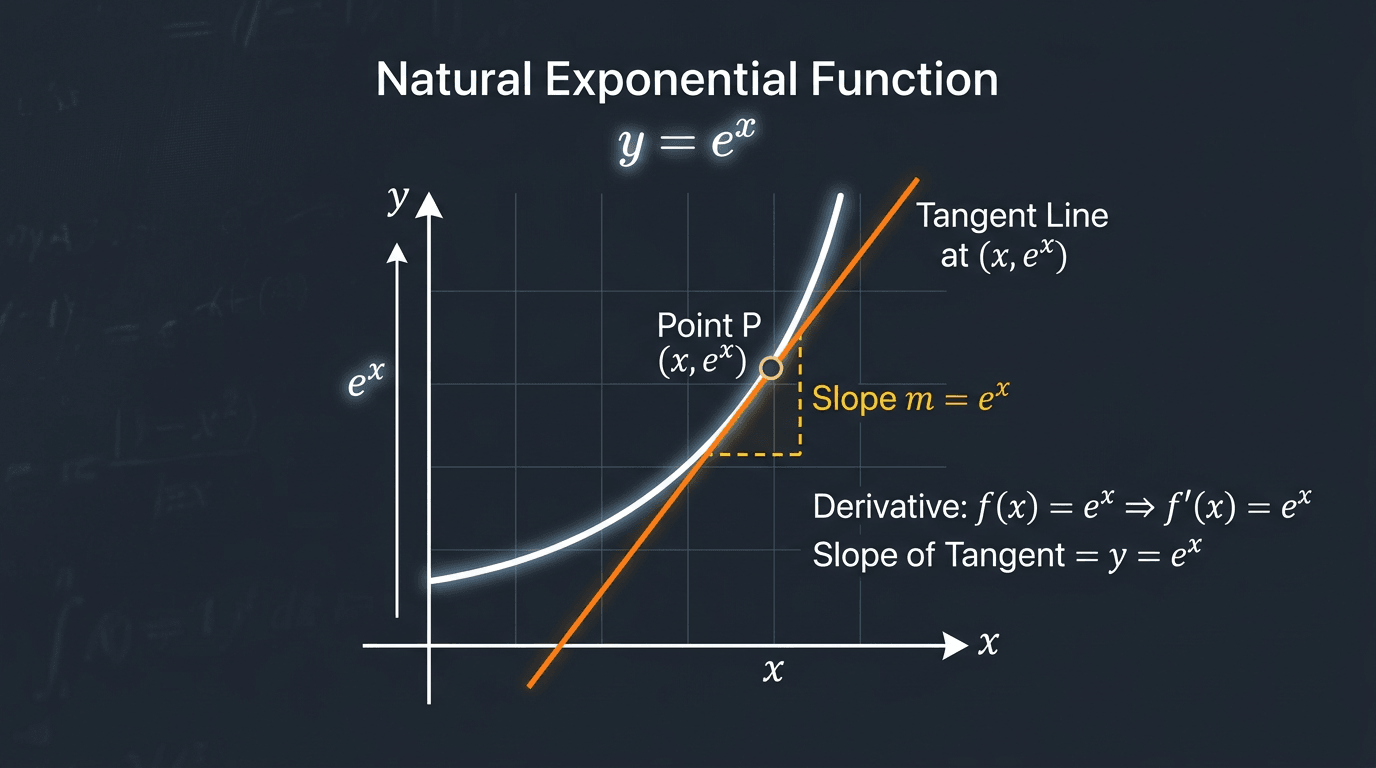
The natural exponential function, denoted as f(x) = ex, is built upon Euler's number, e (approximately equal to 2.71828). Euler's number is not arbitrary; it is uniquely defined in mathematics such that the function ex is its own derivative. This is one of the most remarkable properties in all of mathematics.
The Fundamental Rule:
The derivative of the natural exponential function with respect to x is simply the function itself:
(d/dx)[ex] = ex
Mathematical Proof Using the Limit Definition
To understand why this is true, we must return to the formal limit definition of the derivative:
Let f(x) = ex. The derivative f'(x) is defined as:
f'(x) = limh → 0 [f(x + h) - f(x)] / h
Substituting our function into this definition, we get:
f'(x) = limh → 0 [ex + h - ex] / h
Using the laws of exponents, we can rewrite ex + h as ex · eh:
f'(x) = limh → 0 [ex · eh - ex] / h
Now, we can factor out the common term ex from the numerator:
f'(x) = limh → 0 [ex(eh - 1)] / h
Since the limit is taken as h approaches 0, the term ex acts as a constant relative to h and can be pulled outside the limit operator:
f'(x) = ex · limh → 0 [(eh - 1) / h]
At this point, we must evaluate the limit limh → 0 [(eh - 1) / h]. By definition, Euler's number e is the unique real number for which this exact limit is equal to 1:
limh → 0 [(eh - 1) / h] = 1
Substituting this value back into our equation yields:
f'(x) = ex · 1 = ex
This completes the proof. Geometrically, this means that at any point on the graph of y = ex, the slope of the tangent line is exactly equal to the y-coordinate of that point.
2. The Derivative of General Exponential Functions: ax
What happens when the base of our exponential function is a number other than e? Let us consider the general exponential function f(x) = ax, where a > 0 and a ≠ 1.
The General Exponential Rule:
The derivative of a general exponential function is the function itself multiplied by the natural logarithm of the base:
(d/dx)[ax] = ax · ln(a)
Derivation Using the Natural Base Identity
We can derive this rule easily by converting the general base a into the natural base e using the identity a = eln(a). Therefore, we can rewrite our function as:
ax = (eln(a))x = ex · ln(a)
Now, we differentiate this expression using the Chain Rule. Let u = x · ln(a). Since ln(a) is a constant, the derivative of u with respect to x is simply ln(a).
Applying the Chain Rule:
(d/dx)[ex · ln(a)] = ex · ln(a) · (d/dx)[x · ln(a)]
(d/dx)[ex · ln(a)] = ex · ln(a) · ln(a)
Substituting ax back in place of ex · ln(a) gives us our final result:
(d/dx)[ax] = ax · ln(a)
Example: Differentiating f(x) = 5x
To differentiate f(x) = 5x, we apply the general formula directly where a = 5:
f'(x) = 5x · ln(5)
3. The Derivative of the Natural Logarithmic Function: ln(x)
The natural logarithmic function, f(x) = ln(x), is the inverse of the natural exponential function ex. It is defined for all real numbers x > 0.
The Natural Logarithm Rule:
The derivative of the natural logarithm of x is the reciprocal of x:
(d/dx)[ln(x)] = 1/x, for x > 0
Proof Using Implicit Differentiation
The most intuitive way to prove this derivative is by leveraging our knowledge of the derivative of ex through a technique called implicit differentiation.
Let y = ln(x). By rewriting this in its equivalent exponential form, we get:
ey = x
Now, we differentiate both sides of this equation implicitly with respect to x. Remember that since y is a function of x, we must apply the Chain Rule to the left side:
(d/dx)[ey] = (d/dx)[x]
ey · (dy/dx) = 1
Now, we solve for dy/dx:
dy/dx = 1 / ey
Recall from our starting equation that ey = x. Substituting this back into our derivative formula gives:
dy/dx = 1/x
This elegant proof demonstrates that the rate of change of a natural logarithmic curve at any point is inversely proportional to its horizontal distance from the y-axis.
The Derivative of ln|x|
In many practical integration and differentiation scenarios, we encounter the absolute value within the logarithm, f(x) = ln|x|, which extends the domain of the function to all non-zero real numbers (x ≠ 0). Let's prove that its derivative is still 1/x using piecewise analysis:
For x > 0, |x| = x, so (d/dx)[ln(x)] = 1/x.
For x < 0, |x| = -x. Applying the Chain Rule to ln(-x) yields: (d/dx)[ln(-x)] = [1/(-x)] · (-1) = 1/x.
Thus, for all non-zero values of x:
(d/dx)[ln|x|] = 1/x
4. The Derivative of General Logarithmic Functions: loga(x)
What if the logarithm has a base other than e? Let us consider the general logarithmic function f(x) = loga(x), where a > 0 and a ≠ 1.
The General Logarithm Rule:
The derivative of a general logarithmic function is given by:
(d/dx)[loga(x)] = 1 / [x · ln(a)]
Derivation Using the Change of Base Formula
To differentiate loga(x), we can use the algebraic Change of Base Formula to rewrite it in terms of the natural logarithm:
loga(x) = ln(x) / ln(a)
Since ln(a) is a constant, the term 1 / ln(a) is simply a constant coefficient. We can factor it out before differentiating:
(d/dx)[loga(x)] = (d/dx)[ (1 / ln(a)) · ln(x) ]
(d/dx)[loga(x)] = (1 / ln(a)) · (d/dx)[ln(x)]
We already know that the derivative of ln(x) is 1/x. Substituting this in gives:
(d/dx)[loga(x)] = (1 / ln(a)) · (1 / x) = 1 / [x · ln(a)]
5. Chain Rule Extensions: Composite Functions
In real-world applications, we rarely differentiate simple variables like ex or ln(x). Instead, we differentiate composite functions where the exponent or the argument of the logarithm is itself a function, such as eg(x) or ln(g(x)). To solve these, we apply the Chain Rule.
Composite Rules Summary
Natural Exponential: (d/dx)[eg(x)] = eg(x) · g'(x)
General Exponential: (d/dx)[ag(x)] = ag(x) · ln(a) · g'(x)
Natural Logarithmic: (d/dx)[ln(g(x))] = g'(x) / g(x)
General Logarithmic: (d/dx)[loga(g(x))] = g'(x) / [g(x) · ln(a)]
Step-by-Step Examples
Example 1: Find the derivative of f(x) = e3x2 + 5.
Here, the inner function is g(x) = 3x2 + 5, which has a derivative of g'(x) = 6x. Applying the composite rule:
f'(x) = e3x2 + 5 · (6x) = 6x · e3x2 + 5
Example 2: Find the derivative of f(x) = ln(sin(x)).
Here, the inner function is g(x) = sin(x), which has a derivative of g'(x) = cos(x). Applying the composite rule:
f'(x) = cos(x) / sin(x) = cot(x)
6. Logarithmic Differentiation: A Advanced Technique
Logarithmic differentiation is a powerful technique used to differentiate highly complex products, quotients, or functions where both the base and the exponent are variables (e.g., y = xx). This technique simplifies differentiation by applying the algebraic properties of logarithms to convert products into sums and exponents into coefficients before taking derivatives.
The Step-by-Step Process
Take the natural logarithm (ln) of both sides of the equation y = f(x).
Simplify the expression using logarithmic properties: ln(u · v) = ln(u) + ln(v) and ln(ur) = r · ln(u).
Differentiate both sides implicitly with respect to x. The left side will always become (1/y) · (dy/dx).
Solve for dy/dx by multiplying both sides by y.
Substitute the original expression for y back into the final equation.
Classic Example: Differentiating y = xx
Let's find the derivative of y = xx for x > 0:
Step 1: Take the natural logarithm of both sides:
ln(y) = ln(xx)
Step 2: Use logarithmic power rules to simplify:
ln(y) = x · ln(x)
Step 3: Differentiate both sides implicitly. Use the Product Rule on the right side:
(1/y) · (dy/dx) = (d/dx)[x] · ln(x) + x · (d/dx)[ln(x)]
(1/y) · (dy/dx) = 1 · ln(x) + x · (1/x)
(1/y) · (dy/dx) = ln(x) + 1
Step 4: Multiply both sides by y to isolate dy/dx:
dy/dx = y · [ln(x) + 1]
Step 5: Substitute y = xx back into the equation:
dy/dx = xx · [ln(x) + 1]
7. Scientific and Physical Applications
Newton's Law of Cooling
Newton's Law of Cooling states that the rate of change of the temperature of an object is proportional to the difference between its own temperature and the surrounding ambient temperature. The temperature T(t) at time t is modeled by:
T(t) = Ts + (T0 - Ts) · e-kt
Where Ts is the surrounding temperature, T0 is the initial temperature, and k is a positive physical constant. By differentiating this function with respect to time t, we find the instantaneous rate of cooling:
dT/dt = -k · (T0 - Ts) · e-kt
This derivative shows that as time passes and the object's temperature approaches the surrounding temperature, the rate of temperature change slows down exponentially.
Radioactive Decay
In nuclear physics, the rate at which a radioactive substance decays is proportional to the mass of the substance remaining. If N(t) represents the quantity of a radioactive isotope at time t, it is modeled by:
N(t) = N0 · e-λt
Where N0 is the initial quantity and λ is the decay constant. Differentiating this function yields the activity (rate of decay) of the sample:
dN/dt = -λ · N0 · e-λt = -λ · N(t)
This differential equation shows that the rate of decay is always directly proportional to the amount of active substance remaining, a defining hallmark of first-order kinetics.
Key Takeaways
The derivative of ex is uniquely ex, making it the only non-zero function that is its own derivative.
For any other positive base a, the derivative of ax is ax · ln(a).
The derivative of the natural logarithm ln(x) is the simple algebraic reciprocal 1/x.
For general logarithms, the derivative of loga(x) is 1 / [x · ln(a)].
Using the Chain Rule allows us to extend these rules to any nested function, enabling us to model complex physical and natural systems with precision.