If you have ever wondered how to find the rate of change of a function that depends on another function, you have run directly into the need for the Chain Rule. This comprehensive guide will break down the Chain Rule from its foundational concepts to its physical applications, giving you a deep, intuitive, and practical understanding of how it works.
Understanding Composite Functions: The Foundation
Before we can dive into the Chain Rule itself, we must understand the mathematical structures it operates on: composite functions. A composite function is essentially a function inside another function. It represents a multi-step process where the output of one function becomes the input for the next.
Mathematically, we write a composite function as:
(f ∘ g)(x) = f(g(x))
In this setup:
g(x) is the inner function. It takes the initial input x and processes it first.
f(u) (where u = g(x)) is the outer function. It takes the output of the inner function and processes it to produce the final result.
To visualize this, imagine a factory assembly line. The first machine (the inner function, g) takes raw metal (x) and shapes it into a gear (u). The second machine (the outer function, f) takes that gear (u) and installs it into a watch (y). The entire process from raw metal to finished watch is the composite function f(g(x)).
What Exactly is the Chain Rule?
The Chain Rule is a formal rule in calculus that allows us to calculate the derivative of a composite function. In simple terms, it tells us how to differentiate a "function of a function."
If we want to know how sensitive the final output of our composite function is to changes in the original input x, we cannot simply differentiate the outer function alone. We must account for how the inner function amplifies or dampens those changes along the way. The Chain Rule states that the rate of change of the composite function is the product of the rate of change of the outer function and the rate of change of the inner function.
The Mathematical Formulations
Depending on the context, mathematicians use two primary notations to express the Chain Rule. Both say the exact same thing, but they highlight different aspects of the relationship.
1. Leibniz Notation (The Rate of Change View)
Named after Gottfried Wilhelm Leibniz, this notation is highly intuitive for scientists and engineers because it treats derivatives as ratios of infinitesimally small changes. Let y = f(u) and u = g(x). The derivative of y with respect to x is expressed as:
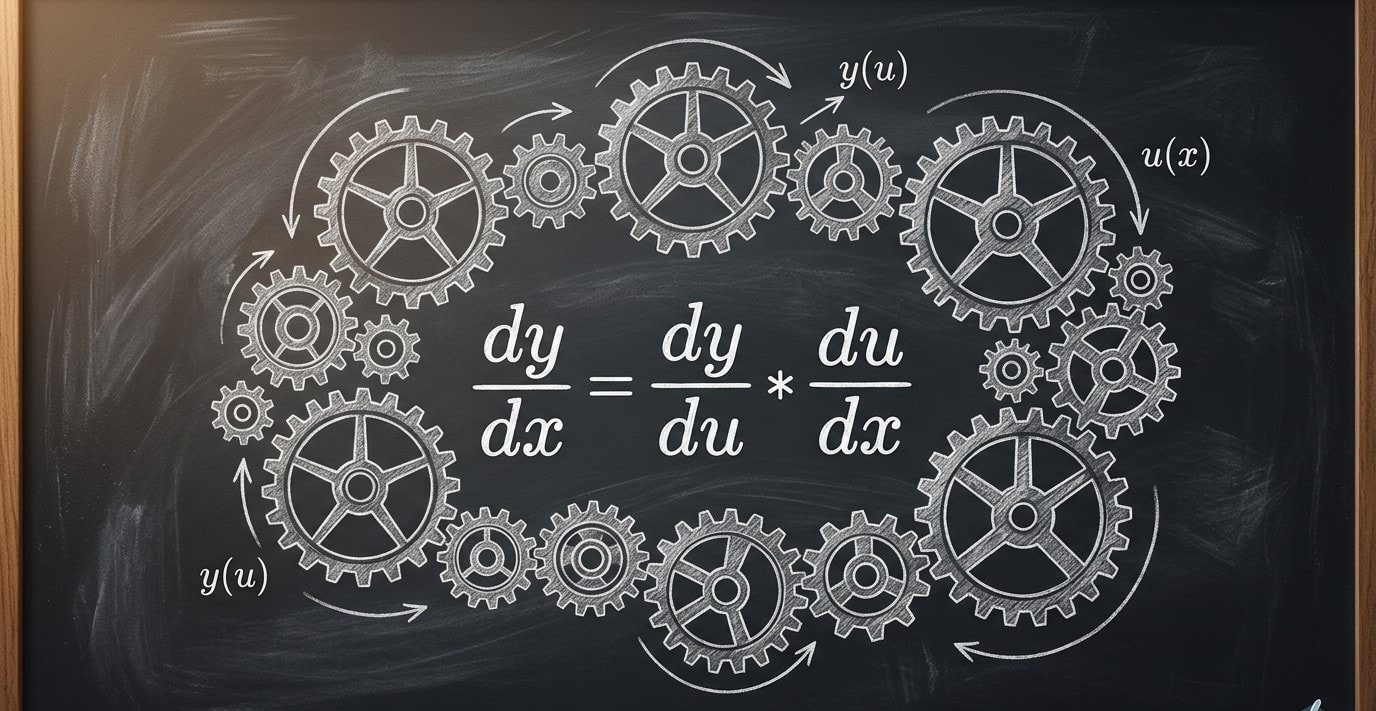
dy/dx = (dy/du) * (du/dx)
This formulation beautifully illustrates why it is called the "Chain" Rule. The term du acts as a link connecting dy and dx. If you treat these terms like algebraic fractions, the du terms appear to cancel out, leaving you with dy/dx. While this is not a rigorous algebraic cancellation, it serves as an excellent conceptual and mnemonic tool.
2. Lagrange/Prime Notation (The Functional View)
Named after Joseph-Louis Lagrange, this notation is cleaner and more common in pure mathematics. It focuses on the functions themselves rather than the variables:
(f(g(x)))' = f'(g(x)) * g'(x)
This formula tells us to perform a two-step calculation:
Differentiate the outer function f(u) with respect to its input, leaving the inner function g(x) completely untouched inside. This gives us f'(g(x)).
Differentiate the inner function g(x) with respect to x. This gives us g'(x).
Multiply these two results together.
The Intuitive Gear Analogy
To truly grasp why we multiply these derivatives, let us look at a physical analogy involving three interlocking gears: Gear A, Gear B, and Gear C.
Suppose Gear A is connected to Gear B, and Gear B is connected to Gear C.
If you turn Gear C, it causes Gear B to turn, which in turn causes Gear A to turn.
Let us define the rates of change:
If Gear B turns 3 times as fast as Gear C, then dB/dC = 3.
If Gear A turns 2 times as fast as Gear B, then dA/dB = 2.
How fast is Gear A turning relative to Gear C? Naturally, you would multiply the ratios: if A turns twice as fast as B, and B turns three times as fast as C, then A must turn 2 * 3 = 6 times as fast as C. Mathematically:
dA/dC = (dA/dB) * (dB/dC) = 2 * 3 = 6
This is precisely what the Chain Rule does. It multiplies the intermediate rates of change to find the total rate of change across the entire chain of dependencies.
Step-by-Step Guide to Applying the Chain Rule
Let us walk through a practical, step-by-step method to apply the Chain Rule to any composite function without getting confused.
Step 1: Identify the layers. Look at the function and determine which part is the "outer layer" and which part is the "inner layer."
Step 2: Differentiate the outer layer. Take the derivative of the outer function as if the inner function were just a single variable (like "u" or "box"). Keep whatever is inside the inner function completely unchanged.
Step 3: Differentiate the inner layer. Find the derivative of the expression inside.
Step 4: Multiply the results. Multiply the derivative of the outer layer by the derivative of the inner layer.
Step 5: Simplify. Clean up the resulting algebraic expression.
Worked Examples
Let us apply these steps to a few concrete examples of varying difficulty.
Example 1: The Power of a Function
Find the derivative of y = (3x2 + 1)5.
Here, we have a composite function:
The inner function is g(x) = 3x2 + 1. Let's call this u.
The outer function is f(u) = u5.
Now, we apply the steps:
Differentiate the outer function with respect to u: d/du (u5) = 5u4. Substituting back our inner function, we get 5(3x2 + 1)4.
Differentiate the inner function with respect to x: d/dx (3x2 + 1) = 6x.
Multiply the two derivatives together:
dy/dx = 5(3x2 + 1)4 * 6x = 30x(3x2 + 1)4
Example 2: Trigonometric Functions
Find the derivative of y = sin(x3).
The inner function is g(x) = x3.
The outer function is f(u) = sin(u).
Applying the Chain Rule:
The derivative of the outer function sin(u) is cos(u). Keeping the inner function intact, we get cos(x3).
The derivative of the inner function x3 is 3x2.
Multiply them together:
dy/dx = cos(x3) * 3x2 = 3x2 cos(x3)
The Multi-Link Chain (Multiple Layers)
The Chain Rule is not limited to just two functions. It can scale to handle functions nested inside functions, nested inside even more functions. For three nested functions, y = f(g(h(x))), the Chain Rule expands to:
dy/dx = f'(g(h(x))) * g'(h(x)) * h'(x)
Think of this like peeling an onion. You differentiate layer by layer, from the outermost skin to the innermost core, multiplying the derivatives of each layer as you go.
Example of a Multi-Link Chain
Find the derivative of y = cos3(4x), which can be rewritten as (cos(4x))3.
This function has three distinct layers:
Outer layer: [box]3
Middle layer: cos[box]
Inner layer: 4x
Let's differentiate layer by layer:
Differentiate the outer layer: 3(cos(4x))2.
Differentiate the middle layer: -sin(4x).
Differentiate the inner layer: 4.
Multiply all three parts together:
dy/dx = 3(cos(4x))2 * (-sin(4x)) * 4 = -12 cos2(4x) sin(4x)
Why the Chain Rule Matters in Science and Physics
1. Related Rates in Physics
Imagine a spherical weather balloon being inflated with helium. The volume (V) of the balloon depends on its radius (r), and the radius is increasing over time (t) as gas is pumped in. If we want to know how fast the volume is increasing over time, we use the Chain Rule:
dV/dt = (dV/dr) * (dr/dt)
By knowing how volume changes with radius (dV/dr, which is the surface area of the sphere) and how fast the radius is expanding (dr/dt), we can instantly calculate the rate of volume expansion over time.
2. Astrophysics and Thermodynamics
In thermodynamics, the pressure of an ideal gas depends on its temperature and volume, both of which might change as a piston moves over time. The Chain Rule allows scientists to track these dynamic changes in real-time, helping to design safer and more efficient engines and thermal systems.
Common Pitfalls and How to Avoid Them
Even experienced calculus students can make mistakes when applying the Chain Rule. Keep these common traps in mind to avoid errors:
Forgetting the inner derivative: The most common mistake is simply differentiating the outer function and forgetting to multiply by the derivative of the inner function. Always double-check if your function has an "inside" that needs its own derivative.
Differentiating the inside too early: When you differentiate the outer layer, keep the inner expression exactly as it is. Do not change the inside of the function until you perform the separate step of multiplying by its derivative.
Confusing notation: Be careful with expressions like sin2(x) vs. sin(x2). The former is (sin(x))2, where the power is the outer layer. The latter has sin(u) as the outer layer and x2 as the inner layer.
Conclusion
The Chain Rule is a cornerstone of calculus that unlocks our ability to model and solve complex real-world problems. By viewing composite functions as layers of an onion or interlocking gears, we can systematically break down complicated derivatives into simple, manageable steps.
Whether you are analyzing physical motion, calculating thermodynamic changes, or diving deep into machine learning algorithms (where the Chain Rule is the engine behind backpropagation), mastering this rule is essential. With practice, identifying the layers of composite functions will become second nature, and you will find yourself applying the Chain Rule with ease and confidence.