In this comprehensive guide, we will explore the derivatives of the six fundamental trigonometric functions: sine, cosine, tangent, cosecant, secant, and cotangent. We will derive these formulas from first principles, explore the geometric and algebraic proofs behind them, and look at how these derivatives are applied to solve real-world physical and scientific problems.
The Foundation: Two Critical Limits
Before we can calculate the derivative of any trigonometric function using the formal limit definition, we must establish two fundamental limits. These limits serve as the building blocks for our proofs.
1. The Limit of sin(h)/h as h Approaches 0
The first critical limit is:
lim (h → 0) [sin(h) / h] = 1
To understand why this is true, we can visualize a sector of a unit circle with a central angle of h radians (where 0 < h < π/2). By comparing the areas of the inner triangle, the circular sector, and the outer right triangle, we establish the inequality:
sin(h) / 2 < h / 2 < tan(h) / 2
Multiplying all terms by 2 gives:
sin(h) < h < tan(h)
If we divide the entire inequality by sin(h) (which is positive since h is in the first quadrant), we get:
1 < h / sin(h) < 1 / cos(h)
Taking the reciprocal of all terms reverses the inequalities:
cos(h) < sin(h) / h < 1
As h approaches 0, cos(h) approaches 1. By the Squeeze Theorem, since sin(h)/h is trapped between cos(h) and 1, its limit must also be 1.
2. The Limit of [cos(h) - 1]/h as h Approaches 0
The second critical limit is:
lim (h → 0) [(cos(h) - 1) / h] = 0
We can prove this limit using our first limit and some basic trigonometric identities. Multiplying the numerator and denominator by the conjugate (cos(h) + 1), we get:
[(cos(h) - 1)(cos(h) + 1)] / [h(cos(h) + 1)] = [cos²(h) - 1] / [h(cos(h) + 1)]
Using the Pythagorean identity sin²(h) + cos²(h) = 1, we substitute -sin²(h) for cos²(h) - 1:
-sin²(h) / [h(cos(h) + 1)] = -[sin(h) / h] * [sin(h) / (cos(h) + 1)]
Now, taking the limit as h approaches 0:
lim (h → 0) [-[sin(h) / h] * [sin(h) / (cos(h) + 1)]] = -(1) * (0 / 2) = 0
With these two foundational limits established, we are now ready to derive the derivatives of the trigonometric functions.
The Derivative of Sine: d/dx [sin(x)]
Let us find the derivative of f(x) = sin(x) using the formal definition of the derivative:
f'(x) = lim (h → 0) [f(x + h) - f(x)] / h
Substituting sin(x) into the formula:
d/dx [sin(x)] = lim (h → 0) [sin(x + h) - sin(x)] / h
Using the trigonometric sum identity, sin(x + h) = sin(x)cos(h) + cos(x)sin(h), we rewrite the expression:
= lim (h → 0) [sin(x)cos(h) + cos(x)sin(h) - sin(x)] / h
Next, group the terms involving sin(x) together:
= lim (h → 0) [sin(x)(cos(h) - 1) + cos(x)sin(h)] / h
We can split this limit into two separate limits:
= sin(x) * lim (h → 0) [(cos(h) - 1) / h] + cos(x) * lim (h → 0) [sin(h) / h]
Substituting our two fundamental limits into this equation yields:
= sin(x) * (0) + cos(x) * (1) = cos(x)
Thus, we have proven our first derivative rule:
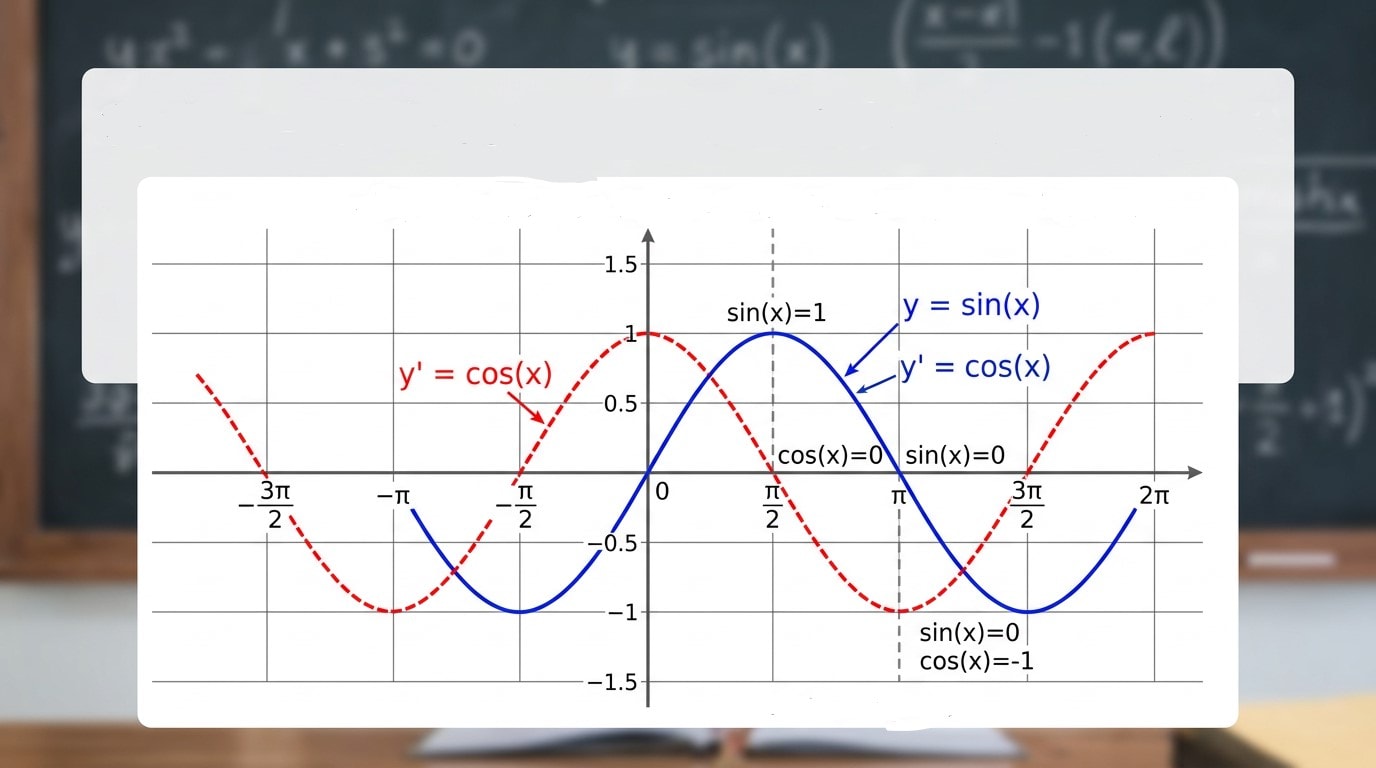
d/dx [sin(x)] = cos(x)
The Derivative of Cosine: d/dx [cos(x)]
We can find the derivative of g(x) = cos(x) using a very similar approach. Using the limit definition:
d/dx [cos(x)] = lim (h → 0) [cos(x + h) - cos(x)] / h
Using the cosine sum identity, cos(x + h) = cos(x)cos(h) - sin(x)sin(h), we substitute:
= lim (h → 0) [cos(x)cos(h) - sin(x)sin(h) - cos(x)] / h
Grouping the cos(x) terms together:
= lim (h → 0) [cos(x)(cos(h) - 1) - sin(x)sin(h)] / h
Splitting the limit:
= cos(x) * lim (h → 0) [(cos(h) - 1) / h] - sin(x) * lim (h → 0) [sin(h) / h]
Applying our fundamental limits:
= cos(x) * (0) - sin(x) * (1) = -sin(x)
This gives us our second fundamental derivative rule:
d/dx [cos(x)] = -sin(x)
The Derivative of Tangent: d/dx [tan(x)]
Instead of using the limit definition for the remaining trigonometric functions, we can leverage the rules of differentiation (specifically the Quotient Rule) and the derivatives of sine and cosine that we just established.
Recall that tan(x) = sin(x) / cos(x). Let's apply the Quotient Rule, which states that for a function u(x) / v(x), the derivative is:
[(u' * v) - (u * v')] / v²
Letting u(x) = sin(x) (so u'(x) = cos(x)) and v(x) = cos(x) (so v'(x) = -sin(x)):
d/dx [tan(x)] = [(cos(x) * cos(x)) - (sin(x) * -sin(x))] / cos²(x)
= [cos²(x) + sin²(x)] / cos²(x)
Using the Pythagorean identity sin²(x) + cos²(x) = 1:
= 1 / cos²(x)
Since 1 / cos(x) = sec(x), we get:
d/dx [tan(x)] = sec²(x)
Derivatives of the Reciprocal Functions
Now we will derive the derivatives of the remaining three trigonometric functions: cosecant, secant, and cotangent.
1. The Derivative of Cosecant: d/dx [csc(x)]
We know that csc(x) = 1 / sin(x). We can differentiate this using the Reciprocal Rule or the Quotient Rule. Let's use the chain rule on (sin(x))¹¹:
d/dx [(sin(x))¹¹] = -1 * (sin(x))¹² * cos(x)
= -cos(x) / sin²(x)
We can rewrite this expression to make it easier to remember:
= -(1 / sin(x)) * (cos(x) / sin(x))
Since 1 / sin(x) = csc(x) and cos(x) / sin(x) = cot(x), we have:
d/dx [csc(x)] = -csc(x)cot(x)
2. The Derivative of Secant: d/dx [sec(x)]
Since sec(x) = 1 / cos(x), we apply the chain rule to (cos(x))¹¹:
d/dx [(cos(x))¹¹] = -1 * (cos(x))¹² * (-sin(x))
= sin(x) / cos²(x)
Rewriting the expression:
= (1 / cos(x)) * (sin(x) / cos(x))
Using reciprocal and quotient identities:
d/dx [sec(x)] = sec(x)tan(x)
3. The Derivative of Cotangent: d/dx [cot(x)]
Since cot(x) = cos(x) / sin(x), we can use the Quotient Rule where u(x) = cos(x) and v(x) = sin(x):
d/dx [cot(x)] = [(-sin(x) * sin(x)) - (cos(x) * cos(x))] / sin²(x)
= -(sin²(x) + cos²(x)) / sin²(x)
Applying the Pythagorean identity:
= -1 / sin²(x)
Since 1 / sin(x) = csc(x):
d/dx [cot(x)] = -csc²(x)
Summary of Trigonometric Derivatives
Below is a quick reference table summarizing the derivatives of all six trigonometric functions:
d/dx [sin(x)] = cos(x)
d/dx [cos(x)] = -sin(x)
d/dx [tan(x)] = sec²(x)
d/dx [csc(x)] = -csc(x)cot(x)
d/dx [sec(x)] = sec(x)tan(x)
d/dx [cot(x)] = -csc²(x)
Tip for memorization: Notice that the derivatives of all "co-" functions (cosine, cosecant, cotangent) are negative, while the others are positive.
Higher-Order Derivatives and Patterns
One of the most fascinating characteristics of trigonometric derivatives is their cyclical nature. Let us look at the successive derivatives of f(x) = sin(x):
First Derivative: f'(x) = cos(x)
Second Derivative: f''(x) = -sin(x)
Third Derivative: f'''(x) = -cos(x)
Fourth Derivative: f&sup4;(x) = sin(x)
Notice that after four derivatives, we return to our original function. This cycle repeats indefinitely. This unique property makes sine and cosine functions central to solving differential equations that describe oscillatory behavior.
Physical and Scientific Applications
1. Simple Harmonic Motion (SHM)
In physics, simple harmonic motion describes the movement of a back-and-forth system, such as a pendulum or a mass attached to a spring. The position of such an object over time t can be modeled by the equation:
x(t) = A * cos(ωt + φ)
Where A is the amplitude, ω is the angular frequency, and φ is the phase constant. To find the velocity v(t) of this object, we take the derivative of position with respect to time (applying the Chain Rule):
v(t) = dx/dt = -A * ω * sin(ωt + φ)
To find the acceleration a(t), we take the derivative of velocity:
a(t) = dv/dt = -A * ω² * cos(ωt + φ)
Notice that a(t) = -ω² * x(t). This differential relationship shows that the acceleration is always proportional and opposite to the displacement, which is the defining characteristic of simple harmonic motion.
2. Electrical Engineering and Alternating Currents (AC)
The voltage V(t) in an alternating current electrical circuit is modeled by a sine wave:
V(t) = V_0 * sin(ωt)
The current passing through a capacitor in such a circuit is proportional to the rate of change of voltage over time:
I(t) = C * (dV / dt)
By taking the derivative of the voltage function, we find:
I(t) = C * V_0 * ω * cos(ωt)
This derivative shows that the current wave is shifted in phase compared to the voltage wave, a critical concept in designing and analyzing electrical grids and electronic devices.
Conclusion
Understanding the derivatives of trigonometric functions is a major milestone in calculus. By deriving these formulas from fundamental geometric limits, we see the deep logic connecting algebra, geometry, and calculus. Whether you are analyzing physical waves, calculating mechanical velocities, or designing electronic circuits, these derivatives provide the mathematical language necessary to quantify change in a cyclical world.