In mathematics, science, and engineering, optimization is one of the most powerful tools we have. Whether you are trying to maximize the efficiency of a solar panel, minimize the cost of manufacturing a product, or determine the peak concentration of a drug in a patient's bloodstream, you are looking for the absolute maximum or absolute minimum of a function. These extreme values are collectively referred to as absolute extrema.
While local extrema tell us about the behavior of a function in a small, localized neighborhood, absolute extrema give us the big picture: the single highest and lowest values that a function can possibly achieve over its entire domain or a specified interval. This comprehensive guide will walk you through the mathematical theory, the step-by-step procedures, and practical examples to help you master finding absolute maximums and minimums.
Understanding Absolute Extrema
Before diving into the calculations, let us formally define what we are looking for. Let f be a function defined on a set D (the domain).
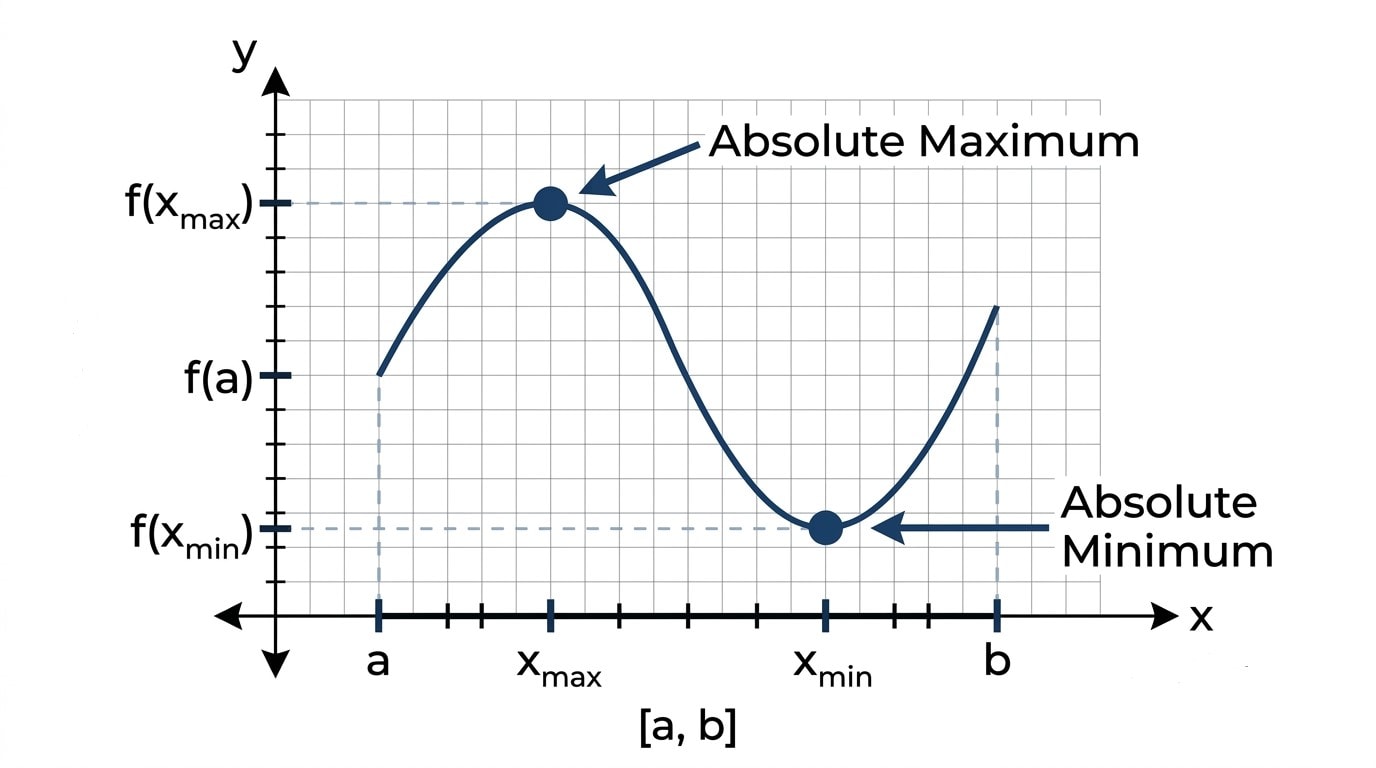
Absolute Maximum: A function f has an absolute maximum at a point c in D if f(c) ≥ f(x) for all x in D. The value f(c) is the maximum value of the function.
Absolute Minimum: A function f has an absolute minimum at a point c in D if f(c) ≤ f(x) for all x in D. The value f(c) is the minimum value of the function.
It is important to note that a function does not always have an absolute maximum or minimum. For instance, the linear function f(x) = x defined on all real numbers grows infinitely large as x approaches infinity and infinitely small as x approaches negative infinity. Therefore, it has no absolute extrema on that domain. To guarantee the existence of these values, we rely on a fundamental theorem of calculus.
The Extreme Value Theorem (EVT)
The Extreme Value Theorem: If a function f is continuous on a closed interval [a, b], then f must attain an absolute maximum value and an absolute minimum value at least once within that interval.
The EVT provides two critical conditions that guarantee the existence of absolute extrema:
The function must be continuous on the entire interval. Any breaks, holes, or vertical asymptotes can disrupt this guarantee.
The interval must be closed (including its endpoints, denoted as [a, b]).
If these conditions are met, we are guaranteed to find both a highest point and a lowest point on the graph of the function within that interval. These extrema can occur either at the boundaries (the endpoints a and b) or at interior points where the function peaks or valleys.
Where Do Absolute Extrema Occur?
According to calculus, if an absolute extremum occurs in the interior of an interval (not at the endpoints), it must occur at a critical point. A critical point of a function f is a number c in the domain of f such that either:
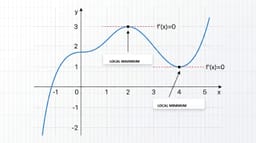
The derivative is zero: f'(c) = 0 (the tangent line is horizontal).
The derivative is undefined: f'(c) is undefined (such as a sharp corner, cusp, or vertical tangent).
Therefore, when searching for absolute extrema on a closed interval, we only need to look at a finite list of candidate points: the critical points inside the interval and the endpoints of the interval.
The Closed Interval Method (Step-by-Step)
To find the absolute maximum and minimum values of a continuous function f on a closed interval [a, b], follow these three systematic steps:
Step 1: Find the Critical Points
Find the derivative of the function, f'(x). Set the derivative equal to zero (f'(x) = 0) and solve for x. Also, identify any values of x where the derivative f'(x) does not exist. Keep only the critical points that lie strictly inside the open interval (a, b).
Step 2: Evaluate the Function at Critical Points
Plug each of the valid critical points found in Step 1 back into the original function f(x) to find their corresponding y-values.
Step 3: Evaluate the Function at the Endpoints
Calculate the values of the original function at the boundaries of the interval, namely f(a) and f(b).
Step 4: Compare the Values
Compare all the outputs obtained from Steps 2 and 3.
The largest of these values is the absolute maximum value of the function on the interval.
The smallest of these values is the absolute minimum value of the function on the interval.
A Concrete Example on a Closed Interval
Let us apply this method to a specific mathematical function. Suppose we want to find the absolute maximum and minimum values of the function:
f(x) = 3x^4 - 4x^3 on the closed interval [-1, 2].
Step 1: Find Critical Points
First, we compute the derivative of f(x) using the power rule:
f'(x) = 12x^3 - 12x^2
Next, we set f'(x) = 0 to find the critical points:
12x^2(x - 1) = 0
This gives us two critical points: x = 0 and x = 1. Both of these values lie within our target interval [-1, 2].
Step 2: Evaluate f(x) at Critical Points
Now we substitute our critical points back into the original function f(x) = 3x^4 - 4x^3:
For x = 0: f(0) = 3(0)^4 - 4(0)^3 = 0
For x = 1: f(1) = 3(1)^4 - 4(1)^3 = 3 - 4 = -1
Step 3: Evaluate f(x) at the Endpoints
Next, we evaluate the function at the boundaries of our interval, x = -1 and x = 2:
For x = -1: f(-1) = 3(-1)^4 - 4(-1)^3 = 3(1) - 4(-1) = 3 + 4 = 7
For x = 2: f(2) = 3(2)^4 - 4(2)^3 = 3(16) - 4(8) = 48 - 32 = 16
Step 4: Compare the Results
Let us list all the values we calculated:
f(0) = 0
f(1) = -1
f(-1) = 7
f(2) = 16
By comparing these values, we can clearly identify the extrema:
The absolute maximum value is 16, which occurs at the endpoint x = 2.
The absolute minimum value is -1, which occurs at the critical point x = 1.
Finding Absolute Extrema on Open or Infinite Intervals
What happens if the interval is not closed, or if the domain is infinite (such as all real numbers)? In these cases, the Extreme Value Theorem does not apply directly, and the function might not have an absolute maximum or minimum. To analyze these functions, we must look at the behavior of the function as it approaches the boundaries or limits at infinity.
The First Derivative Test for Absolute Extrema
If a continuous function has only one critical point in its entire domain, we can determine if it is an absolute extremum using a simple variation of the First Derivative Test:
If f'(x) > 0 for all x < c and f'(x) < 0 for all x > c, then f(c) is the absolute maximum of the function.
If f'(x) < 0 for all x < c and f'(x) > 0 for all x > c, then f(c) is the absolute minimum of the function.
Using Limits to Determine Extrema
When dealing with intervals like (-∞, ∞) or open intervals like (a, b), we must compute the limits of the function as x approaches the boundaries. For example, if we have a function f(x) on the real numbers, and we find that:
lim (as x → ∞) f(x) = ∞ and lim (as x → -∞) f(x) = ∞
This tells us that the function grows boundlessly in both directions. Therefore, there is no absolute maximum. However, because the function goes up to infinity on both sides, it must reach a bottom-most point somewhere in between. The lowest of the critical points will be the absolute minimum.
Common Pitfalls to Avoid
When solving these optimization problems, students often make a few common errors. Keep these tips in mind to avoid mistakes:
Do not forget the endpoints: It is highly common to find all the critical points and forget to evaluate the function at the boundary endpoints. As seen in our example, the absolute maximum occurred at an endpoint!
Do not plug critical values into the derivative: When evaluating candidates in Step 2, make sure to plug them back into the original function f(x), not the derivative f'(x). Plugging critical points into the derivative will simply yield zero or an undefined value.
Filter out irrelevant critical points: Only evaluate critical points that lie inside the specified interval. If you find a critical point at x = 5 but your interval is [0, 3], ignore it.
Summary of Key Takeaways
Finding the absolute maximum and minimum of a function is a straightforward process when approached methodically. Here is a quick recap of the essentials:
Absolute extrema represent the absolute highest and lowest outputs of a function on a given domain.
The Extreme Value Theorem guarantees the existence of both a maximum and minimum if the function is continuous on a closed interval.
Candidates for absolute extrema are always either critical points (where f'(x) = 0 or is undefined) or endpoints of the interval.
For open or infinite intervals, use limits and derivative sign analysis to determine if absolute extrema exist and where they lie.