Introduction to Divisibility
Mathematics is full of patterns, shortcuts, and elegant rules that make handling large numbers surprisingly simple. One of the most famous and widely used shortcuts in arithmetic is the divisibility rule. Divisibility rules allow us to determine whether a given number can be divided by another number evenly—meaning without leaving a remainder—all without performing the actual, tedious process of long division.
Among these rules, the rule for the number 3 is one of the most fascinating and easiest to apply. Whether you are simplifying fractions, factoring large algebraic expressions, or preparing for a competitive math competition, mastering the divisibility rule for 3 is an essential milestone. In this comprehensive guide, we will explore what this rule is, look at step-by-step examples, dive deep into the mathematical proof of why it works, and practice with real-world problems.
What Is the Divisibility Rule for 3?
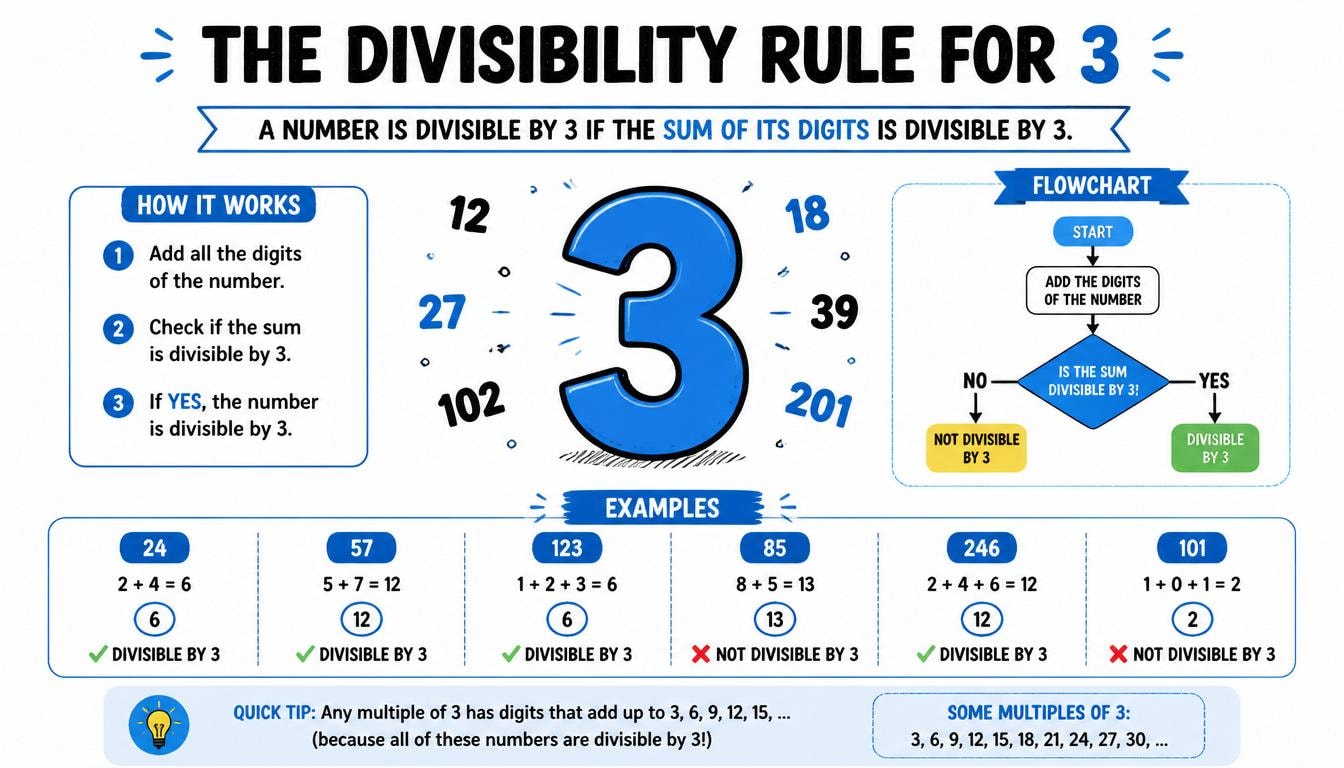
The divisibility rule for 3 states that a whole number is completely divisible by 3 if and only if the sum of its individual digits is also divisible by 3.
Unlike the divisibility rules for 2, 5, or 10, which only require you to look at the very last digit of a number, the rule for 3 requires you to look at all the digits together. This makes it a unique and active rule that works regardless of how many digits the number has—whether it is a two-digit number like 27 or a ten-digit number like 1,002,003,006.
Step-by-Step Guide: How to Apply the Rule
To check if any number is divisible by 3, you can follow these three simple steps:
Identify the digits: Write down or look closely at all the individual digits that make up the number.
Sum the digits: Add all of those digits together to get a single sum.
Evaluate the sum: Check if the resulting sum is a multiple of 3 (such as 3, 6, 9, 12, 15, 18, 21, 24, 27, 30, and so on). If the sum is divisible by 3, then the original number is also divisible by 3. If the sum is not divisible by 3, then the original number is not divisible by 3.
Applying the Rule to Small and Medium Numbers
Let us look at a few basic examples to see this rule in action:
Example 1: Is 72 divisible by 3?
Step 1: The digits of 72 are 7 and 2.
Step 2: Add them together: 7 + 2 = 9.
Step 3: Since 9 is a multiple of 3 (3 x 3 = 9), 72 is divisible by 3. (Indeed, 72 divided by 3 is exactly 24).Example 2: Is 143 divisible by 3?
Step 1: The digits of 143 are 1, 4, and 3.
Step 2: Add them together: 1 + 4 + 3 = 8.
Step 3: Since 8 is not a multiple of 3, 143 is not divisible by 3. (Dividing 143 by 3 leaves a remainder of 2).Example 3: Is 516 divisible by 3?
Step 1: The digits of 516 are 5, 1, and 6.
Step 2: Add them together: 5 + 1 + 6 = 12.
Step 3: Since 12 is a multiple of 3 (3 x 4 = 12), 516 is divisible by 3. (516 divided by 3 is exactly 172).
The Power of the Rule with Extremely Large Numbers
The true beauty of the divisibility rule for 3 shines when we deal with massive numbers. Performing long division on a seven-digit or eight-digit number can take several minutes and is highly prone to calculation errors. The sum-of-digits method reduces this complex task to basic single-digit addition in a matter of seconds.
Let us examine the number 5,784,312.
Let's test 5,784,312:
1. Sum the digits: 5 + 7 + 8 + 4 + 3 + 1 + 2
2. Calculate: 5 + 7 = 12; 12 + 8 = 20; 20 + 4 = 24; 24 + 3 = 27; 27 + 1 = 28; 28 + 2 = 30.
3. The sum is 30.
4. Since 30 is divisible by 3 (3 x 10 = 30), the original number 5,784,312 is completely divisible by 3.
The "Double-Sum" Shortcut (Digital Roots)
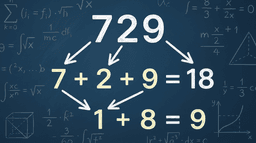
What if the sum of the digits is still a large number, and you are not immediately sure if it is divisible by 3? You can simply apply the exact same rule to the sum itself! This process is related to finding the digital root of a number.
For example, let's test the number 9,998,886:
Sum of the digits: 9 + 9 + 9 + 8 + 8 + 8 + 6 = 57
If you do not know if 57 is divisible by 3 off the top of your head, apply the rule to 57:
Sum of the digits of 57: 5 + 7 = 12
Since 12 is clearly divisible by 3, then 57 is divisible by 3, which means the original giant number 9,998,886 is also divisible by 3!
Why Does It Work? The Mathematical Proof
To truly understand mathematics, we must go beyond memorizing rules and look at the underlying proofs. Why does adding the digits of a number tell us anything about its divisibility by 3? The answer lies in our base-10 positional numeral system.
Every number we write is actually a shorthand representation of powers of 10. Let's take a three-digit number, which we can write algebraically as abc. The value of this number is:
Value = 100a + 10b + c
We can rewrite the numbers 100 and 10 in terms of numbers that are immediately adjacent to them and easily divisible by 3. Specifically, we can write 100 as (99 + 1) and 10 as (9 + 1). Let's substitute these into our equation:
Value = (99 + 1)a + (9 + 1)b + c
Now, let's distribute the variables a and b:
Value = 99a + a + 9b + b + c
Next, let's rearrange the terms to group the multiples of 9 and the individual digits together:
Value = (99a + 9b) + (a + b + c)
Let us analyze the two parts of this rearranged expression:
The first part, (99a + 9b): Since 99 is divisible by 3 (99 = 3 x 33) and 9 is divisible by 3 (9 = 3 x 3), any integer multiplied by 99 or 9 will also be divisible by 3. Therefore, the term (99a + 9b) is always, guaranteed to be divisible by 3, no matter what digits a and b are.
The second part, (a + b + c): This is simply the sum of the individual digits of our original number!
Because the first part of our expression is already divisible by 3, the divisibility of the entire number depends entirely on whether the second part—the sum of the digits (a + b + c)—is divisible by 3. If (a + b + c) is divisible by 3, then the entire sum is divisible by 3. This algebraic proof works for numbers of any length, whether they have 2, 5, or 100 digits!
Comparison with Other Divisibility Rules
Understanding how the rule for 3 fits into the broader landscape of divisibility rules helps solidify your mental math framework. Here is a quick comparison table:
Rule for 2: Check if the last digit is even (0, 2, 4, 6, 8). Focuses only on the units place.
Rule for 3: Sum all digits and check if the sum is divisible by 3. Focuses on the entire digit structure.
Rule for 4: Check if the last two digits form a number divisible by 4. Focuses on the tens and units place.
Rule for 5: Check if the last digit is 0 or 5. Focuses only on the units place.
Rule for 9: Sum all digits and check if the sum is divisible by 9. This is highly similar to the rule for 3, because 9 is also based on powers of 10 being 1 greater than multiples of 9 (99, 999, etc.).
Practice Exercises
Test your understanding of the divisibility rule for 3 with these practice problems. Try to solve them using the sum-of-digits method before looking at the solutions.
Is the number 2,043 divisible by 3?
Is the number 8,116 divisible by 3?
Is the number 45,903 divisible by 3?
What is the smallest digit you can place in the blank space of 7_2 to make the number divisible by 3?
Solutions and Explanations
Answer: Yes. The sum of the digits is 2 + 0 + 4 + 3 = 9. Since 9 is divisible by 3, 2,043 is divisible by 3 (2,043 / 3 = 681).
Answer: No. The sum of the digits is 8 + 1 + 1 + 6 = 16. Since 16 is not divisible by 3, 8,116 is not divisible by 3.
Answer: Yes. The sum of the digits is 4 + 5 + 9 + 0 + 3 = 21. Since 21 is divisible by 3 (3 x 7 = 21), 45,903 is divisible by 3 (45,903 / 3 = 15,301).
Answer: 0. Let the missing digit be x. The sum of the digits is 7 + x + 2 = 9 + x. For the number to be divisible by 3, the sum (9 + x) must be divisible by 3. Since 9 is already divisible by 3, the smallest single-digit value we can choose for x is 0. (The number 702 is divisible by 3).
Key Takeaways
The divisibility rule for 3 is a quick mental math shortcut: add the digits of a number, and if the sum is divisible by 3, the entire number is.
This rule works because of our base-10 system, where powers of 10 (10, 100, 1000) are always one unit higher than multiples of 9, which are inherently divisible by 3.
You can apply the rule recursively (summing the digits of the sum) if you encounter large numbers.
Mastering this rule saves time in division, fraction simplification, and prime factorization.