Mathematics is built upon patterns, order, and rules that simplify complex calculations. Among these, divisibility rules are some of the most powerful tools we learn early in our mathematical journeys. They allow us to look at a massive number and instantly determine whether it can be divided evenly by another number without performing long division. Of all these rules, the most fundamental and frequently used is the divisibility rule for 2.
In this comprehensive guide, we will explore everything you need to know about the divisibility rule for 2. We will look at the rule itself, understand the mathematical proof of why it works using place value, examine how it defines even and odd numbers, walk through step-by-step examples, and see how this rule is applied in computer science and everyday life.
What Does "Divisible" Actually Mean?
Before diving into the specific rule for the number 2, it is essential to understand what divisibility means in a mathematical context. A whole number is said to be divisible by another whole number if, when you divide them, the result (the quotient) is also a whole number, and the remainder is exactly zero.
Mathematical Definition: If a and b are integers, we say that a is divisible by b (written as b | a) if there exists an integer q such that a = b × q. In this case, there is no fractional part or remainder left over.
For example, 10 is divisible by 2 because 10 divided by 2 is exactly 5, with zero remainder. On the other hand, 11 is not divisible by 2 because 11 divided by 2 is 5 with a remainder of 1.
The Divisibility Rule for 2
The divisibility rule for 2 is incredibly simple and elegant:
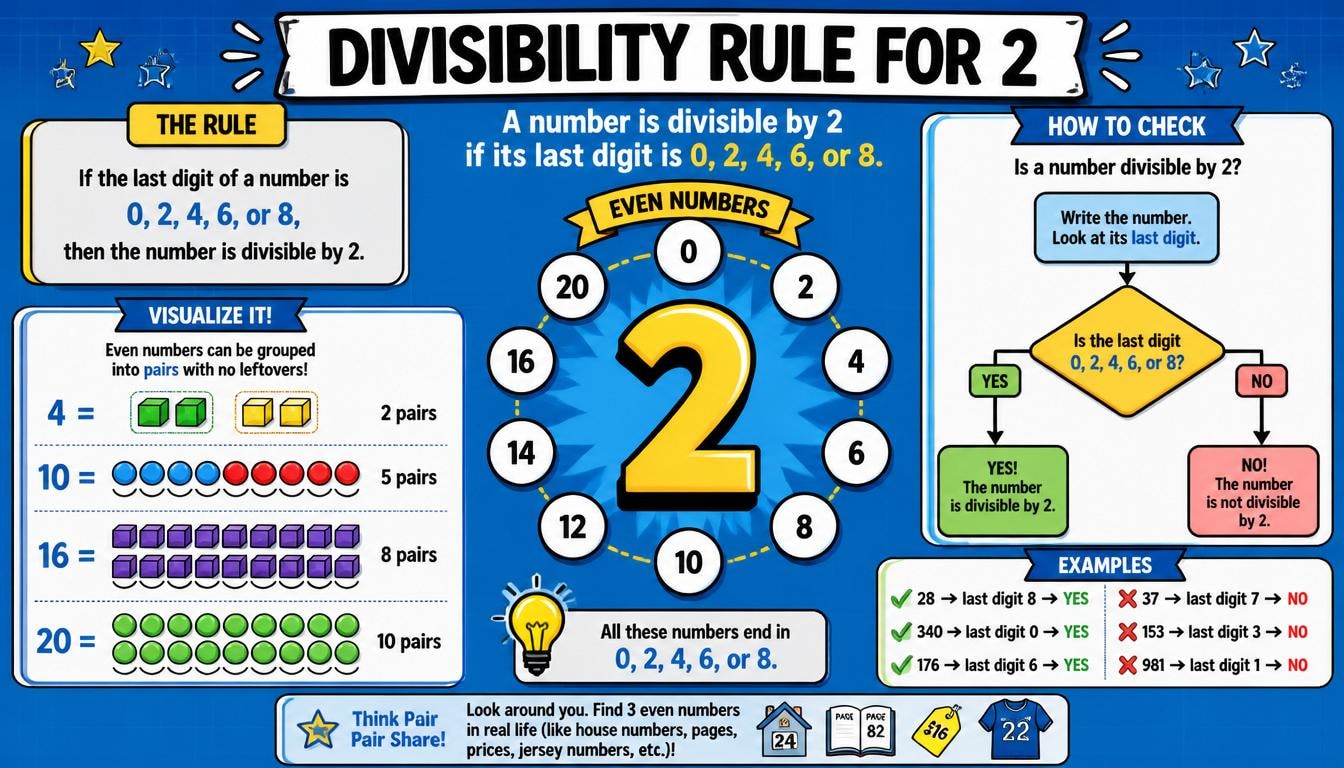
A whole number is divisible by 2 if and only if its last digit (the ones place) is an even number. The even digits are 0, 2, 4, 6, and 8.
This means that no matter how long or complex a number is—whether it has three digits, ten digits, or a hundred digits—you only ever need to look at the very last digit on the right. If that single digit is 0, 2, 4, 6, or 8, the entire number is divisible by 2.
Why Does This Rule Work? (The Place Value Proof)
To truly master mathematics, we must not just memorize rules; we must understand why they work. The secret behind the divisibility rule for 2 lies in our base-10 number system, which is built on powers of ten.
Let us look at how we write numbers using place value. Consider a three-digit number, which we can represent as abc. In place value terms, this number can be written as:
Number = (a × 100) + (b × 10) + c
Let's analyze each of these parts in relation to the number 2:
The hundreds term, a × 100, can be rewritten as a × (2 × 50), which is 2 × (50a). Because it is multiplied by 2, this term is always divisible by 2, regardless of what the digit a is.
The tens term, b × 10, can be rewritten as b × (2 × 5), which is 2 × (5b). This term is also always divisible by 2, regardless of what the digit b is.
In fact, every single place value higher than the ones place (tens, hundreds, thousands, ten-thousands, etc.) is a multiple of 10. Since 10 is divisible by 2 (10 = 2 × 5), any multiple of 10, 100, 1000, or higher powers is also guaranteed to be divisible by 2.
Therefore, when we look at the sum:
(a × 100) + (b × 10) + c
The first two terms are already perfectly divisible by 2. The divisibility of the entire number depends entirely on the remaining term, which is the last digit, c. If c is divisible by 2, then the entire number is divisible by 2. The only single-digit numbers divisible by 2 are 0, 2, 4, 6, and 8. This is the mathematical proof of the rule!
Even vs. Odd Numbers
The divisibility rule for 2 is also the exact definition of what makes a number "even" or "odd":
Even Numbers: Any integer that can be divided by 2 without leaving a remainder. Even numbers always end in 0, 2, 4, 6, or 8.
Odd Numbers: Any integer that cannot be divided by 2 evenly (it will always leave a remainder of 1). Odd numbers always end in 1, 3, 5, 7, or 9.
Step-by-Step Examples
Let us apply the rule to a few different numbers to see how quickly and easily we can determine their divisibility by 2.
Example 1: Testing the number 734
Identify the last digit of the number. The last digit of 734 is 4.
Check if the last digit is even (0, 2, 4, 6, or 8). Yes, 4 is an even number.
Conclusion: 734 is divisible by 2. (If we calculate it: 734 / 2 = 367, which is a whole number).
Example 2: Testing the number 9,825
Identify the last digit of the number. The last digit of 9,825 is 5.
Check if the last digit is even. No, 5 is an odd number.
Conclusion: 9,825 is not divisible by 2. (If we calculate it: 9,825 / 2 = 4912.5, which is not a whole number).
Example 3: Testing a very large number, 1,489,576,320
Identify the last digit of the number. The last digit is 0.
Check if the last digit is even. Yes, 0 is considered an even digit in this context because any number ending in 0 represents a multiple of 10, which is divisible by 2.
Conclusion: 1,489,576,320 is divisible by 2.
Practical Applications of the Rule
The divisibility rule for 2 is not just an abstract math trick; it has widespread practical applications in both daily life and scientific fields:
Computer Science and Programming: Computers operate on binary code (0s and 1s). Determining if a number is even or odd is one of the most common operations in programming. Developers use the modulo operator (usually represented as
%) to check divisibility by 2. For example,if (number % 2 == 0)is used to execute specific logic for even numbers, such as alternating row colors in a table or distributing data loads across servers.Fair Sharing and Grouping: In daily life, if you have a collection of items (like candies, cards, or coins) and you want to split them perfectly between two people without cutting anything in half, you can instantly tell if it is possible by checking if the total count is divisible by 2.
Simplifying Fractions: When reducing fractions to their simplest form, checking if both the numerator and the denominator are divisible by 2 is always the easiest first step to take. If both end in an even digit, you can instantly divide both by 2 and work with smaller, simpler numbers.
Summary of Key Takeaways
To wrap up, let's review the essential points of the divisibility rule for 2:
A number is divisible by 2 if it can be divided by 2 with no remainder.
You only need to look at the last digit (the ones place) of the number.
If the last digit is 0, 2, 4, 6, or 8, the entire number is divisible by 2.
This rule works because our base-10 system ensures that all place values from the tens place upward are automatically divisible by 2.
This rule defines whether a number is even (divisible by 2) or odd (not divisible by 2).