Have you ever looked at a massive number like 5,739,216 and wondered if you could divide it evenly by 4 without spending several minutes doing tedious long division? In the world of mathematics, divisibility rules act as powerful shortcuts. They allow us to determine whether one number can be divided by another without leaving a remainder, often in just a matter of seconds.
Among these rules, the divisibility rule for 4 is one of the most elegant, practical, and easy to learn. Whether you are a student mastering basic arithmetic, an aspiring mathematician exploring number theory, or someone preparing for standardized tests, understanding this rule will significantly boost your mental math capabilities. In this comprehensive guide, we will explore the divisibility rule for 4, understand the mathematical proof of why it works, look at step-by-step examples, and examine its real-world applications.
The Core Rule: What Is the Divisibility Rule for 4?
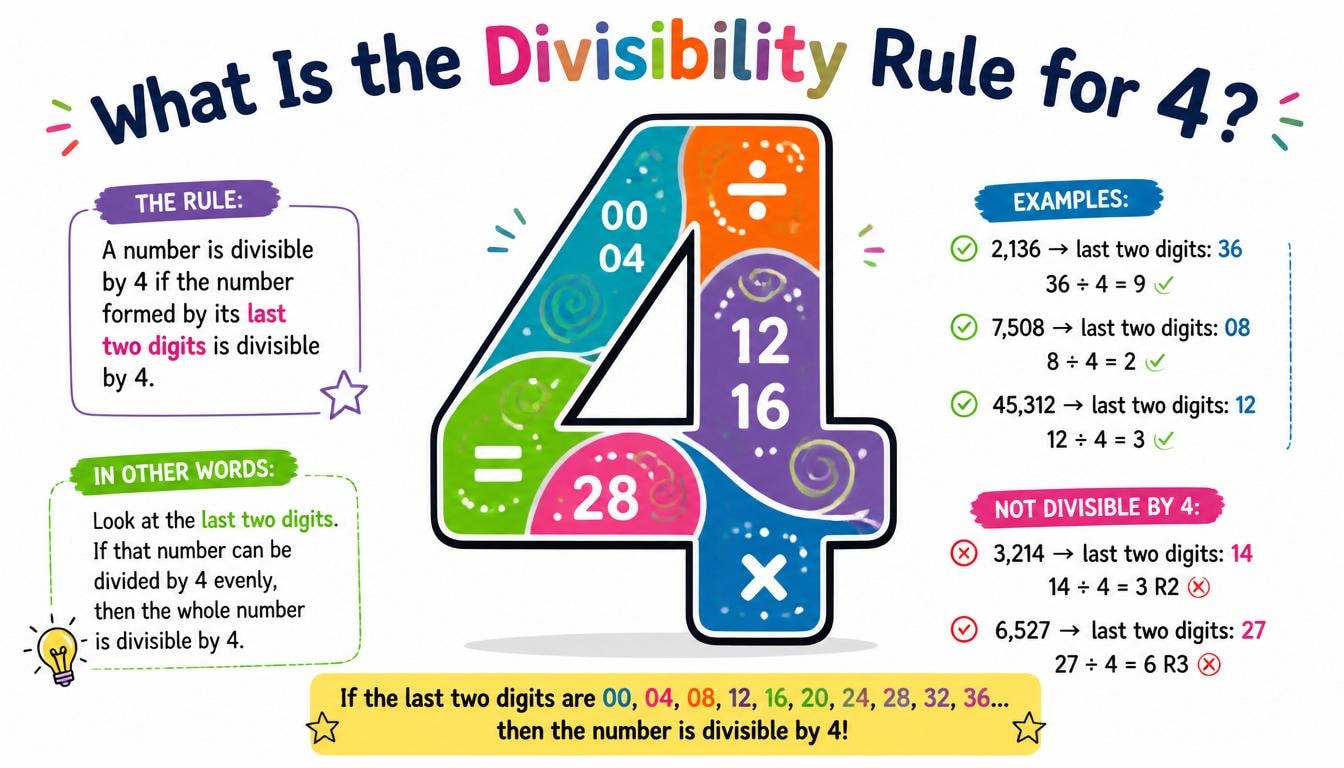
The divisibility rule for 4 states:
A whole number is divisible by 4 if the number formed by its last two digits is divisible by 4, or if the last two digits are "00".
This means that no matter how long a number is—whether it has three digits, ten digits, or a hundred digits—you only ever need to look at the last two digits (the tens digit and the ones digit) to determine if the entire number is divisible by 4. The rest of the digits to the left have absolutely no impact on the number's divisibility by 4.
Why Does This Rule Work? The Mathematical Proof
To truly appreciate mathematics, we must move beyond memorization and understand the "why" behind the rules. The divisibility rule for 4 is rooted deeply in our base-10 place value system.
Let us break down any whole number using its place values. Consider a four-digit number represented as abcd. We can write this number in its expanded algebraic form:
Number = (a × 1000) + (b × 100) + (c × 10) + d
Now, let us analyze the place values in this equation in relation to the number 4:
The thousands term: a × 1000. Since 1000 is divisible by 4 (1000 ÷ 4 = 250), any multiple of 1000 is also divisible by 4. Therefore, (a × 1000) is always divisible by 4.
The hundreds term: b × 100. Since 100 is divisible by 4 (100 ÷ 4 = 25), any multiple of 100 is also divisible by 4. Therefore, (b × 100) is always divisible by 4.
In fact, any place value of 100 or greater (100, 1,000, 10,000, 100,000, etc.) is a multiple of 100. Because 100 is a multiple of 4, all of these higher place values are guaranteed to be divisible by 4, regardless of what digits are in those positions.
This leaves us with only the last two terms of our expanded number: (c × 10) + d, which represents the two-digit number formed by the tens and ones digits (cd). Since all the other parts of the number are already guaranteed to be divisible by 4, the entire number will be divisible by 4 if and only if this remaining two-digit number cd is divisible by 4.
Step-by-Step Guide to Applying the Rule
Applying this rule is a simple three-step process:
Isolate the last two digits of the given number.
Check if this two-digit number is divisible by 4. (If the last two digits are "00", it is automatically divisible).
Draw your conclusion: If the two-digit number is divisible by 4, then the original, larger number is also divisible by 4. If it is not, then the larger number is not divisible by 4.
Detailed Examples in Action
Let us look at a few practical examples to see how easy this rule is to apply in real life.
Example 1: Testing a Three-Digit Number
Let's test the number 348.
Step 1: Identify the last two digits. The last two digits of 348 are 48.
Step 2: Check if 48 is divisible by 4. We know that 4 × 12 = 48. Since 48 divides evenly by 4, it is divisible.
Conclusion: Since 48 is divisible by 4, the entire number 348 is divisible by 4.
Example 2: Testing a Large Number
Let's test the number 9,572,114.
Step 1: Identify the last two digits. The last two digits of 9,572,114 are 14.
Step 2: Check if 14 is divisible by 4. When we try to divide 14 by 4, we get 3 with a remainder of 2 (14 = 4 × 3 + 2). Since there is a remainder, 14 is not divisible by 4.
Conclusion: Since 14 is not divisible by 4, the entire number 9,572,114 is not divisible by 4.
Example 3: Numbers Ending in "00"
Let's test the number 1,200.
Step 1: Identify the last two digits. The last two digits are 00.
Step 2: According to our rule, any number ending in "00" is a multiple of 100, and since 100 is divisible by 4, "00" satisfies the rule.
Conclusion: The number 1,200 is divisible by 4.
The "Half of a Half" Shortcut for Mental Math
If you find yourself struggling to quickly determine if a two-digit number is divisible by 4, there is a fantastic mental math shortcut you can use. This is known as the "half of a half" rule.
Mathematically, dividing a number by 4 is the exact same as dividing it by 2, and then dividing the result by 2 again. Therefore, to check if a number is divisible by 4:
Take the last two digits of the number.
Cut that number in half (divide by 2).
If the result of that division is still an even number, then the original number is divisible by 4.
Let's try this with the number 72:
Half of 72 is 36.
Is 36 even? Yes, it ends in 6.
Since 36 is even, 72 is divisible by 4. (Indeed, 72 ÷ 4 = 18).
Now let's try it with the number 54:
Half of 54 is 27.
Is 27 even? No, it is odd.
Since 27 is odd, 54 is not divisible by 4. (54 ÷ 4 = 13.5).
How the Rule of 4 Connects to Other Divisibility Rules
Understanding how the rule of 4 fits into the broader family of divisibility rules can help you see the beautiful patterns in mathematics. Specifically, there is a direct relationship between the divisibility rules of the powers of 2 (which are 2, 4, 8, 16, and so on):
Divisibility by 2 (21): A number is divisible by 2 if its last 1 digit is even (divisible by 2).
Divisibility by 4 (22): A number is divisible by 4 if the number formed by its last 2 digits is divisible by 4.
Divisibility by 8 (23): A number is divisible by 8 if the number formed by its last 3 digits is divisible by 8.
Divisibility by 16 (24): A number is divisible by 16 if the number formed by its last 4 digits is divisible by 16.
This elegant progression shows that as the power of 2 increases, the number of digits you need to check at the end of the number increases by exactly one. This makes memorizing these rules much more intuitive!
Real-World Application: Finding Leap Years
One of the most common real-world applications of the divisibility rule for 4 is determining whether a given year is a leap year.
A standard calendar year has 365 days, but because the Earth takes approximately 365.24 days to orbit the sun, we add an extra day (February 29) roughly every four years to keep our calendar aligned with the seasons. The rule for determining a leap year in the Gregorian calendar is as follows:
The year must be divisible by 4.
However, if the year is a century year (ending in 00), it must also be divisible by 400 to be a leap year.
By using the divisibility rule for 4, you can instantly check almost any year:
2024: The last two digits are 24. Since 24 is divisible by 4, 2024 is a leap year.
1997: The last two digits are 97. Since 97 is odd, it is not divisible by 4, so 1997 was not a leap year.
1800: This is a century year ending in 00. While it is divisible by 4, we must check if it is divisible by 400. Since 1800 is not divisible by 400, it was not a leap year.
Summary of Key Takeaways
The divisibility rule for 4 is an incredibly useful tool that simplifies mental calculations. Here is a quick summary of what we have learned:
To check if any number is divisible by 4, you only need to look at the last two digits.
If the last two digits form a number divisible by 4, or if they are "00", the entire number is divisible by 4.
This rule works because 100 and all higher powers of 10 are naturally divisible by 4.
You can use the "half of a half" method as a quick mental shortcut to test the last two digits.
This rule is widely used in everyday life, most notably to calculate leap years.
By mastering this simple rule, you can bypass long division, solve math problems faster, and develop a deeper appreciation for the structured beauty of numbers!