How do you calculate the total distance traveled when your speed is changing continuously? This is the exact type of problem that led to the creation of one of the most powerful tools in mathematics: the integral. Along with derivatives, integration forms the foundation of calculus, a branch of mathematics developed independently by Isaac Newton and Gottfried Wilhelm Leibniz in the late 17th century to describe how things change and accumulate over time.
The Core Concept: Integration as Accumulation
At its most fundamental level, integration is the process of accumulation. While differentiation cuts a changing process into tiny, instantaneous moments to find the rate of change (the speed at any exact instant), integration does the exact opposite. It glues those tiny, instantaneous moments back together to find the total accumulation (the total distance traveled).
Integration is the mathematical equivalent of addition, but for things that are changing continuously rather than in discrete steps. Instead of adding separate numbers like 1 + 2 + 3, integration adds up an infinite number of infinitely small quantities.
The Geometric Interpretation: Area Under the Curve
To visualize what an integral is, we turn to geometry. If we plot a constant speed on a graph where the horizontal axis represents time and the vertical axis represents speed, the journey is represented by a flat, horizontal line. The distance traveled is simply the area of the rectangle formed under that line.
However, if your speed varies, the graph becomes a curving, irregular line. The total distance traveled is still represented by the area under that curve, but we can no longer use the simple formula for the area of a rectangle (width times height) because the height is constantly changing.
The Riemann Sum: Approximating with Rectangles
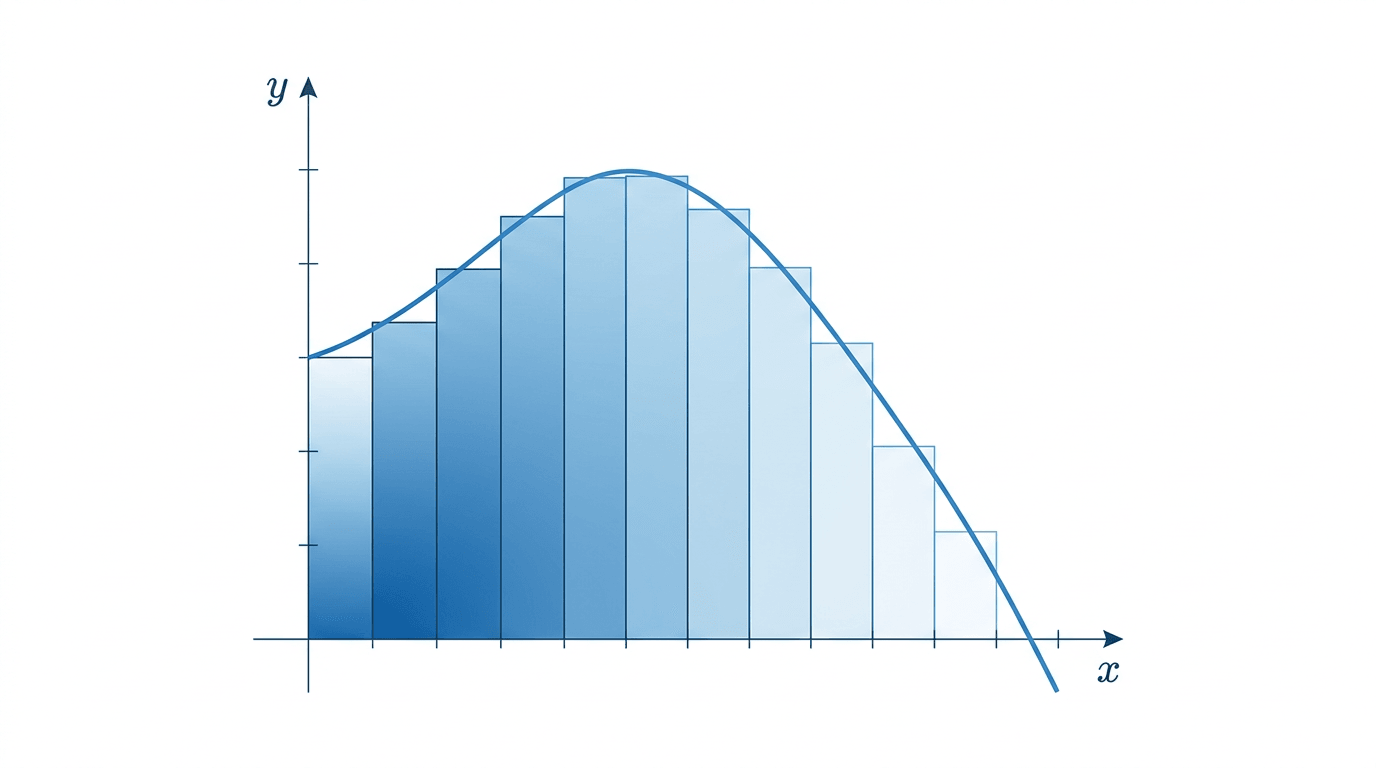
To find the area under an irregular curve, mathematicians use a brilliant approximation technique called the Riemann Sum, named after the German mathematician Bernhard Riemann. The process works as follows:
Divide: We divide the interval on the horizontal axis (from start time a to end time b) into several smaller subintervals of equal width, which we call Δx (Delta x).
Build Rectangles: Above each subinterval, we draw a vertical rectangle that reaches up to touch the curve. The height of each rectangle corresponds to the value of the function f(x) at that specific point.
Calculate Areas: The area of each individual rectangle is its width multiplied by its height: f(x) × Δx.
Sum Them Up: We add the areas of all these rectangles together to get an approximation of the total area under the curve.
If we use only a few wide rectangles, our approximation will be highly inaccurate because the tops of the rectangles will either overshoot or undershoot the actual curve. But what happens if we make the rectangles thinner and use more of them?
The Limit of Infinite Rectangles
As we increase the number of rectangles, making each one infinitely thin (Δx approaches zero), the gaps between the rectangles and the curve disappear. The sum of the areas of these infinitely thin rectangles approaches the exact area under the curve.
This transition from approximation to exact value using limits is the definition of the definite integral. Mathematically, we write it as:
∫ab f(x) dx
Let's break down this beautiful notation, designed by Leibniz:
∫: The integral symbol, which is an elongated "S", standing for "summa" (Latin for sum). It tells us we are summing up an infinite number of tiny parts.
a and b: The limits of integration, representing the starting point (a) and the ending point (b) of our measurement.
f(x): The integrand, which represents the height of our infinitely thin rectangles at any point x.
dx: The differential, which represents an infinitely small width (the limit of Δx as it approaches zero).
The Two Types of Integrals
In mathematics, you will encounter two main types of integrals: definite and indefinite. While they are deeply related, they serve different purposes.
1. The Definite Integral
A definite integral has specific upper and lower limits (like a and b). It calculates a precise numerical value representing the net signed area under a curve over a specific interval. Because it results in a single number, it is used to calculate physical quantities like total work, area, volume, or accumulated distance.
2. The Indefinite Integral (The Antiderivative)
An indefinite integral does not have limits of integration. Instead of finding a specific number, it finds a general formula—a new function—whose derivative is the original function. For this reason, integration is often called antidifferentiation.
When we find the indefinite integral of a function f(x), we write:
∫ f(x) dx = F(x) + C
Here, F(x) is the antiderivative, meaning that if you take the derivative of F(x), you get back to f(x). The + C is the "constant of integration." We must include it because the derivative of any constant number is zero. Since we lose this constant information during differentiation, we must add it back as a placeholder when integrating.
The Fundamental Theorem of Calculus: The Ultimate Bridge
For a long time, finding areas under curves and finding the rates of change of functions were treated as two completely separate geometric problems. The breakthrough that revolutionized science was the discovery of the Fundamental Theorem of Calculus, which proved that differentiation and integration are inverse operations, much like multiplication and division.
The theorem states that if we want to evaluate the definite integral of a continuous function f(x) from a to b, we do not need to draw infinite rectangles and calculate their limits. Instead, we can simply find the antiderivative F(x) of the function and evaluate the difference between its values at the boundaries:
∫ab f(x) dx = F(b) - F(a)
This simple equation is incredibly powerful. It means that to find the exact area under a complex curve, we only need to know the behavior of its antiderivative at the two endpoints of the interval.
Physical and Scientific Applications of the Integral
1. Physics: Calculating Work Done by a Variable Force
In physics, work is defined as force multiplied by distance. If you push a box with a constant force of 10 Newtons over a distance of 5 meters, the work done is 50 Joules. But what if you are compressing a spring? The further you compress the spring, the harder you have to push. The force changes continuously. To calculate the total work done, physicists integrate the variable force function over the distance compressed.
2. Kinematics: Finding Position from Velocity
If you know the acceleration of an object as a function of time, you can integrate it to find its velocity function. If you integrate the velocity function over a period of time, you find the exact position and total displacement of the object. This is how spacecraft navigation systems calculate their location in deep space.
3. Medicine: Measuring Cardiac Output
Doctors use integration to measure cardiac output—the volume of blood pumped by the heart per unit of time. By injecting a known amount of dye into an atrium and measuring its concentration in the blood over time, medical equipment can integrate the concentration curve to determine exactly how efficiently a patient's heart is pumping.
4. Probability and Statistics: The Bell Curve
In statistics, continuous probability distributions (like the famous normal distribution or "bell curve") use integrals to determine probability. The total area under a probability density curve is exactly 1 (representing a 100% chance of all possible outcomes). To find the probability of an event occurring within a specific range, statisticians integrate the curve between those two points.
Key Takeaways
Integration is accumulation: It is the mathematical process of adding together an infinite number of infinitely small parts to find a total quantity.
It represents area: Geometrically, the definite integral of a function is the exact area under its curve between two specific points.
It is the opposite of differentiation: The Fundamental Theorem of Calculus proves that integration and differentiation are inverse operations.
It is essential for science: From calculating the trajectory of rockets to modeling economic growth and biological systems, integrals allow us to understand and predict phenomena where change is continuous and dynamic.