Subtraction is one of the four fundamental arithmetic operations that we use every single day. Whether you are calculating change at a grocery store, tracking the countdown to your favorite holiday, or solving complex algebraic equations later in your academic journey, subtraction is an indispensable tool. But how exactly do we subtract natural numbers, and what are the scientific and mathematical principles behind this operation?
In this comprehensive guide, we will explore the concept of subtraction within the set of natural numbers. We will break down the terminology, examine the core mathematical properties, walk through step-by-step methods—including visual models and the standard column algorithm—and analyze common mistakes so you can master this essential mathematical skill.
Understanding Natural Numbers and Subtraction
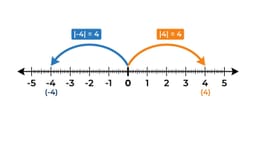
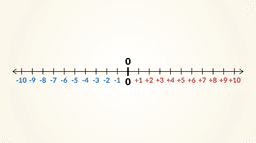
Before diving into the subtraction process, it is vital to define what natural numbers are. In mathematics, natural numbers are the basic counting numbers we use to quantify physical objects. They typically start at 1 and go on infinitely (1, 2, 3, 4, 5, and so on). In many modern educational and mathematical contexts, 0 is also included in this set, forming the set of non-negative integers.
At its core, subtraction is the process of taking one quantity away from another. It answers questions such as: "How many are left?", "How much more is one quantity than another?", or "What is the difference between these two values?". Subtraction can also be understood as the inverse operation of addition. If adding means putting groups together, subtracting means taking them apart.
The Anatomy of a Subtraction Equation
Every subtraction problem consists of three distinct parts, each with its own mathematical name. Understanding these terms is crucial for following mathematical explanations and solving word problems:
Minuend: The number from which another number is to be subtracted. This is the starting quantity (the larger number when working strictly within natural numbers).
Subtrahend: The number that is to be subtracted or taken away from the minuend.
Difference: The result or answer obtained by subtracting the subtrahend from the minuend.
We write a subtraction equation horizontally like this:
Minuend − Subtrahend = Difference
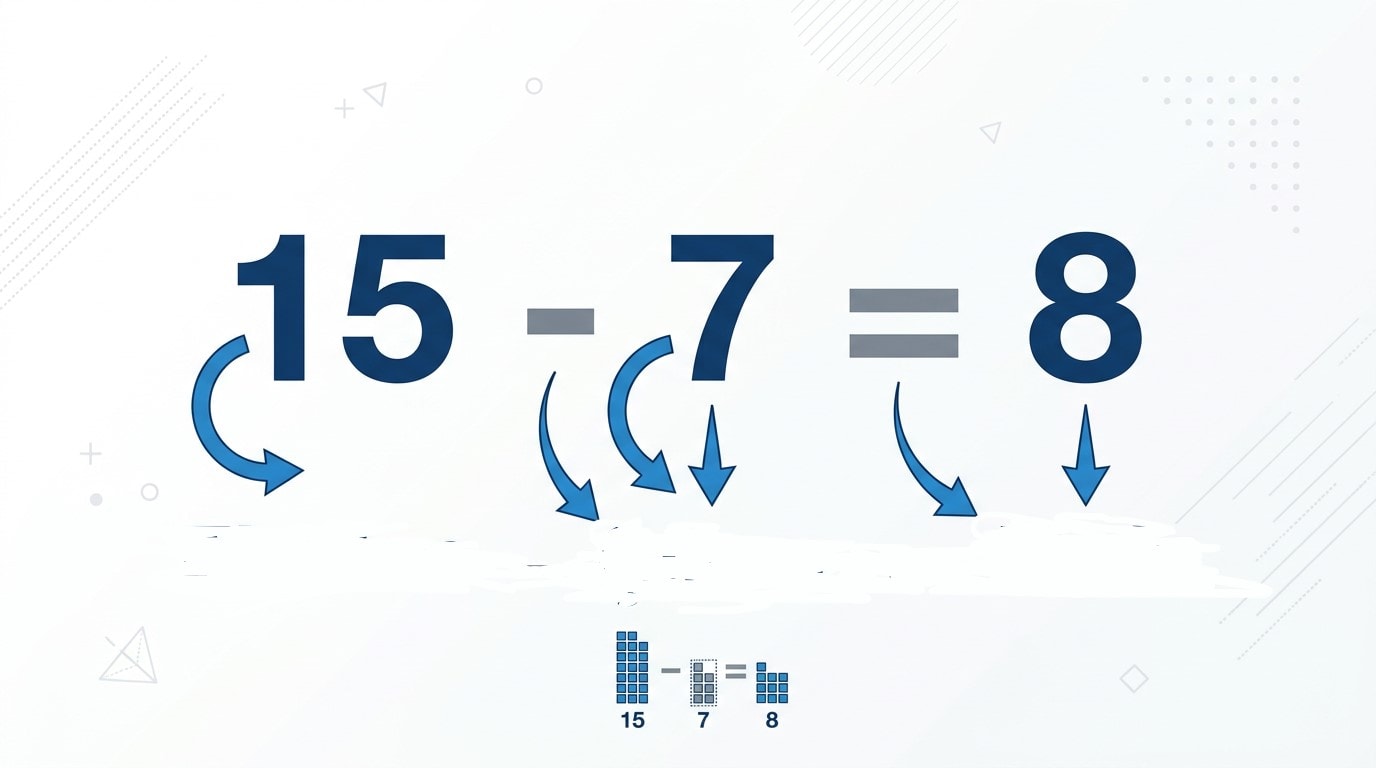
Example: 15 − 7 = 8
In this example, 15 is the minuend, 7 is the subtrahend, and 8 is the difference.
Important Mathematical Properties of Subtraction
Unlike addition, subtraction is highly sensitive to the order of numbers. When working with natural numbers, we must keep several key mathematical properties in mind:
1. Non-Commutative Property
Addition is commutative, meaning that changing the order of the addends does not change the sum (e.g., 5 + 3 is the same as 3 + 5). However, subtraction is not commutative. The order of the numbers matters significantly:
10 − 4 = 6, but 4 − 10 does not equal 6. In fact, within the set of natural numbers, you cannot subtract a larger number from a smaller one because the result would be a negative number, which is an integer, not a natural number.
2. Non-Associative Property
Subtraction is also not associative. This means that how we group numbers in a multi-step subtraction problem changes the final outcome:
(12 − 5) − 2 = 7 − 2 = 5
12 − (5 − 2) = 12 − 3 = 9
Because 5 does not equal 9, we must always perform subtraction in the order specified, typically from left to right, unless parentheses indicate otherwise.
3. The Closure Constraint
The set of natural numbers is "closed" under addition, meaning adding two natural numbers always results in another natural number. However, natural numbers are not closed under subtraction. If the subtrahend is larger than the minuend (e.g., 3 − 8), the result is not a natural number. Therefore, when subtracting natural numbers, we operate under the condition that the minuend must be greater than or equal to the subtrahend.
Visualizing Subtraction: Models for Beginners
Before jumping into long columns of numbers, visual models help build a strong conceptual understanding of how subtraction works.
The Take-Away Model
This is the most intuitive form of subtraction. Imagine you have a collection of physical objects, such as apples or blocks:
Start with a set of 8 blocks (the Minuend).
Physically remove or "take away" 3 blocks (the Subtrahend).
Count the remaining blocks to find the Difference (5 blocks).
The Number Line Model
A number line is an excellent tool for visualizing subtraction as backward movement or distance. To subtract on a number line:
Locate the minuend on the number line (e.g., start at the number 9).
Move or "hop" to the left by the number of units specified by the subtrahend (e.g., jump 4 spaces to the left).
The point where you land is your difference (you land on 5, so 9 − 4 = 5).
The Standard Algorithm: Column Subtraction
When dealing with larger multi-digit natural numbers, visual models become impractical. This is where the standard column subtraction algorithm is used. The key to this method is place value (aligning ones, tens, hundreds, thousands, etc.).
Scenario A: Subtraction Without Regrouping (No Borrowing)
This is the simplest form of column subtraction, where each digit in the minuend is greater than or equal to the corresponding digit in the subtrahend.
Let's solve: 758 − 234
Align the numbers vertically according to their place value:
      7 5 8  (Minuend)
    − 2 3 4  (Subtrahend)
    _______
Subtract the Ones column: 8 − 4 = 4. Write 4 in the ones place.
      7 5 8
    − 2 3 4
    _______
          4
Subtract the Tens column: 5 − 3 = 2. Write 2 in the tens place.
      7 5 8
    − 2 3 4
    _______
        2 4
Subtract the Hundreds column: 7 − 2 = 5. Write 5 in the hundreds place.
      7 5 8
    − 2 3 4
    _______
      5 2 4
The final difference is 524.
Scenario B: Subtraction With Regrouping (Borrowing)
When a digit in the subtrahend is larger than the digit directly above it in the minuend, you must "regroup" or "borrow" from the next higher place value column to the left.
Let's solve: 624 − 387
Align the numbers vertically:
      6 2 4
    − 3 8 7
    _______
Subtract the Ones column (4 − 7): Since 4 is smaller than 7, we cannot subtract it directly. We must borrow 1 ten from the tens column.
The 2 in the tens column becomes a 1.
The 4 in the ones column gets 10 added to it, becoming 14.
Now, perform 14 − 7 = 7. Write 7 in the ones place.
Subtract the Tens column (1 − 8): Since we borrowed, we now have a 1 in the tens place. 1 is smaller than 8, so we must borrow from the hundreds column.
The 6 in the hundreds column becomes a 5.
The 1 in the tens column gets 10 added to it, becoming 11.
Now, perform 11 − 8 = 3. Write 3 in the tens place.
Subtract the Hundreds column (5 − 3): 5 − 3 = 2. Write 2 in the hundreds place.
      5 11 14  (Regrouped view)
      6  2  4
    − 3  8  7
    _________
      2  3  7
The final difference is 237.
How to Handle Zeros in Regrouping
One of the most common hurdles for students is subtracting when the minuend contains zeros (e.g., 503 − 267 or 4000 − 1582). This requires "borrowing across zeros."
Let's look at 503 − 267:
In the ones column, we cannot do 3 − 7. We look to the tens column to borrow, but it is a 0. We cannot borrow from 0.
We must look further left to the hundreds column (5).
Borrow 1 from the hundreds column: the 5 becomes 4, and the tens column 0 temporarily becomes 10.
Now, we can borrow 1 from this tens column (which is now 10, so it becomes 9) to give to the ones column. The 3 in the ones column becomes 13.
Now perform the calculations column by column:
Ones: 13 − 7 = 6
Tens: 9 − 6 = 3
Hundreds: 4 − 2 = 2
The final difference is 236.
Common Mistakes and How to Avoid Them
Recognizing errors is a powerful way to solidify your math skills. Here are the most frequent mistakes made during natural number subtraction:
The "Subtract the Smaller Digit" Error: When faced with a column like 4 on top and 7 on bottom, students often write down 3 (subtracting 4 from 7) instead of regrouping. Remember, you must always subtract the bottom digit from the top digit, never the other way around.
Forgetting to Decrement After Borrowing: When borrowing from a neighbor column, always write down the new, smaller number immediately. If you do not cross out the original number and write its new value, you will likely forget that you borrowed from it.
Misaligning Columns: Always align numbers by their rightmost digit (ones place). If you align numbers from the left, your place values will be completely incorrect, leading to massive calculation errors.
How to Verify Your Answer
Because subtraction is the inverse of addition, you can easily check your work using addition. This is a scientific and reliable way to ensure your answer is 100% correct:
Difference + Subtrahend = Minuend
Let's check our previous problem: 237 (Difference) + 387 (Subtrahend). If we add these together: 237 + 387 = 624. Because this matches our original minuend (624), we know our subtraction was correct!
Key Takeaways
Natural numbers are counting numbers starting at 1 (or 0 in some contexts) and going up.
The components of subtraction are the Minuend, Subtrahend, and Difference.
Unlike addition, subtraction is not commutative and not associative.
When subtracting multi-digit numbers, place value alignment is critical.
Regrouping (borrowing) is required when a digit in the subtrahend is larger than the digit above it in the minuend.
You can always verify your subtraction calculations by adding the difference to the subtrahend.